Entry No. 46 — the Augusta & Fort Eisenhower file — filed under: miscellanea
Fort Gordon WWII POW Cemeteries
World War II prisoner-of-war burial sites on the military installation. The linked survey records prisoners’ names, ranks, and places of capture.
→ Three at a time, never the same twice — explore weird Augusta & Fort Eisenhower
The story
Deep behind the security checkpoints of Fort Eisenhower—known for eight decades as Camp and Fort Gordon—sits a small, pine-shaded plot containing 22 enemy combatants who never made it back across the Atlantic. Between October 1943 and the end of World War II, the post operated as an internment camp for Axis prisoners of war brought over in the holds of returning Allied supply ships. Thousands of captured troops, primarily swept up from Erwin Rommel's Afrika Korps and subsequent campaigns across Western Europe, spent the remainder of the war cutting firebreaks, felling timber, and harvesting peanuts and cotton across regional Georgia farm details.
The 1929 Geneva Convention obligated the United States military to bury deceased prisoners of war with the same dignity and honors given to its own fallen soldiers. Over the course of the camp's operation, 22 prisoners died in captivity from illness, natural causes, or work-related accidents. They were laid to rest just inside old Gate 2 in two technically distinct, adjacent plots: 21 German soldiers on one side and a solitary Italian soldier on the other. In November 2020, specialists from the Office of Army Cemeteries in Arlington traveled to the site with heavy leveling equipment, resetting and laser-aligning every headstone to meet Army Regulation 290-5—applying the exact same maintenance standards to these POW markers as those given to graves at Arlington National Cemetery.
Every November, coinciding with Germany's Volkstrauertag (National Day of Mourning), the base holds a small, solemn diplomatic ritual where German and Italian liaison officers, base chaplains praying in three languages, and the U.S. Army Signal Corps band gather to lay wreaths. For the remaining days of the year, the enclosure sits utterly silent behind an austere border of low white posts and linked chain.
What it's like
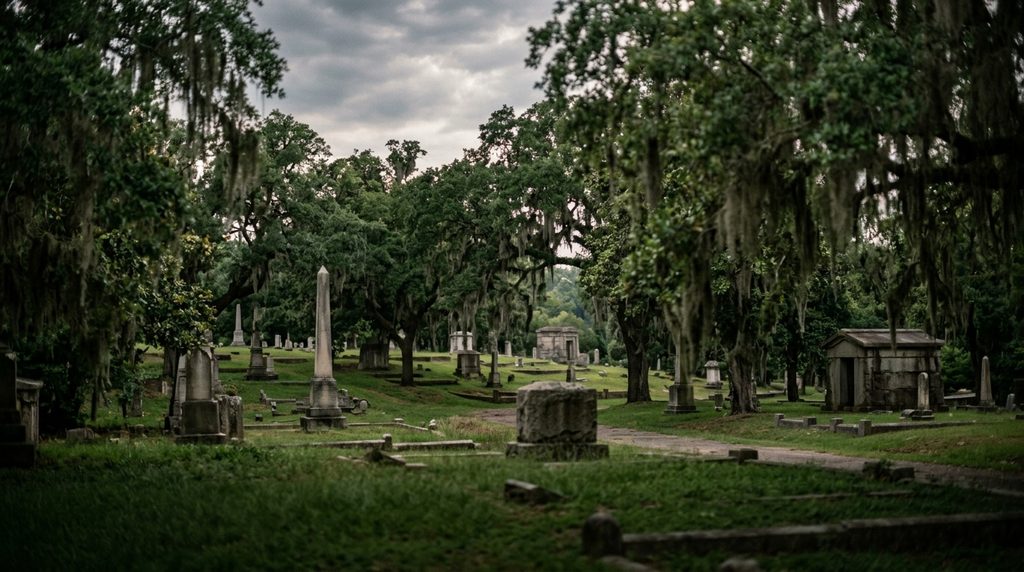
Getting to the graves requires clearing the security apparatus of an active military base. Civilians without DoD credentials cannot use old Gate 2; you must pull into the Visitor Control Center at Gate 6 off Gordon Highway, present a REAL ID driver's license, submit to a federal criminal background check, and pick up a temporary vehicle pass. Once through the gate, you navigate past training installations to the quiet Gordon Highway perimeter. The cemetery is open during daylight hours, with no docents, no gift shop, and only a modest gravel shoulder for parking. It is an eerie, stark pocket of the Georgia woods: twenty-two uniform white markers set against red clay and longleaf pines, thousands of miles from where these men started out.
The move: Once you’ve cleared Gate 6, stand together in the pine shade by the 22 POW graves and read each other a name, rank, and place of capture from the survey.
- 📍 Fort Gordon, Augusta, GA
- 💸 $$
- ⚡ Up for anything
- 🌗 Indoors
Where: On Fort Eisenhower (formerly Fort Gordon), near Gate 2 / Gordon Highway, Augusta, GA 30905-5000 (on-post site — no public street address)
Hours: Added 2026-11-17 — confirm current hours before you go.
Pair it with
- Bingo Palace — Since you have already cleared the Gate 6 background check to get on-post, take a short drive across the installation to this surreal garrison bingo hall and its Jackpot Cafe.
- Good Shephard Chapel (Fort Gordon Open Circle) — Stay inside the base security perimeter to explore another unexpected installation subculture: an active pagan open circle meeting out of a military chapel.
- Guard House Museum — Head off-base into Augusta to visit the surviving guardhouse from the historic Augusta Arsenal, bridging the city's 19th-century military footprint with its World War II past.
More weird in Augusta & Fort Eisenhower


Good to know
Who is buried in the cemetery?
The cemetery contains 22 World War II prisoners of war—21 German soldiers and one Italian soldier—who died of disease or accidental causes while interned at Camp Gordon between 1943 and the postwar repatriation period.
Can the general public visit an active military base cemetery?
Yes, but you cannot simply drive through the perimeter. Non-DoD cardholders must enter via Gate 6 off Gordon Highway, stop at the Visitor Control Center, present a valid government-issued photo ID (REAL ID compliant), and pass an NCIC background check before being issued a visitor pass.
Why are there two distinct plots?
The Army initially organized the burial grounds into separate sites to keep German and Italian remains segregated, resulting in 21 German graves in one section and the lone Italian prisoner in an adjacent plot. They are now managed jointly as a single 'closed' military cemetery under the Office of Army Cemeteries.
What are the visiting hours?
The cemetery itself is accessible during daylight hours. If you need to obtain an on-post visitor pass, verify the Gate 6 Visitor Control Center hours ahead of time, as it generally operates on weekdays and closes on weekends and federal holidays.
Plan a visit & invite your people →
Further reading: Reddit · armycemeteries.army.mil · army.mil · home.army.mil
last checked: 2026-11-17