Entry No. 35 — the Augusta & Fort Eisenhower file — filed under: miscellanea
Living History Park
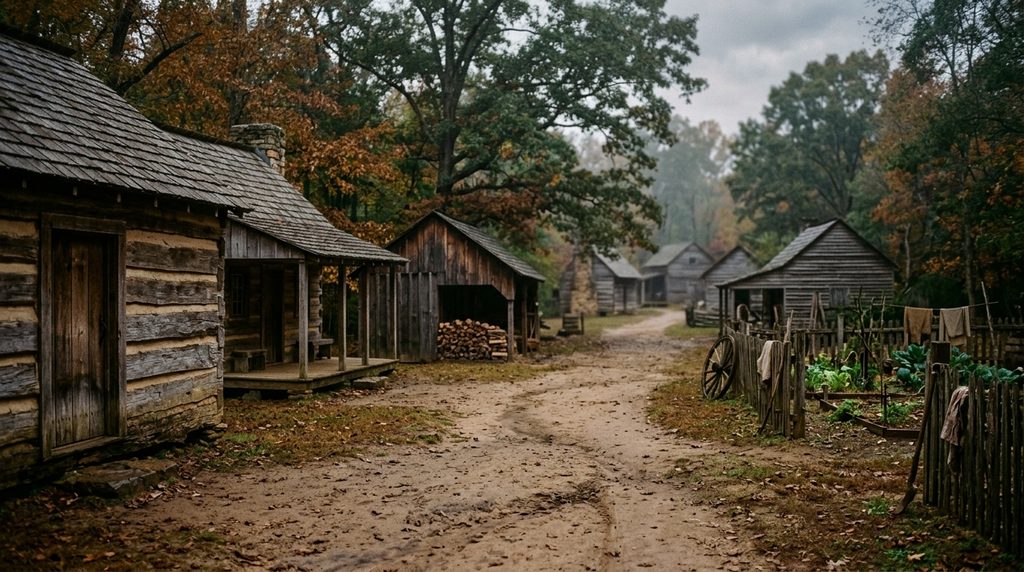
A 7.5-acre park dedicated to 18th-century colonial life, with free living-history exhibits and demonstrations. Its events include Christmas in the Backcountry and the Colonial Trades Fair.
→ Three more unusual museums & collections in Augusta & Fort Eisenhower — never the same twice
The story
In the early 1990s, this 7.5-acre parcel tucked behind residential North Augusta was an abandoned, swampy municipal dumping ground anchored by a derelict city waterworks pump station. Antiques dealer Lynn Thompson saw an unlikely canvas: she wanted to resurrect the Carolina backcountry as it functioned between 1735 and 1785. She convinced city officials to lease the blighted tract to her Olde Towne Preservation Association for a token $100 a year, rallied a crew of neighborhood volunteers, and set out to build a fictional colonial frontier settlement dubbed Willow Springs entirely from scratch.
The park's genuine quirk is that it is completely citizen-built, grant-and-donation funded, and operated without a single salaried employee. The volunteers didn't import pristine antique buildings; they hand-built them out of salvaged scrap and raw lumber. The blacksmith forge began in 1993 as four utility poles holding up a flat roof before gaining its stone and brick chimney. The potter's shed was pieced together from timber salvaged out of torn-down North Augusta homes. And the centerpiece of the property—the Spring House Tavern—is the literal concrete carcass of the old municipal waterworks pump house, sunk three-quarters underground to stay cool in the summer heat, outfitted with bar cabinets and paved over with donated bricks.
Today, more than twenty period structures flank the dirt paths, from a grist mill and an apothecary to a cabinetmaker's shop and a 1750s-style hunter's cabin. On an ordinary quiet afternoon, the whole complex feels like an eerie, deserted backwoods hamlet frozen inside modern suburbia. But during recurring living-history weekends and major seasonal gatherings like the Colonial Trades Fair and Christmas in the Backcountry, the silence breaks for black-powder musket drills, wood coopering, open-fire baking, and hot iron ringing off the forge.
What it's like
Turn off West Spring Grove Avenue into what looks like a quiet residential neighborhood, and you'll suddenly find yourself facing a clearing of log cabins and split-rail fences. On an ordinary weekday, you won't encounter staff, velvet ropes, or ticket booths; the village functions as an open, shaded community park where you can wander the dirt tracks and peek through cabin windows (a phone-based audio tour provides building-by-building context). The best time to visit is during scheduled living-history weekends or trade fairs, when volunteers dress in period backcountry garb, open the forge and meeting house, fire muskets, and demonstrate colonial trades. Parking is informal along the street and grass fringes, admission is free (drop a bill in the donation box), and the ground is packed dirt and uneven grass, so skip delicate footwear.
The move: Follow the shaded dirt tracks past split-rail fences and take turns peeking through the cabin windows of Willow Springs, a colonial village volunteers built from scrap and raw lumber.
- 📍 North Augusta, SC
- 💸 $
- ⚡ Up for anything
- 🌗 Indoors
Where: 299 W. Spring Grove Avenue, North Augusta, SC 29841
Hours: Added 2026-11-17 — confirm current hours before you go.
Pair it with
- Ezekiel Harris House — Cross the Savannah River to contrast the rough-hewn, dirt-floor cabins of Willow Springs with the soaring 1797 Federal mansion of a wealthy frontier tobacco merchant.
- Augusta Canal Discovery Center at Enterprise Mill — Jump forward from North Augusta's 18th-century manual backcountry trades directly into the 19th-century water-powered industrial revolution at the Enterprise Mill.
- Sole Augusta — Trade the woodsmoke and unpaved colonial pathways for craft cocktails and an intimate open-air courtyard patio in downtown Augusta.
More weird in Augusta & Fort Eisenhower

Good to know
How much does admission cost?
Admission is completely free year-round, including during major living-history festivals, though the volunteer-run non-profit relies on donation boxes placed around the grounds.
Can you go inside the buildings?
On regular self-guided days, the structures are locked to protect the furnishings, though you can look in through the windows; the doors open and interiors come alive during scheduled living-history demonstrations and festival weekends.
Is the park open every day?
The park is generally accessible to pedestrians daily during daylight hours, but check the official park calendar before making a trip, as the grounds close occasionally for private events and weddings.
Where do visitors park?
There is no massive commercial parking lot; visitors park along the designated spaces on West Spring Grove Avenue and adjacent neighborhood turnouts.
Plan a visit & invite your people →
Further reading: aafmaa.com · wrdw.com · aikencountysc.gov · explorenorthaugusta.com · colonialtimes.us · postandcourier.com
last checked: 2026-11-17