Entry No. 17 — the Edinburgh, UK file — filed under: miscellanea
Craigentinny Marbles
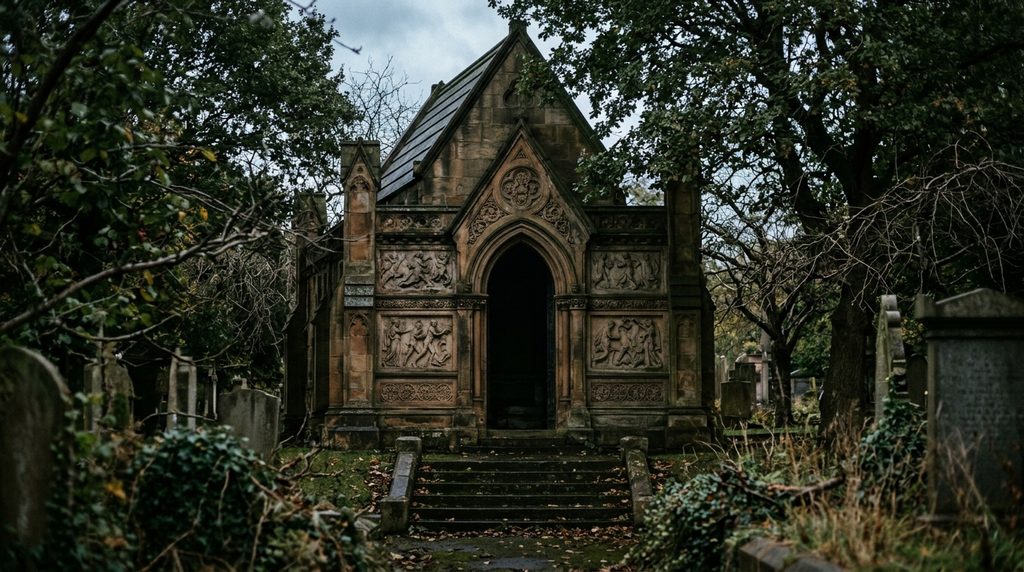
An eccentric 1867 mausoleum monument hidden away in suburban Edinburgh, renowned for its unexpected and elaborate classical carved relief sculptures.
→ Three more haunted places & dark-history spots in Edinburgh, UK — never the same twice
The story
William Henry Miller made his fortune, served as MP for Newcastle-under-Lyme, and indulged an obsession so intense it earned him the moniker 'Measure Miller'—he never attended a book auction without a pocket ruler to measure the exact millimeters of uncropped margins. When he died a bachelor in 1848, his obsessive precision turned downward. Paralyzed by the prospect of Edinburgh's notorious body-snatchers disturbing his remains (or perhaps determined to keep his reclusive physical secrets intact), his will contained strict orders: bury him forty feet underground in a lead-lined coffin at the bottom of a stone-lined shaft, cap it with heavy stone slabs, and encase the spot inside a massive Roman-style sepulcher set in the open pastures of his Craigentinny estate, far from any churchyard.
Architect David Rhind, best known for designing Edinburgh's classical commercial banks, spent years raising a 30-foot classical mausoleum modeled after the monumental tombs lining Rome's Appian Way. The crowning touch arrived in 1867 with two colossal Carrara marble bas-reliefs sculpted by Alfred Gatley. The north face features 'The Overthrow of Pharaoh in the Red Sea'—a chaotic, violent swirl of drowning cavalry, thrashing horses, and crashing waves—while the south face shows 'The Song of Moses and Miriam' in triumphant jubilation. The friezes proved so extraordinarily detailed that locals promptly nicknamed the tomb the 'Craigentinny Marbles,' measuring them against the Parthenon sculptures in the British Museum.
What turns the monument from an architectural curiosity into full-blown surrealism is what happened in the 1930s. The sprawling Miller estate farmland was sold off and subdivided for suburban development. Rather than attempt the titanic task of exhuming Miller or tearing down 30 feet of solid Roman stone, the council simply built a tight cul-de-sac of roughcast bungalows and a manicured lawn bowling club directly around it. Today, the monumental imperial tomb sits hemmed in by clipped privet hedges, laundry lines, and driveways, dwarfing the neighboring suburban semi-detached homes.
What it's like
Finding the tomb requires navigating the quiet, unassuming residential loop of Craigentinny Crescent until you hit an iron gate between suburban front drives. The mausoleum looms directly in front of you, marooned on a tiny patch of manicured grass with the Craigentinny Bowling Club green sitting on the other side. You cannot enter the monument—it is sealed solid and Miller remains buried deep beneath your feet—but you can walk entirely around the low perimeter railings on the public pavement for free. It is dead quiet, residential, and completely unstaffed; bring a zoom lens or binoculars to pick out the chariot wheels and terrified faces carved into Gatley's north frieze, and park considerately along the street so you don't block the residents' driveways.
The move: Wind through Craigentinny Crescent to the iron gate between suburban driveways, then circle the Roman-style tomb and trade theories about the book-measuring millionaire buried forty feet beneath your shoes.
- 📍 Craigentinny, Edinburgh
- 💸 Free
- ⚡ Up for anything
- 🌗 Outdoors
Where: 3C Craigentinny Crescent, Craigentinny, Edinburgh EH7 6QA
Hours: Added 2026-11-17 — confirm current hours before you go.
Pair it with
- Piershill Cemetery — Walk five minutes west to follow one eccentric Victorian burial with another: illusionist Sigmund Neuberger ('The Great Lafayette') interred beside his pampered terrier, Beauty.
- The Sheep Heid Inn & Historic Skittles Alley — Take a twenty-minute walk south into historic Duddingston to chase a 40-foot-deep Roman grave with a pint and a vintage frame at Scotland's oldest pub.
- Georgian Antiques — Head a mile and a half north toward the docks to channel 'Measure Miller's' obsessive collector spirit across five packed floors of taxidermy and oddities.
More weird in Edinburgh, UK


Good to know
Can you go inside the mausoleum?
No. The stone mausoleum is completely solid with no public entrance, and William Henry Miller's coffin is sealed beneath stone slabs inside a shaft roughly forty feet deep. You view the entire monument and its friezes from outside the perimeter railings.
Is there an admission fee or opening hours?
No, it is completely free to view. Because the mausoleum sits exposed within a public residential crescent, you can view it from the pavement at any time, though you will need decent daylight to see the relief sculptures clearly.
Why is it nicknamed the Craigentinny Marbles?
The moniker was coined in the 1860s in reference to the Elgin Marbles in the British Museum. Contemporary critics and locals felt Alfred Gatley's classical high-relief panels were among the finest carved stone friezes produced in the Victorian era.
Why was William Henry Miller buried forty feet underground?
Miller left explicit instructions in his will to be buried at the base of a deep, stone-lined shaft covered by heavy slabs. While rumors persisted that he feared Edinburgh's infamous resurrection men or held occult beliefs, his exact motives were never officially recorded beyond the rigid instructions left to his executors.
Plan a visit & invite your people →
Further reading: planetedinburgh.wordpress.com · portal.historicenvironment.scot · edinphoto.org.uk · edinburgharchitecture.co.uk · craigentinnybc.co.uk
last checked: 2026-11-17