Entry No. 57 — the Edinburgh, UK file — filed under: miscellanea
Glass Lab Edinburgh
A studio and community focused on stained glass, glass fusing, and kiln-formed glass that runs half-day, full-day, and weekend glass art workshop experiences.
→ Three more hands-on workshops & classes in Edinburgh, UK — never the same twice
The story
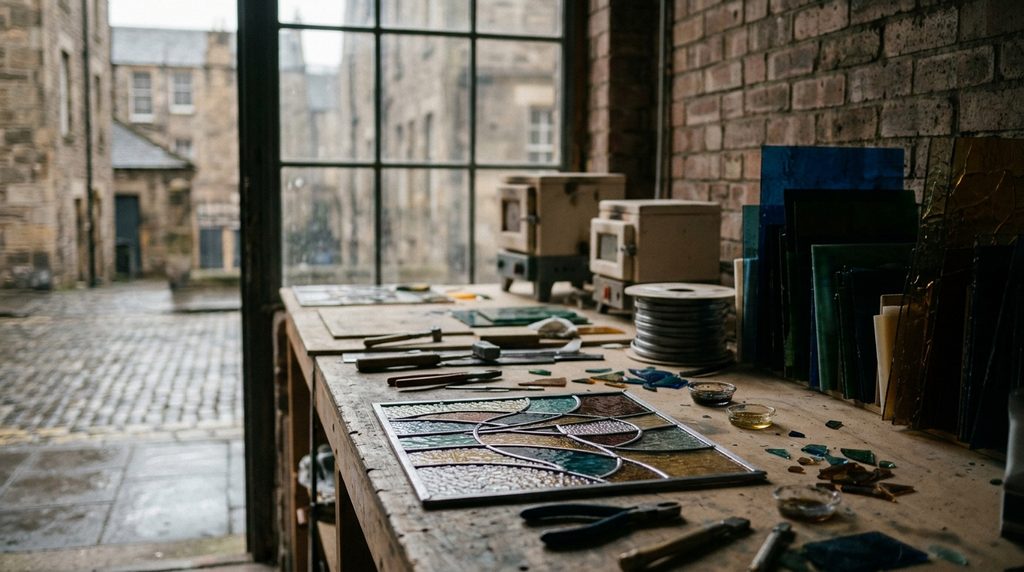
Glass Lab Edinburgh sits in an industrial dead-end near the Leith docks, looking less like a classroom and more like a trade glazier's workshop that accidentally left the door unbolted. It was established by two working artists: David Mola, who literally grew up in his family's glazier workshop in Spain, and Jeff Zimmer, an Edinburgh-based glass artist whose eerie, layered kiln-fired works sit in the permanent collection of London’s Victoria and Albert Museum. They set up the studio in 2020 not to run sanitized craft parties, but to keep the stubbornly physical trade of architectural and kiln-formed glass alive.
Most people encounter stained glass only as untouchable heritage behind church pews or in Victorian fanlights, surrounded by the myth that it requires a guild apprenticeship to touch. Inside the Lab, that mystique is stripped away in favor of physics and muscle memory: scoring along curved steel templates, snapping sheets with grozing pliers, wrapping razor-thin copper foil, and sweating lead came together with sizzling soldering irons.
The space doubles as a working repair atelier. You might be practicing basic glass cutting on scrap float while a few feet away, historic Edinburgh residential panels are stripped down for re-leading, or complex kiln-cast enamels are being prepared for public commissions.
What it's like
Finding it is your first test: you navigate past an unmarked roundabout off Lindsay Road into a concrete parking lot behind North Leith Sands. Inside, the room smells of cutting oil, hot solder flux, and wet stone from the grinders. There are no delicate parlor vibes here; you are issued safety glasses and taught how to exert real downward body weight onto a wheel cutter to get a clean score. Closed-toe shoes are an absolute requirement—splinters of colored glass inevitably ping onto the floor. If you take a copper-foil or traditional leading taster, you leave with a finished panel; if your session involves kiln fusing, your piece has to bake and cool through an annealing cycle overnight, meaning you'll pick it up later or arrange postage.
The move: Find the unmarked spot behind North Leith Sands, put on your safety glasses, and take turns leaning real body weight onto a wheel cutter to score a clean line in glass.
- 📍 Edinburgh
- 💸 $
- ⚡ Up for anything
- 🌗 Indoors
Where: 17 North Leith Sands, Edinburgh EH6 4ER, United Kingdom
Hours: Added 2026-11-17 — confirm current hours before you go.
Pair it with
- Portal Leith — Walk six-tenths of a mile up to Bernard Street to follow industrial glass cutting with an apothecary full of curated minerals, dried botanicals, and bone specimens.
- Trinity House Maritime Museum — Stroll down to Kirkgate to inspect Leith's deep seafaring guilds, historic navigation equipment, and genuine narwhal tusks.
- Georgian Antiques — Pair learning how historic windows are assembled with a wander through five floors of salvage, antique taxidermy, and architectural hardware.
- Puffin Sauna — Head to Leith Links afterwards to sweat out the solder flux and workshop dust in an outdoor wood-fired sauna barrel followed by a cold dip.
More weird in Edinburgh, UK

Good to know
Do I need any background in glass cutting or art?
No. The beginner workshops and one-day experiences start from absolute scratch, covering basic glass handling, scoring, breaking, and safety before you begin assembling a piece.
Can I take my glass home right after the session?
It depends on the technique. Copper-foil and leaded stained glass pieces are assembled cold and soldered on-site, so you can walk out with them. Fused or kiln-painted glass must spend hours in the kilns to fuse and slowly anneal, so it has to be collected later or shipped.
What is the dress code?
Practical work clothes and solid, closed-toe footwear. Sandals, open shoes, and delicate fabrics are completely banned around glass scoring, flying chips, and hot irons.
Do they sell glass craft supplies directly to the public?
Yes, they carry a physical stock of lead came, solder, cutting tools, and colored sheet glass for hobbyists, though they don't operate a web store; you must visit during studio hours or arrange collection in advance.
Plan a visit & invite your people →
Further reading: Official site · gointo.town · cgs.org.uk
last checked: 2026-11-17