Entry No. 50 — the Edinburgh, UK file — filed under: miscellanea
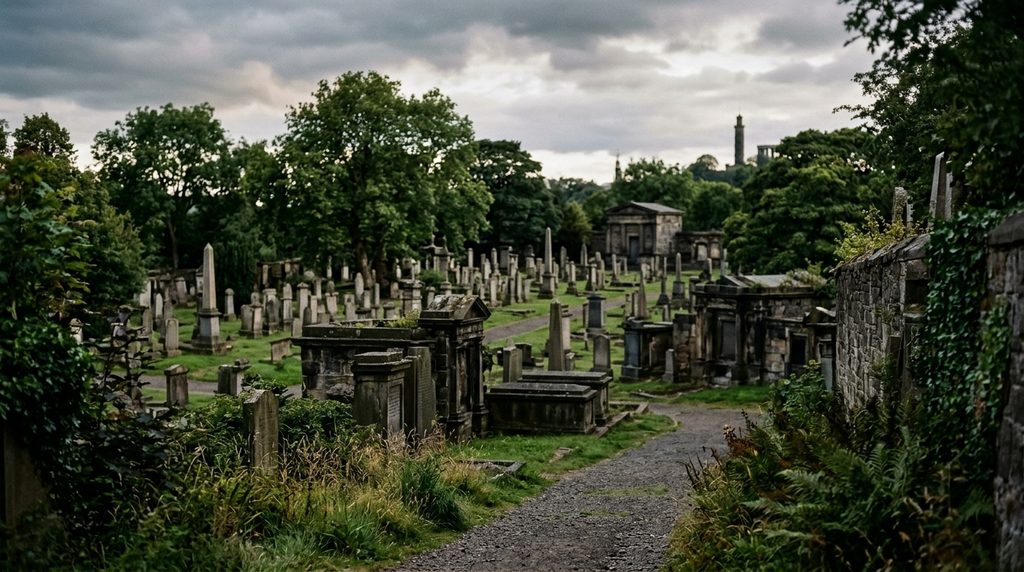
Old Calton Burial Ground
An atmospheric, free-to-visit 18th-century graveyard sitting at the base of Calton Hill that features intricate memento mori motifs and quiet, melancholic corners.
→ Three more haunted places & dark-history spots in Edinburgh, UK — never the same twice
The story
In 1819, Edinburgh city planners committed an act of urban surgery that would make modern preservationists faint: they took the grand new approach road of Waterloo Place and drove it straight through the middle of an active eighteenth-century graveyard. Engineers blasted rock, cut deep trenches, and severed the burial ground in two. Hundreds of bodies were disinterred and hauled downhill to be reburied at New Calton, while high neoclassical ashlar screen walls were thrown up along the new roadway to conceal the severed earth and crypts from polite traffic. To this day, a small, neglected scrap of the graveyard remains marooned on the north side of the street, while the main terrace rises above the southern retaining wall.
Step through the southern gate and the dead here tell an eccentric story. Tucked near the corner is a massive, Roman-style cylindrical mausoleum designed by Robert Adam for the philosopher David Hume. When Hume died in 1776, a notorious and unrepentant atheist in a strictly Presbyterian town, his friends were terrified that pious mobs or grave robbers would desecrate his remains; they posted an armed watch with pistols over the fresh grave for eight nights until the ground settled. Just paces away looms the 90-foot Political Martyrs' Monument, honoring reformers transported to Australia for sedition in the 1790s, and beside that stands a life-sized bronze of Abraham Lincoln—the Scottish-American Soldiers Monument, erected in 1893 to honor Scots who died fighting for the Union, and the only Civil War memorial on foreign soil.
Deeper among the narrow stone aisles, the politics give way to raw eighteenth-century mortality. The headstones don't deal in gentle euphemisms: trade emblems like weavers' shuttles, shoemakers' knives, and compasses are crammed shoulder-to-shoulder with grinning skulls, winged hourglasses, and crossed femur bones. Peer over the southern boundary wall and you catch an abrupt view of the castellated Governor's House—the lone, turreted remnant of the grim Calton Jail, which once held prisoners directly beside the graveyard's edge before being torn down in the 1930s.
What it's like
You enter off Waterloo Place through a heavy iron gate and climb a shadowed flight of stone stairs straight into the hillside, instantly dropping the engine noise of Princes Street for damp cemetery silence. Because tourists usually hurry right past the gate on their way to the summit of Calton Hill, you will often share the mossy aisles and crumbling table tombs with nobody except ravens and neighborhood dog walkers. The uneven ground turns slick in Edinburgh rain and several older crypts are fenced off for stone stabilization, so wear real shoes. Before you leave, cross Waterloo Place to seek out the small, forgotten northern enclosure hidden behind the retaining wall on the other side of the tarmac.
The move: Pass through the heavy iron gate off Waterloo Place, climb the shadowed stone stairs into the hillside, and hunt among mossy table tombs for the Roman-style cylindrical mausoleum designed by Robert Adam.
- 📍 Calton Hill
- 💸 $$
- ⚡ Up for anything
- 🌗 Indoors
Where: 27 Waterloo Place, Edinburgh EH1 3BQ, United Kingdom
Hours: Added 2026-11-17 — confirm current hours before you go.
Pair it with
- Surgeons' Hall Museums — After seeing where Hume's friends stood armed guard against body snatchers, walk south to explore the anatomical trade and medical specimens that fueled Edinburgh's grave-robbing black market.
- The Voodoo Rooms — A short walk back toward the east end of Princes Street brings you out of mossy eighteenth-century crypts and into theatrical dining rooms draped in gold leaf, chandeliers, and rum.
- Jackson the Tailor — Head down past Waverley Station to swap the stark memento mori skulls of Calton Hill for bespoke cocktails hidden behind a vintage tailor-shop frontage.
More weird in Edinburgh, UK

Good to know
Why is there an Abraham Lincoln statue in an Edinburgh cemetery?
Unveiled in 1893, the Scottish-American Soldiers Monument honors Scottish volunteers who died fighting for the Union Army during the American Civil War; it was the first statue of a U.S. president erected outside the United States.
Where is the other half of the burial ground?
Directly across Waterloo Place. When the city blasted the road through in 1819, they split the site; a small, quiet northern patch still sits behind the street's neoclassical screen wall.
Why were armed guards stationed at David Hume's grave?
Hume was famous for his radical philosophical skepticism and atheism; fearing that religious outrage or resurrectionists looking for medical cadavers would target his corpse, his inner circle stood watch with firearms for eight nights after his 1776 burial.
Is Old Calton Burial Ground free to visit?
Yes. The burial ground is owned and managed by the City of Edinburgh Council, completely free of charge, and open daily during daylight hours.
Plan a visit & invite your people →
Further reading: billbaber.com · hauntedhotels.uk · Reddit · edinburgh.gov.uk · curiousedinburgh.org · oldedinburghclub.org.uk
last checked: 2026-11-17