Entry No. 35 — the Edinburgh, UK file — filed under: miscellanea
St Cecilia's Hall & Music Museum
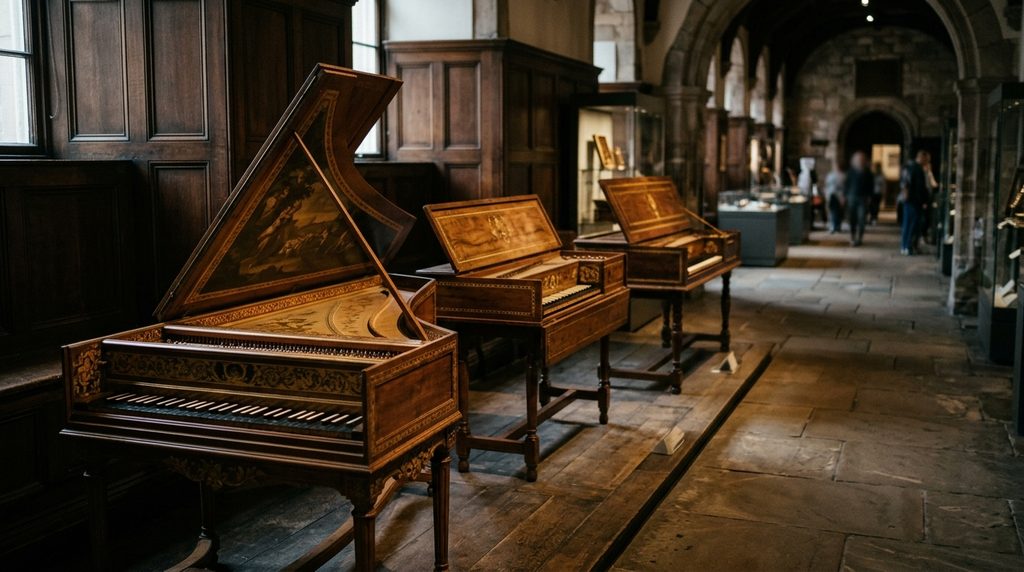
Housed within Scotland's oldest purpose-built concert hall, this hyper-focused collection showcases ornate, centuries-old historic keyboards and musical instruments.
→ Three more unusual museums & collections in Edinburgh, UK — never the same twice
The story
Drop off the Royal Mile down the steep slope of Niddry Street and you will find yourself in the Cowgate ravine facing Scotland's oldest purpose-built concert hall. The Edinburgh Musical Society commissioned architect Robert Mylne to construct it in 1763, designing an intimate, acoustic oval chamber named for the patron saint of musicians. But city planners did the hall dirty: when the South Bridge was thrown across the valley in 1787, it left St Cecilia's marooned at the bottom of a dark, bypassed alley while high-society patrons abandoned it for the New Town's breezy Assembly Rooms.
By 1801, the Musical Society surrendered the deed, triggering a 150-year carnival of reinvention. The Georgian concert room was chopped up and reused as a Baptist church, a Freemason lodge, a school, a warehouse, and the Excelsior Ballroom. In 1959, the University of Edinburgh stepped in to rescue the carcass, strip away the partitions, and reinstall the original room to house the Raymond Russell Collection of Early Keyboard Instruments.
The museum's collecting philosophy is hyper-specific: it acquires instruments that have fallen out of regular modern use. Rather than standard orchestral fare, you are staring down the dead ends and ancestors of Western musical technology—virginals, clavichords, serpentine brass, John Snetzler chamber organs, and ornate 18th-century harpsichords with painted lids whose mechanical actions are kept in operational, playable condition by resident conservators.
What it's like
Entering off Niddry Street, the contemporary entrance leads up into whisper-quiet galleries and the restored rosy oval hall upstairs. It is virtually empty compared to the busker chaos on the Royal Mile a minute away. The fragile historic instruments are kept behind glass or ropes—you cannot play them yourself—so bring your own wired headphones to plug into your phone and load the free Bloomberg Connects digital guide, which lets you hear recordings of the exact harpsichords and spinets you are standing beside.
The move: Slip down Niddry Street into the Cowgate, climb to the restored rosy oval hall upstairs, and share a pair of wired headphones to listen to the instruments you can't touch.
- 📍 Cowgate, Edinburgh
- 💸 $
- ⚡ Up for anything
- 🌗 Indoors
Where: St Cecilia’s Hall, 50 Niddry Street, Edinburgh EH1 1LG, United Kingdom
Hours: Added 2026-11-17 — confirm current hours before you go.
Pair it with
- The Burrow — After an hour spent among delicate 18th-century soundboards, head one alley over to Blackfriars Street to nurse rare whiskies in a cellar hidden beneath a pizzeria.
- The Secret Arcade — Climb up toward Cockburn Street to trade courtly keyboard history for several hundred varieties of Polish flavored vodka stashed down a narrow close.
- Blackie House Library + Museum — Double down on Edinburgh's quietest collector obsessives by booking ahead for William Zachs's private archive just up the ridge.
More weird in Edinburgh, UK
Good to know
How much does it cost to visit?
General admission is free. It is owned and operated by the University of Edinburgh, though donations are accepted at the door.
When is the museum open?
Regular public hours run Tuesday through Saturday from 10:00 AM to 5:00 PM, with last entry at 4:30 PM. The museum is closed on Sundays and Mondays.
Are you allowed to play the historical keyboards?
No. The collection consists of rare, centuries-old conservation pieces. Only museum staff and visiting artists are permitted to play them, but the companion audio app carries recordings of the actual instruments.
Do they still put on live concerts?
Yes. The oval room hosts regular ticketed performances, talks, and early-music series where musicians play period repertoires on historical instruments in their intended acoustic setting.
Plan a visit & invite your people →
Further reading: Atlas Obscura · hiddenscotland.com · Reddit · anorcadianabroad.com · stcecilias.ed.ac.uk · simpsonandbrown.co.uk
last checked: 2026-11-17