Entry No. 34 — the Great Lakes & North Shore file — filed under: miscellanea
Dinosaur Discovery Museum
A focused natural history museum dedicated specifically to exploring the evolutionary link between theropod dinosaurs and modern-day birds.
→ Three more unusual museums & collections in Great Lakes & North Shore — never the same twice
The story
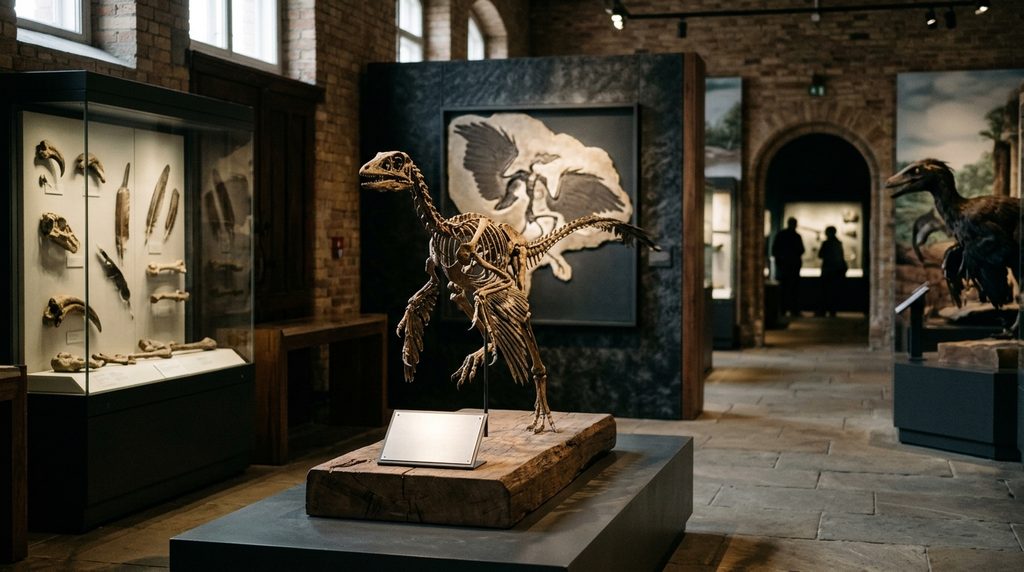
Most natural history museums hedge their bets with a chaotic mix of woolly mammoths, minerals, and taxidermied elk. Kenosha’s Dinosaur Discovery Museum does not bother with filler. Set inside a 1908 Beaux Arts former federal post office, this institution focuses on a single, uncompromising scientific argument: the direct evolutionary descent linking carnivorous theropod dinosaurs to modern feathered birds. You won't find lumbering sauropods or gentle ceratopsians on the main floor; every mount in the room belongs to a two-legged predatory lineage.
Opened in 2006 as a partnership between Kenosha's municipal museum system and Carthage College paleontology faculty, it holds the largest collection of theropod skeletal casts in North America. The mounts avoid sensationalized poses in favor of precise cladistics, and the institution uses an honest visual code: bones cast directly from discovered fossils are finished in light hues, while black cast pieces deliberately indicate anatomy that paleontologists had to sculpt to fill in missing gaps. Circling the room, you watch the skeletal mechanics of apex hunters like Tyrannosaurus rex and Acrocanthosaurus gradually contract into the agile, wishbone-bearing structures of primitive avians like Archaeopteryx.
Downstairs, the focus turns from evolutionary diagrams to field paleontology. The lower gallery features the laboratory space and the bones of "Little Clint," a remarkably rare three-year-old juvenile Tyrannosaurus rex discovered in Montana’s Hell Creek Formation during Carthage College digs. Rather than treating dinosaurs as cinematic monsters, the exhibits break down the actual grind of paleontology—from plaster jackets to microscopic dental analysis.
What it's like
You'll enter through a grand historic portico guarded by an outdoor statue of Dilophosaurus and step directly into a quiet, high-ceilinged gallery ringed by fossil casts. It is compact—the main floor and the lower-level lab can easily be absorbed in under an hour—making it an unhurried stop where you can inspect bone sutures and skull attachments up close without fighting crowd barriers. The venue sits directly on the route of Kenosha’s historic electric streetcar line, and parking around the square is generally hassle-free.
The move: Pass the outdoor Dilophosaurus statue and explore the quiet, high-ceilinged Beaux Arts gallery, inspecting carnivorous theropod skeletal casts and skull attachments up close without fighting crowd barriers.
- 📍 Kenosha, WI
- 💸 $
- ⚡ Up for anything
- 🌗 Indoors
Where: 5608 10th Avenue, Kenosha, WI 53140
Hours: Added 2026-11-18 — confirm current hours before you go.
Pair it with
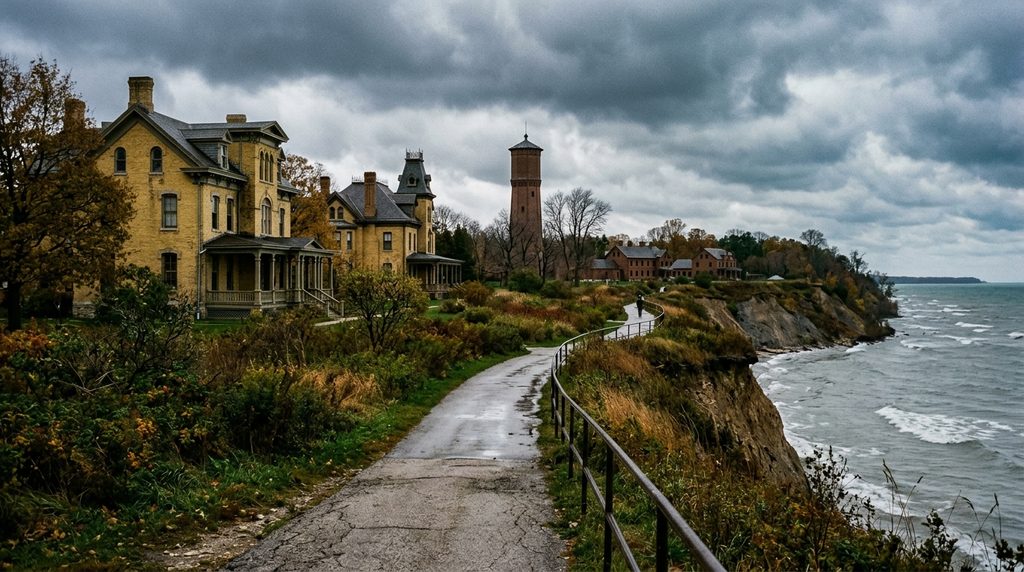
- Kemper Center — Drive less than a mile south along the lakefront to trade theropod cladistics for Victorian gothic halls and Kenosha's most enduring headless nun folklore.
- Russell Military Museum — Cross the state line into Russell to swap delicate anatomical casts for an untamed, outdoor boneyard of Cold War jets, helicopters, and car-crushing tanks.
- Illinois Beach State Park & Ancient Dunes — Head ten minutes down the shore to exit prehistoric fossil mounts and hike through living ancient dunes and carnivorous wetland bogs on Lake Michigan.
More weird in Great Lakes & North Shore

Good to know
How much does it cost to visit?
General admission is completely free, though donations are accepted at the desk.
What are the standard hours?
The museum is open Tuesday through Sunday from 12:00 PM to 5:00 PM, and closed on Mondays and major holidays.
Are the dinosaur bones real or casts?
The towering skeletons in the main gallery are scientific casts; bone elements colored light represent casts of real fossil finds, while black elements mark reconstructed bones. Real fossil specimens, including material from the juvenile T. rex 'Little Clint,' are preserved in the lower level.
Is the museum suitable for small children?
Yes; while the main gallery is academically oriented, the lower level includes dedicated hands-on dig tables, bone rubbing stations, and kid-friendly activities.
Plan a visit & invite your people →
Further reading: museums.kenosha.org · madisonroadtrip.com · Wikipedia · kenoshanews.com · extinctmonsters.net · Official site
last checked: 2026-11-18