Entry No. 44 — the Honolulu & Oahu file — filed under: miscellanea
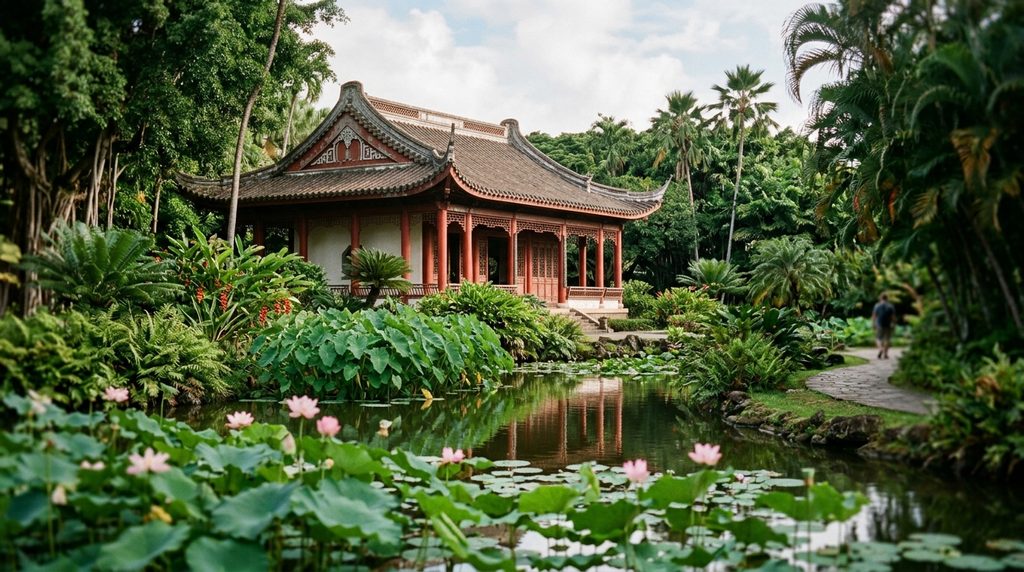
Chinese Hall at Moanalua Gardens
This temple-like hall mixes Victorian and Chinese styling, and the original owners built it for galas and dinners. It can be seen from the gardens near the lotus pond and taro patch.
→ Three more weird outdoor & roadside oddities in Honolulu & Oahu — never the same twice
The story
In 1884, banker and kingdom financier Samuel Mills Damon inherited the entire ahupuaʻa of Moanalua from Princess Bernice Pauahi Bishop. Flush with cash and imperial ambition after attending Queen Victoria's Diamond Jubilee in 1897, Damon hired a Scottish horticulturist from Edinburgh and set about transforming forty acres of wetland taro and rice paddies into a manicured Victorian estate. But Damon also wanted grand architectural monuments honoring Pacific Rim cultures. Between 1904 and 1906, he commissioned Chinese artisans and imported an entire pavilion piece by piece directly from China—complete with glazed ceramic roof tiles, dramatic upturned eaves, and intricately carved camphorwood wall panels.
The resulting Chinese Hall was an eccentric collision: a traditional Chinese ceremonial hall repurposed as a high-society Victorian party pad. Damon built a dedicated private spur off the Oahu Railway so Honolulu's diplomatic corps, visiting admirals, and kingdom elites could step right off a railcar and directly into black-tie galas and banquets hosting up to 300 people.
When the state carved the Moanalua Freeway right through the lower estate around 1960, the hall had to be saved. It was dismantled and relocated mauka (inland) to its current resting place beside a lotus and koi pond and an active loʻi kalo (taro patch), standing just paces away from King Kamehameha V’s 1850s summer cottage.
What it's like
Ninety-nine percent of the people paying the garden admission are tour groups rushing straight toward the monstrous monkeypod tree in the main lawn—a tree that became a cult corporate icon in Japan after decades of Hitachi commercials. Walk completely past them toward the back waterways, where the grounds abruptly go dead quiet. You’ll find the Chinese Hall perched beside the pond like a misplaced shrine. You cannot casually walk inside; the interior remains locked except for rare private functions or heritage exhibitions, so expect an exterior viewing through the palms. Take your time inspecting the weathered timber joinery and carved panels from across the water before wandering over to Prince Lot's gingerbread cottage next door.
The move: Walk past the giant monkeypod to the quiet lotus pond and trace the Chinese Hall’s upturned eaves with your eyes, imagining a Victorian dinner party under those glazed roof tiles.
- 📍 Moanalua, Honolulu
- 💸 Free
- ⚡ Up for anything
- 🌗 Outdoors
Where: 2850 Moanalua Road, Honolulu, HI 96819
Hours: Added 2026-11-17 — confirm current hours before you go.
Pair it with
- Bishop Museum — Hawaiian Hall & Pacific Curiosities — Princess Pauahi's husband Charles Reed Bishop and Chinese Hall's builder Samuel Mills Damon were close banking partners; the soaring Victorian koa casework here is the formal institutional counterpart to Damon's private garden compound.
- Helena’s Hawaiian Food — Just two miles down the road in Kalihi, this James Beard-winning institution is the essential unpretentious stop for pipikaula short ribs and poi after a quiet walk around the royal estate.
- La Mariana Sailing Club — Drive down into the industrial docks of Keʻehi Lagoon to trade turn-of-the-century garden architecture for Honolulu's last authentic 1955 mid-century tiki refuge.
More weird in Honolulu & Oahu
Good to know
Can you go inside the Chinese Hall?
No, not on a standard visit. The interior is kept locked to protect the century-old wood carvings, opening to the public only during rare special events, booked private functions, or scheduled private tours.
Why was a Chinese temple hall built on a royal Hawaiian estate?
Samuel Mills Damon envisioned Moanalua as a multicultural showcase representing cultures around the Pacific Rim. Rather than building a Western pastiche, he imported genuine architectural components from China and hired Chinese craftsmen to assemble the hall specifically for hosting large dinners and galas.
Is the hall in its original location?
No. It originally stood closer to the ocean (makai), but the expansion of the Moanalua Freeway in 1960 forced the Damon estate to dismantle the structure and shift it to its current spot next to the pond and taro patch.
What is the admission cost to see the hall and grounds?
Admission to Moanalua Gardens is $10 for adults, with discounts for Hawaii residents (kamaʻāina) and military ($4). The park is open daily from 8:30 a.m. to 4:00 p.m.
Plan a visit & invite your people →
Further reading: honolulumagazine.com · Official site · sah-archipedia.org · manoa.hawaii.edu · hawaiiangardenhistoryanddesign.wordpress.com · imagesofoldhawaii.com
last checked: 2026-11-17