Entry No. 65 — the Honolulu & Oahu file — filed under: miscellanea
Foster Botanical Garden
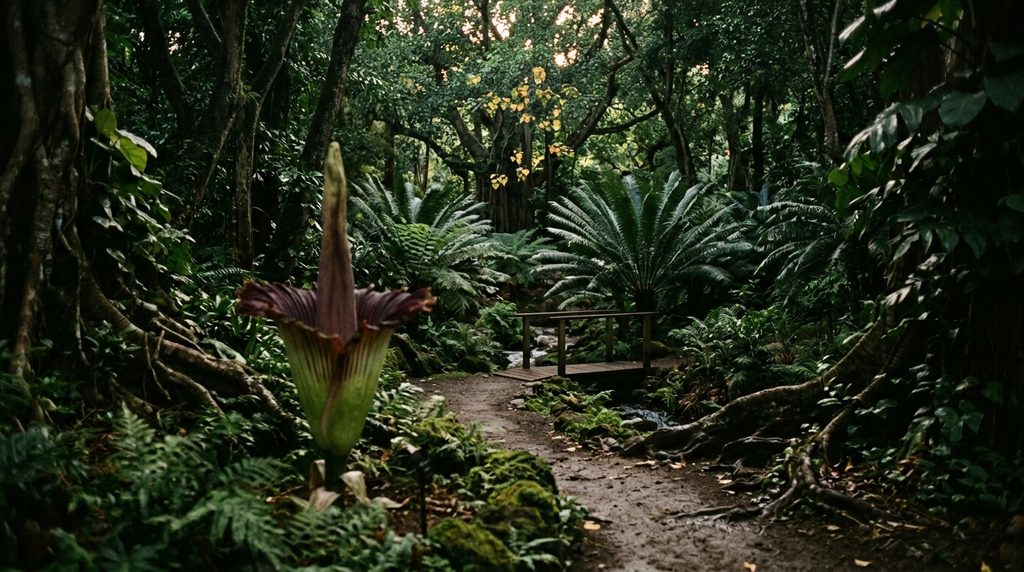
A downtown garden with a corpse flower known for its rotting-meat smell and a Prehistoric Glen with ancient cycads. A visitor guide identifies its Bodhi tree as a descendant of the tree under which the Buddha reached enlightenment.
→ Three more weird outdoor & roadside oddities in Honolulu & Oahu — never the same twice
The story
In 1853, Queen Kalama leased a parcel of Nuʻuanu land to Dr. William Hillebrand, a German physician at Queen's Hospital with a collector's obsession for foreign flora. Hillebrand spent two decades introducing exotic trees from across the globe to the upper terrace before returning to Germany. In 1884, the property was purchased by Mary Elizabeth Mikahala Robinson Foster—a Hawaiian philanthropist of aliʻi lineage who became the islands' first prominent Buddhist. Foster guarded and expanded the collection for decades, eventually bequeathing the estate to the City and County of Honolulu at her death in 1930 under a legally binding condition: the grounds had to remain preserved forever as a public tropical park.
Foster's personal spiritual connections gave the garden its most revered living relic. After meeting Sri Lankan Buddhist revivalist Anagarika Dharmapala in 1893 and funding his international restoration efforts, Dharmapala brought Foster a live cutting in 1913 from the sacred Jaya Sri Maha Bodhi in Anuradhapura, Ceylon. That tree had been propagated in 288 B.C. from the original tree in Bodh Gaya, India, under which Siddhartha Gautama reached enlightenment. Today, Mary's sapling is a hulking, heart-leafed sacred fig (*Ficus religiosa*)—a direct genetic clone of the world's most sacred tree, sitting quietly within earshot of downtown traffic.
The rest of the 14-acre grounds lean hard into evolutionary oddities. The Prehistoric Glen contains a living fossil nursery of ancient cycads, primitive seed plants that dominated the landscape during the Mesozoic era long before flowering trees appeared. In the greenhouse conservatory, the garden maintains specimens of *Amorphophallus titanum*, the titan arum. Every few years, one breaks dormancy to rapidly produce a massive inflorescence that warms itself up to human body temperature, filling the greenhouse with the pungent stench of decaying animal flesh to attract carrion beetles.
What it's like
You step off the sun-baked asphalt of North Vineyard Boulevard right into an abrupt wall of humid jungle shade, where the roar of traffic and highway hum never entirely fades past the canopy. Pay admission at the small gift shop counter, take a printed grounds map, and wind through paved pathways that are generally dead-quiet on weekday mornings. Shade-loving mosquitoes are relentless along Nuʻuanu Stream and under the dense tree canopies, so apply bug spray before you venture past the entrance terrace. If you're coming specifically to catch the corpse flower bloom in the conservatory, check city park notices beforehand; its putrid display typically collapses within 48 hours.
The move: Grab a grounds map, duck into the humid shade to find the ancient cycads in the Prehistoric Glen, and see which of you volunteers for the first sniff if the corpse flower is blooming.
- 📍 Central Honolulu
- 💸 $$
- ⚡ Up for anything
- 🌗 Indoors
Where: 50 North Vineyard Boulevard, Honolulu, HI 96817
Hours: Added 2026-11-17 — confirm current hours before you go.
Pair it with
- Hound & Quail — Trade living evolutionary relics for preserved oddities, taxidermy, and vintage medical curiosities just four blocks away in Chinatown.
- Skull & Crown Trading Co. — Follow up the garden's rare, rotting-meat corpse flower by heading down the street for dark rum drinks served with macabre special-effects garnish.
- Olay’s Thai Lao Cuisine — Walk directly out of the Bodhi tree grove and into Olay's hidden Chinatown courtyard for Lao sausage and curry noodles.
More weird in Honolulu & Oahu


Good to know
How much does it cost to get in?
Admission is $5 for general adult visitors, $3 for Hawaii residents with local ID, $1 for children ages 6 to 12, and free for kids under 5.
Is parking available on site?
Yes, there is a dedicated free parking lot on property accessed directly from North Vineyard Boulevard, though spaces are limited and can fill up quickly.
How often does the corpse flower actually bloom?
Unpredictably. A titan arum requires years between blooms to store enough energy in its subterranean corm, and the flower lasts only 24 to 48 hours; the garden typically posts advance warnings when one starts spiking.
How long does a visit usually take?
Plan for 60 to 90 minutes to casually circle the walking loops, view the heritage trees, explore the cycad glen, and visit the orchid conservatory.
Plan a visit & invite your people →
Further reading: honolulu.gov · Facebook · princewaikiki.com · Wikipedia · globalbuddhism.org
last checked: 2026-11-17