Entry No. 59 — the Honolulu & Oahu file — filed under: miscellanea
Grave of the Father of Baseball (Oʻahu Cemetery)
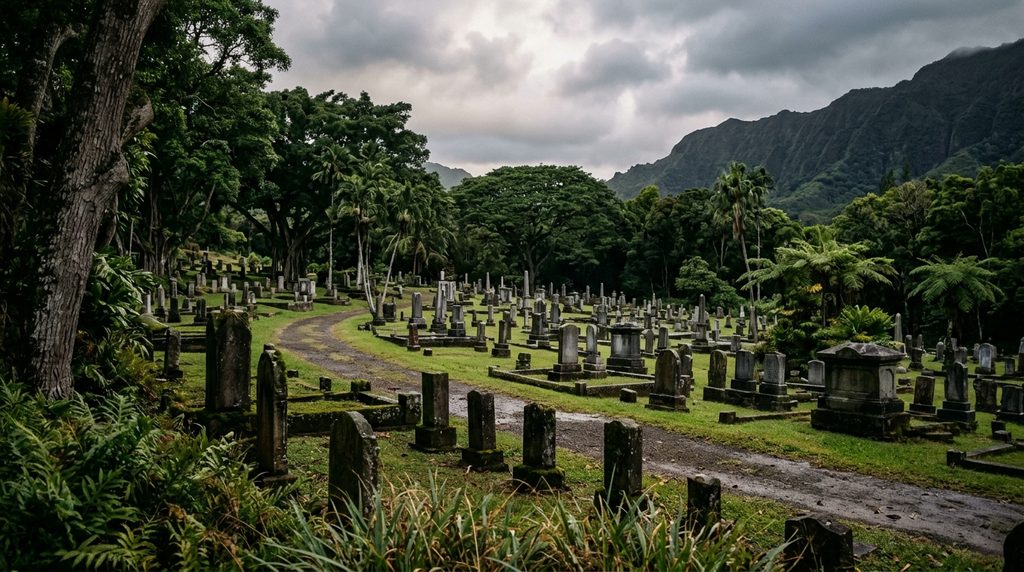
A grave singled out by Roadside America as that of the “Father of Baseball” sits inside Oʻahu Cemetery on Nuʻuanu Avenue.
→ Three more haunted places & dark-history spots in Honolulu & Oahu — never the same twice
The story
In 1845, a Manhattan bookkeeper and volunteer firefighter named Alexander Joy Cartwright Jr. helped codify the twenty rules of the Knickerbocker Base Ball Club—fixing four bases into a ninety-foot diamond, mandating nine-inning games with three outs per side, and outlawing the brutal playground habit of throwing the ball at basemen to record an out. Four years later, struck by gold fever, Cartwright headed west across the continent, teaching his rulebook to settlers and frontier outposts from Missouri to California. In late 1849, intending to catch a ship home via China, he docked in Honolulu Harbor, fell ill, recovered, and decided to spend the rest of his life on the island.
Instead of returning to mainland baseball, Cartwright embedded himself in the Kingdom of Hawaiʻi. King Kamehameha III appointed him chief engineer of Honolulu's newly established fire department in 1850. He became a trusted confidant and executor for Queen Emma, advised King Kalākaua, and helped establish the Honolulu Library and Reading Room, insisting that women be admitted as patrons. Meanwhile, he paced out Hawaiʻi's very first baseball diamond on the dirt at Makiki Field. When Cartwright died in July 1892—six months before the kingdom was overthrown—his mainland obituary barely registered. Decades passed before the Baseball Hall of Fame inducted him in 1938, followed by a 1953 Congressional resolution officially designating him the "Father of Modern Baseball."
His final resting place isn't in Cooperstown or Brooklyn; it sits beneath monkeypod trees in Oʻahu Cemetery, Hawaiʻi's oldest public burial ground. Marked by an imposing pink granite monument, Cartwright's plot has quietly operated as a pilgrimage site for baseball traditionalists. Babe Ruth made a point to visit and pay his respects during an island barnstorming tour in 1934. To this day, visitors regularly slip through the cemetery gates to balance dirt-scuffed Rawlings baseballs, pennies, and folded scorecards along the granite base.
What it's like
Oʻahu Cemetery sits just mauka of downtown Honolulu along Nuʻuanu Avenue, where cool mountain trade winds keep the 18-acre Victorian garden cemetery lush and damp. Drive in through the stone entrance gates and follow the paved interior lanes past weathered marble statuary and 19th-century family obelisks. Cartwright's grave is distinguished by a tall, polished pink granite obelisk rising in the family plot; if you get turned around in the grid, the front office can provide a map marking notable interments. You'll know you found it by the offerings tucked into the grass—game balls, ticket stubs, and coins left by traveling fans. It is an active, quiet cemetery, so keep a respectful volume and bring insect repellent for the Nuʻuanu shade.
The move: Drive through Oʻahu Cemetery’s stone gates and past weathered marble statues, then see who spots Cartwright’s polished pink granite obelisk first and name one baseball rule he helped settle.
- 📍 Nuʻuanu, Honolulu
- 💸 Free
- ⚡ Up for anything
- 🌗 Outdoors
Where: 2162 Nuʻuanu Avenue, Honolulu, HI 96817
Hours: Added 2026-11-17 — confirm current hours before you go.
Pair it with
- National Memorial Cemetery of the Pacific (Punchbowl) — Pair Cartwright's peaceful Victorian garden memorial with the crater rim of Punchbowl, where over 50,000 Pacific veterans rest inside an extinct volcanic caldera two miles east.
- Kawaiahaʻo Church & Royal Crypts — Head down into downtown Honolulu to see the coral-block church where the Hawaiian royal aliʻi worshipped while Cartwright was serving as their fire chief and financial advisor.
- Merchant Street Post Office — Follow Cartwright's 19th-century civic footprint into the historic Merchant Street district where Honolulu's commerce and municipal affairs operated during the kingdom era.
More weird in Honolulu & Oahu
Good to know
Where is Cartwright's marker located within the grounds?
Alexander Cartwright is buried in the Cartwright family plot, marked by a prominent pink granite obelisk. If you have trouble spotting it among the 19th-century headstones, the front office near the entrance provides grounds maps.
Why is Alexander Cartwright credited as the Father of Baseball instead of Abner Doubleday?
The story that Abner Doubleday invented baseball in Cooperstown was a 20th-century myth. Cartwright drew up the 1845 Knickerbocker Rules that defined the modern diamond, 90-foot base paths, nine players, and nine-inning structure, which earned him induction into the Baseball Hall of Fame in 1938.
Did Babe Ruth actually visit this grave?
Yes. While visiting the Hawaiian Islands during an international baseball tour in 1934, Babe Ruth made an intentional pilgrimage to Oʻahu Cemetery to pay homage at Cartwright's monument.
What else is historically significant about Oʻahu Cemetery?
Founded in 1844 by a land grant from King Kamehameha III, it was Hawaiʻi's first non-denominational public cemetery. It holds the islands' finest collection of 19th-century gravestone art, the graves of mythologist Joseph Campbell and prominent kingdom diplomats, and Hawaiʻi's only dedicated Civil War veterans plot.
Plan a visit & invite your people →
Further reading: Roadside America · luc.hawaii.gov · dlnr.hawaii.gov · honolulumagazine.com · Official site · sabr.org
last checked: 2026-11-17