Entry No. 49 — the Honolulu & Oahu file — filed under: miscellanea
The Stones of Life
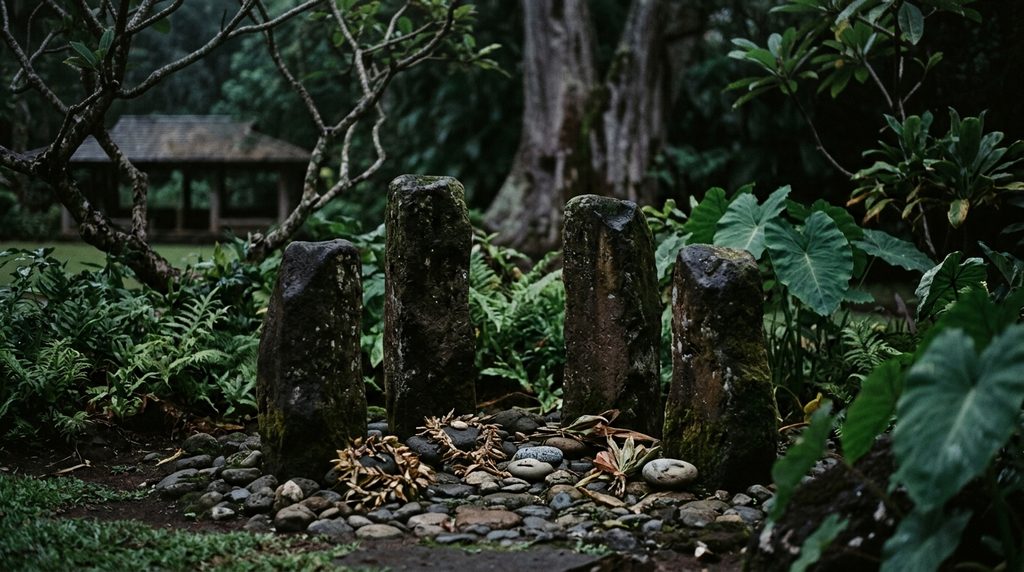
A monument dedicated to four māhū healers who, in the story recounted by the supplied theater page, helped Hawaiʻi during a plague. The monument gives Zachariah Ezer’s play its title.
→ Three more weird outdoor & roadside oddities in Honolulu & Oahu — never the same twice
The story
Millions of tourists jostle for selfies at the bronze Duke Kahanamoku statue on Waikīkī Beach, completely oblivious to four dark, pitted basalt boulders resting inside a low railing beside the beach police substation. These are Nā Pōhaku Ola Kapaemāhū a Kapuni—the Healer Stones of Kapaemahu. According to oral tradition, four māhū (individuals embodying dual male and female spirits) named Kapaemāhū, Kapuni, Kinohi, and Kahāloa sailed from Tahiti to Oʻahu centuries ago, establishing their home at Ulukou. Beloved across the island for curing afflictions through touch, herbology, and spiritual power, the healers eventually prepared to return home. Before departing, they asked the island's high chiefs to quarry four massive boulders from a hillside in Kaimukī. Over the course of a single night under a full moon, thousands of people passed the multi-ton rocks hand to hand down to the shoreline, where the healers spent a full lunar cycle conducting rituals to permanently transfer their mana into the stone.
What happened in the twentieth century is a textbook study in colonial amnesia and indignity. In 1941, the sacred stones were quietly paved over and buried beneath the concrete foundation of a beachfront bowling alley. They remained entombed beneath the lanes for 22 years until the building was torn down in 1963. Even after preeminent Hawaiian cultural authority Mary Kawena Pukui intervened to save them from being carted off to a dump, city planners and tour promoters spent decades sanitizing the legend. The healers' queer and dual-gender identity was scrubbed clean, and promotional literature rebranded the site as the palatable, Disneyfied "Wizard Stones."
In 1997, traditional healer Papa Henry Auwae and master stonemason Billy Fields gave the boulders their current dignified home, setting them atop a raised stone platform (paepae) joined by Taʻahu Ea, a ceremonial stone brought as a gift from Tahiti. Yet the full moʻolelo remained officially unacknowledged until 2023, when public advocacy finally forced the city to install bronze interpretive signage restoring the healers' māhū legacy. Today, the monument stands as an anchor of indigenous Hawaiian history, radiating quiet gravity in the very heart of Waikīkī's commercial sprawl.
What it's like
Look for the raised stone platform just makai (seaward) of Kalākaua Avenue, tucked between the Waikīkī police precinct and the sand. The monument sits inside a waist-high iron fence shaded by foliage, often marked by braided ti-leaf offerings and orchid leis laid across the stonework. The atmosphere is an odd collision of worlds: roaring trolley traffic and tourists hauling foam surfboards on one side, and thousands of pounds of sacred volcanic basalt on the other. It is free and fully accessible 24/7 from the public promenade, but visit in the early morning before the sunbathers set up their loungers if you want to stand before the stones without a crowd.
The move: Find the low iron fence between the Waikīkī police precinct and the sand, then pause together over the four pitted basalt boulders honoring māhū healers and look for braided ti leaves and orchid leis.
- 📍 Honolulu
- 💸 $$
- ⚡ Up for anything
- 🌗 Indoors
Where: Kūhiō Beach Park (on Kalākaua Avenue near the Duke Kahanamoku statue / Waikīkī Police Substation), commonly given as 2425 Kalākaua Ave, Honolulu, HI 96815
Hours: Added 2026-11-17 — confirm current hours before you go.
Pair it with
- Kawehewehe — Waikīkī's other ancient healing landmark sits four-tenths of a mile up the sand, where subterranean freshwater springs once mingled with the tide to create a ceremonial restoration site.
- In The Southern Sun — Just a tenth of a mile away, this immersive cultural exhibit offers modern artistic context for Waikīkī’s sacred original landscapes before resort development paved them over.
- Green Lady Cocktail Room — Trade the midday beach glare for this dimly lit hideaway tucked behind an unmarked door near the bamboo wall of the White Sands Hotel.
More weird in Honolulu & Oahu
Good to know
What does māhū mean in this history?
In traditional Hawaiian society, māhū refers to individuals who embody both masculine and feminine traits and spirits. Far from being marginalized, they held respected societal roles as healers, genealogists, and caretakers of sacred cultural protocols.
Why were they historically called the Wizard Stones?
During the twentieth century, Western translators and tourism operators replaced the Hawaiian term kahuna (a trained expert or priest) and erased the healers' māhū identity, inventing the label 'Wizard Stones' to appeal to foreign tourists without acknowledging native gender concepts.
Can I touch or step inside the platform?
No. The stones are an active wahi pana (sacred site). Visitors should remain outside the railing and avoid touching the boulders or disturbing the offerings left on the platform.
Where did the rocks actually come from?
Geological analysis matches oral traditions: the dark vesicular basalt stones were quarried several miles inland from the basalt outcrops of Kaimukī and hand-carried to Waikīkī beach.
Plan a visit & invite your people →
Further reading: lamama.org · hmdb.org · publicartinpublicplaces.info · Wikipedia · kapaemahu.info · bishopmuseum.org
last checked: 2026-11-17