Entry No. 34 — the Lawton & Fort Sill file — filed under: miscellanea
Fort Sill ADA Training Support Facility
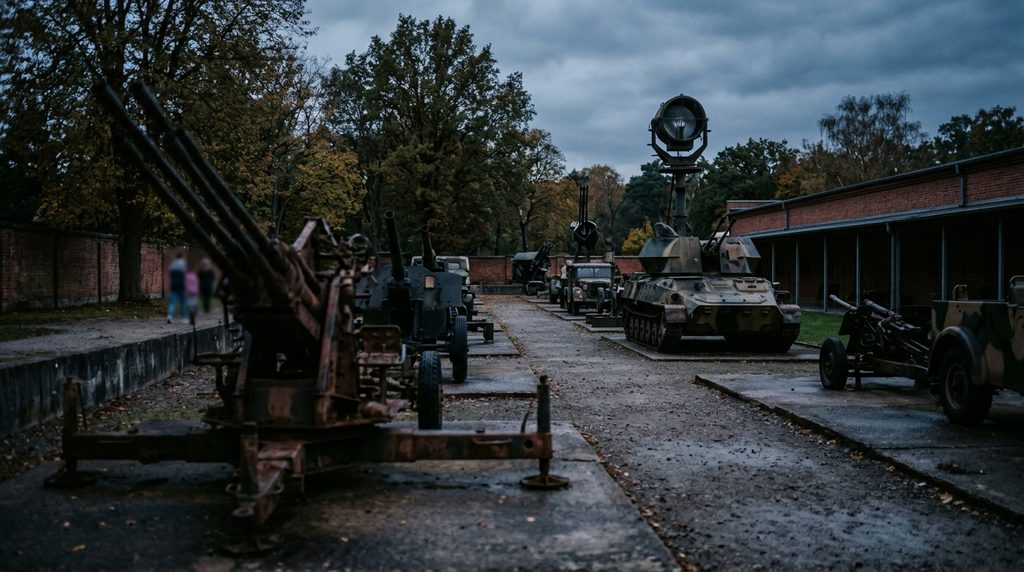
This specialized air-defense artillery facility displayed artifacts from past wars and conflicts at a rare public open house. The supplied reporting describes public access as an occasional event.
→ Three more unusual museums & collections in Lawton & Fort Sill — never the same twice
The story
On paper, Fort Sill holds one of the most comprehensive air-defense collections in the Western Hemisphere. In practice, the Army categorized it as a Training Support Facility rather than an official public museum—a bureaucratic distinction that means its primary mandate is educating soldiers at the Fires Center of Excellence rather than running public tour hours. That administrative designation comes with a remarkable side effect: unlike civilian-facing military museums, which are required to demilitarize and weld weapons shut, an instructional TSF keeps its artillery pieces mechanically intact.
Inside the 40,000-square-foot high-bay facility, the Air Defense Artillery branch charts its operational lineage from the Coast Artillery Corps of 1907 straight into the missile age. Greeting entrants is a scale diorama of a three-inch antiaircraft gun on Corregidor from the opening hours of World War II—where the branch earned its 'First to Fire' motto—overseen by its bug-eyed mythical mascot, the Oozlefinch. Deeper in the bays sits the only surviving three-inch M1918 anti-aircraft gun from World War I, a complete battery of German 88mm guns, and genuine Nazi rocketry captured at the underground Nordhausen plant by the 3rd Armored Division, including a V-1 flying bomb, a V-2 rocket, and rare Wasserfall and Rheintochter surface-to-air missiles.
Because the facility was built for Officer Candidate School and Advanced Individual Training classes, public access is the exception rather than the rule. Beyond occasional open houses coordinated with Fort Sill leadership, the hangar remains an insular, working classroom—meaning that unless you happen to catch the doors swung wide for an announced public event, you are looking at a world-class missile museum locked behind base protocol.
What it's like
Visiting requires aligning your calendar with an announced public open house or arranging access through the facility curator in advance. Before reaching the building on post, all civilian adults must stop at the Fort Sill Visitor Control Center with a Real ID or passport to submit to a background check and obtain an entry pass. Once inside Building 730, the atmosphere is distinctly operational rather than museum-polished: rows of tracked vehicles, radar searchlights, missile trailers, and experimental laser prototypes crowd the bays with minimal velvet-rope buffering.
The move: Catch a public open house in Building 730 and start at the miniature Corregidor gun emplacement before looking up at the full-size air-defense artillery in the high bay.
- 📍 Fort Sill, north of Lawton
- 💸 $
- ⚡ Up for anything
- 🌗 Indoors
Where: 730 Schimmelpfennig Avenue, Building 730, Fort Sill, OK 73503
Hours: Added 2026-11-18 — confirm current hours before you go.
Pair it with
- U.S. Army Field Artillery Museum & Atomic Annie — Walk down the road to visit Fort Sill's fully public heavy-artillery complex and stand under the barrel of Atomic Annie, the Army's Cold War 280mm nuclear cannon.
- Fort Sill National Historic Landmark & Old Post Quadrangle — Trade high-tech surface-to-air interceptors for frontier history at the intact 1870s stone quadrangle and the guardhouse where Geronimo spent his final days.
- Jack Daniel’s Lounge — Wrap up a day on base at an officially sanctioned Jack Daniel's lounge, an incongruous post watering hole located just down the road.
More weird in Lawton & Fort Sill


Good to know
Is the facility open to the public on a regular schedule?
No. Unlike the neighboring Field Artillery Museum, the Training Support Facility is a dedicated military training installation that opens to the broader public only during designated open house events or by special arrangement.
What credentials do I need to access the building on post?
Civilian visitors without Department of Defense credentials must stop at a Fort Sill Visitor Control Center to clear a background check and receive a post pass; a valid Real ID driver's license or passport is required.
Why is it designated a Training Support Facility instead of a museum?
The Army created the facility under the Fires Center of Excellence primarily to train soldiers, OCS candidates, and officers on branch history and equipment evolution, which also allows weapons to remain intact rather than demilitarized.
What are the most significant artifacts displayed inside?
Highlights include the world's sole surviving WWI-era 3-inch M1918 antiaircraft gun, German 88mm guns, intact Nordhausen-captured German V-1, V-2, Wasserfall, and Rheintochter missiles, Cold War missile interceptors, and modern directed-energy short-range air-defense prototypes.
Plan a visit & invite your people →
Further reading: kswo.com · navalgazing.net · sill-www.army.mil · army.mil · dvidshub.net
last checked: 2026-11-18