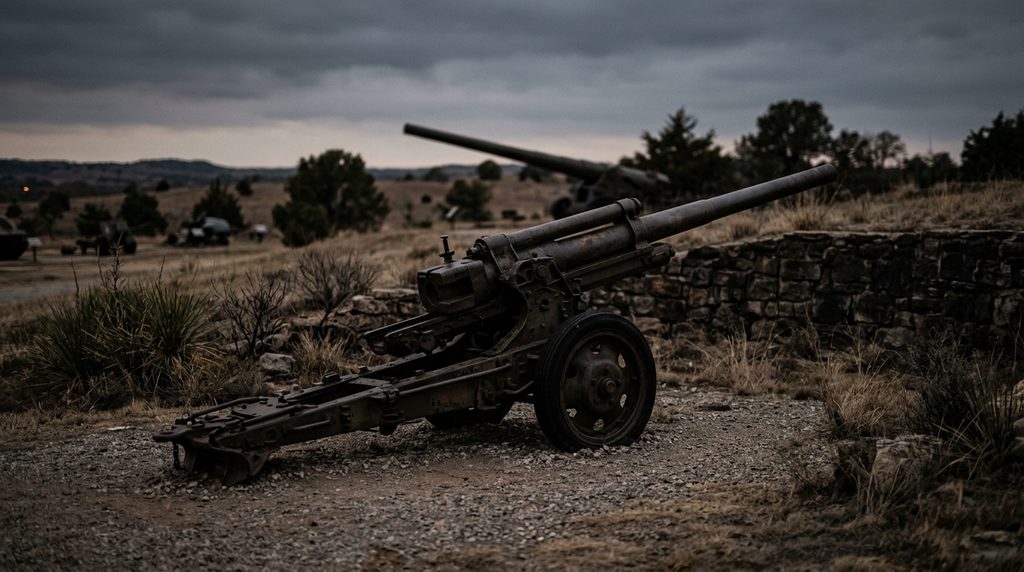
Entry No. 22 — the Lawton & Fort Sill file — filed under: miscellanea
Mule Gun at the U.S. Army Field Artillery Museum
Roadside America singles out the museum’s Mule Gun as a separate offbeat stop near Atomic Annie.
→ Three more unusual museums & collections in Lawton & Fort Sill — never the same twice
The story
Newton’s third law is completely merciless, but late-nineteenth-century ordnance planners apparently figured an American army mule could out-stubborn physics. Standard mountain artillery of the era was designed to be broken down, strapped across several pack animals in pieces, and painstakingly reassembled on high ground before opening fire. To someone in uniform around 1880, this looked like wasted time. The solution proposed was as simple as it was unhinged: bolt an iron one-pounder rifled cannon directly onto a wooden pack-saddle tree and discharge the weapon while it was still strapped to the animal's spine.
According to Fort Sill’s museum records, the ensuing live-fire trial unraveled immediately into slapstick horror. Once rigged up, the mule became alarmed by the contraption, broke loose, and began violently spinning in circles, sweeping a loaded artillery barrel directly across the panicking crowd of military observers. In the chaos, the animal managed to step on its own firing lanyard. The 29-inch tube erupted, and the violent recoil reportedly hurled the beast ass-over-teakettle down an embankment and into a nearby creek. Similar experiments during the Mexican War had routinely broken the legs of the unfortunate beasts burdened with them, and the U.S. Army abruptly shelved the concept forever.
Today, the lone surviving prototype rests inside the U.S. Army Field Artillery Museum, dwarfed by surrounding rows of polished brass cannons, tracked howitzers, and ballistic missiles. It is an unassuming, absurd contraption of iron and harness leather—a physical reminder that military engineering has occasionally advanced by sheer, reckless trial and error.
What it's like
Visiting requires clearing active Army base security before you see any hardware. Stop first at the Fort Sill Visitor Control Center at T6701 Sheridan Road to submit your Real ID, vehicle registration, and proof of insurance for an on-the-spot background check and visitor pass. Once through the gate and inside the Field Artillery Museum's main building, look past the massive twentieth-century howitzers for the compact, pack-saddle-mounted barrel; admission is free, the galleries are quiet, and you can easily inspect the awkward rigging up close without fighting crowds.
The move: Once you’re inside the museum, find the iron one-pounder on its wooden pack saddle and picture the mule that broke loose and spun in circles during the trial.
- 📍 Fort Sill / Lawton, Oklahoma
- 💸 Free
- ⚡ Up for anything
- 🌗 Outdoors
Where: Artillery Park (Field Artillery Museum), Randolph Road / Sheridan Road area, Fort Sill, OK 73503 (base mailing/visitor control: T6701 Sheridan Road, Fort Sill, OK 73503)
Hours: Added 2026-11-18 — confirm current hours before you go.
Pair it with
- U.S. Army Field Artillery Museum & Atomic Annie — The Mule Gun sits inside the same museum whose outdoor park features Atomic Annie, capturing the full absurd spectrum of U.S. artillery design from pack-animal recoil disaster to 85-ton nuclear cannon.
- Fort Sill National Historic Landmark & Old Post Quadrangle — Located less than a half-mile away, this preserved 1870s stone quadrangle and corral showcases the frontier cavalry post as it operated when pack mules were the primary logistical backbone of the plains.
- Jack Daniel’s Lounge — A quirky base-operated watering hole less than a mile away, perfect for grabbing a drink on an active military post after pondering 19th-century ballistics experiments.
More weird in Lawton & Fort Sill

Good to know
What was the purpose of the Mule Gun?
Built around 1880, the experimental one-pounder rifled cannon was designed to be fired directly from a wooden pack saddle on a mule's back, intended to give cavalry rapid artillery support in rough terrain without the delay of unpacking and assembling a wheeled carriage.
Did the mule survive the trial firing?
Museum records recount that the mule survived its test after spinning wildly and stepping on its own firing lanyard, though the recoil flipped the animal violently down into a nearby creekbed.
Where is the gun located within Fort Sill?
It is housed inside the permanent gallery of the U.S. Army Field Artillery Museum near Sheridan and Randolph roads, directly across from the outdoor Artillery Park.
Can the general public enter Fort Sill to see it?
Yes. Civilians can visit for free by stopping at the Fort Sill Visitor Control Center (T6701 Sheridan Road) near Bentley Gate to complete a background check and obtain a day pass with a valid government photo ID and vehicle paperwork.
Plan a visit & invite your people →
Further reading: Roadside America · Official site · travelok.com
last checked: 2026-11-18