Entry No. 17 — the London, UK file — filed under: miscellanea
Grant Museum of Zoology
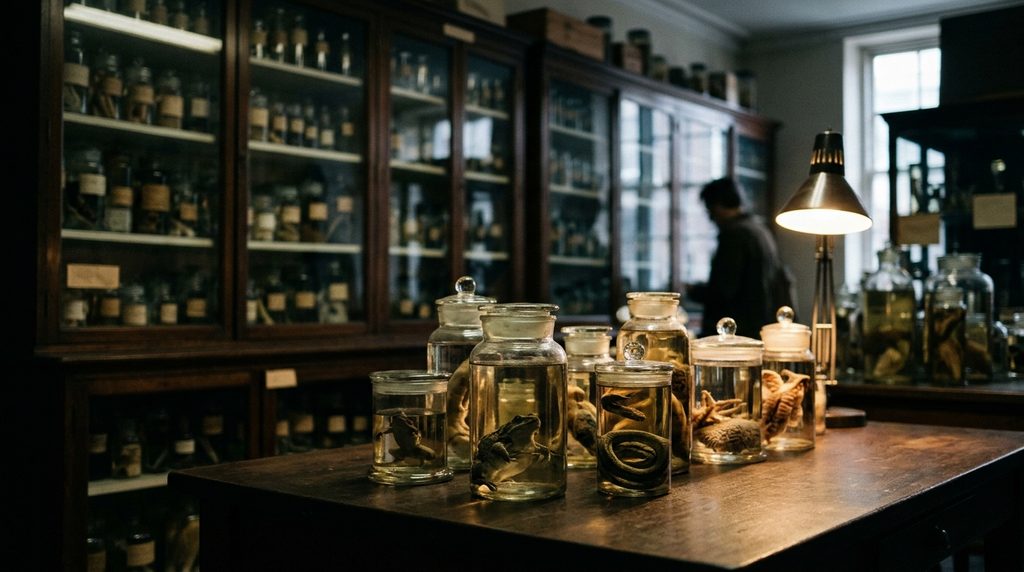
A small zoology museum singled out for its collection of specimens preserved in jars.
→ Three more oddity shops & curiosities in London, UK — never the same twice
The story
In 1828, Robert Edmond Grant arrived in London as England’s first professor of comparative anatomy, handed an empty classroom at the newly founded University of London and told to teach animal biology from scratch. His solution was ruthless and practical: collect specimens from livestock butchers, private collectors, and the nascent London Zoo, dissect them for lecture demonstrations, and pickle whatever did not rot in alcohol jars. Decades earlier in Edinburgh, Grant had mentored a teenage Charles Darwin, feeding him radical ideas on transmutation long before the voyage of the Beagle. When Grant died in 1874, he bequeathed his private hoard of roughly 10,000 pickled carcasses and skeletons to the college, seeding what remains London's last university zoology collection.
Because the collection was amassed to teach medical and biology students rather than entertain tourists, it lacks the sanitizing sheen of South Kensington. That utilitarian pedagogical streak explains its strangest artifacts. The museum's mascot is the famous Jar of Moles: eighteen European moles crammed snout-to-tail in preservation fluid, packed tight simply because large glass vessels and pure alcohol were too expensive to waste on single critters intended for student scalpel practice. Nearby stands one of only seven quagga skeletons known to exist on Earth. UCL curators had the extinct South African zebra displayed in plain sight since 1911, mistaking it for a common zebra until an examination in 1972 revealed what it actually was (meanwhile, the museum's second mounted 'zebra' turned out to be an ordinary donkey).
The room rewards close inspection over broad sweeps. In the center aisles sits the Negus Collection of Bisected Heads—mammalian skulls, from badgers to pangolins, sliced precisely down the sagittal plane to reveal the mechanics of their nasal passages and brains like biological cold cuts. Tucked into one corner is the Micrarium, a walk-in, floor-to-ceiling cubicle backlit by fluorescent light panels and lined with 2,323 antique microscope slides featuring whole fleas, beetle wings, and slices of whale eyes. It is essentially an unapologetic Victorian research vault that forgot to close down when the nineteenth century ended.
What it's like
You enter through UCL's Rockefeller Building, bypass the student flow, and step directly into a single high-ceilinged room smelling faintly of wood polish and old ethanol. The entire museum fits within a converted Edwardian medical library, meaning you can walk its perimeter in three minutes, but parsing the handwritten Victorian labels and jarred brains takes well over an hour. It is free, uncrowded on weekday afternoons, and distinctly scholarly—often with university researchers or student invigilators stationed near the entrance. If you want quiet time with the bisected heads and the glowing Micrarium without dodging student sketchers, aim for 1:30 PM on a Tuesday or Thursday.
The move: Peer at the jarred brains together in the old medical library, taking turns guessing what animal each came from before you decipher the handwritten Victorian labels.
- 📍 Bloomsbury
- 💸 $$
- ⚡ Up for anything
- 🌗 Indoors
Where: Rockefeller Building, University College London, 21 University Street, London WC1E 6DE
Hours: Added 2026-11-18 — confirm current hours before you go.
Pair it with
- Hunterian Museum — A mile south in Holborn, this serves as the human counterpart to the Grant, trading pickled moles for thousands of John Hunter's 18th-century surgical preparations and anatomical anomalies in glass jars.
- Crypt Gallery at St Pancras Church — A five-minute walk east, this subterranean brick vault swaps pickled laboratory specimens for atmospheric contemporary art staged among the resting places of 557 interred Londoners.
- Treadwell’s Books — Just three blocks away in Bloomsbury, you can pivot from the cold empirical dissections of Victorian science into shelves of European folklore, witchcraft grimoires, and occult scholarship.
More weird in London, UK
Good to know
Do I need tickets or an advance booking to get in?
No. General admission is completely free and operates entirely on a walk-in basis for individual visitors. You only need to arrange an advance booking if you are visiting as an organized group of ten or more.
Why are eighteen moles packed into one single jar?
It was cost efficiency. In the nineteenth century, custom glass jars and industrial alcohol were expensive commodities for university anatomy departments. Lab technicians pickled whole batches of dissection subjects together in single jars to save bench space and preservation fluid.
What are the museum's rarest exhibits?
The headliner is the quagga skeleton—one of only seven preserved examples of the extinct South African plains zebra left in the world. The collection also holds rare bones of the extinct dodo, fluid-preserved Tasmanian tiger (thylacine) specimens, and Blaschka glass models of delicate marine invertebrates.
What are the regular opening hours?
The museum is open to the public Tuesday through Friday from 1:00 PM to 5:00 PM, and Saturdays from 11:00 AM to 5:00 PM (last admission is at 4:45 PM). It remains closed on Sundays, Mondays, and major university holiday breaks.
Plan a visit & invite your people →
Further reading: Time Out · Facebook · globetotting.com · designmynight.com · ucl.ac.uk · natural-history-conservation.com
last checked: 2026-11-18