Entry No. 37 — the London, UK file — filed under: miscellanea
SS Great Eastern’s Launch Ramp
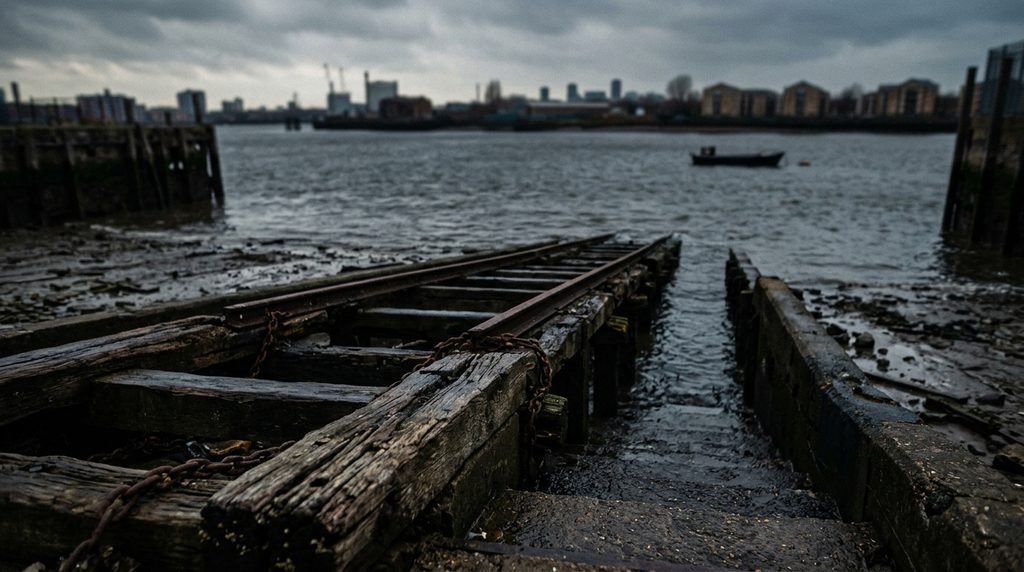
Remains of the ship’s launch ramp survive at the southeastern tip of the Isle of Dogs.
→ Three more haunted places & dark-history spots in London, UK — never the same twice
The story
In November 1857, Isambard Kingdom Brunel stood on the muddy Millwall foreshore to launch the SS Great Eastern—an iron monster nearly 700 feet long and five times the displacement of anything afloat. It was engineered to steam all the way to Australia and back without stopping for coal. The problem was geography: the river Thames at this bend was far too narrow for a traditional stern-first slide without ramming the bow straight into the Deptford dockyards opposite. Brunel was forced into an audacious compromise: he laid down two parallel, sloping slipways of timber and iron to push the 12,000-ton leviathan into the water sideways. When he gave the signal on launch day, a massive winch drum spun out of control, hurling workers through the air, killing one, and leaving the iron hull jammed after moving barely three feet.
What followed was three months of public humiliation and mechanical warfare. Brunel brought in screaming hydraulic rams, chains, and tugs, staging thirteen separate attempts to shove the ship inch by agonizing inch toward the water. The ordeal broke the company’s finances and Brunel’s health—he suffered a stroke aboard her decks just before her 1859 maiden voyage and died days later. Though the ship went on to lay the first enduring transatlantic telegraph cable in 1866, her birthplace was abandoned to general heavy industry. In June 1944, a German V-1 flying bomb slammed directly into the foreshore here, detonating against Brunel's submerged concrete footings.
Rediscovered and scheduled as an ancient monument during the 1980s Docklands redevelopment, the slipways survived by sheer mass. Today, the preserved timber baulks and inclined concrete ways sit marooned among manicured riverside apartment courtyards—a bizarre industrial scar embedded in prime London real estate.
What it's like
Follow the Thames Path around the southern curve of the Isle of Dogs until you reach Burrells Wharf and Napier Avenue. Most joggers blow right past the railed viewpoint without looking down, but time your arrival for low tide and you will see the black, heavily weathered timber baulks and concrete rails slicing down the bank into the river mud. An information board and a set of massive iron links are mounted near the terrace above. There are no turnstiles, tickets, or attendants. The river foreshore below is treacherous with slick Thames silt—keep your boots on the public path unless you know the tides and hold a Port of London Authority foreshore permit.
The move: Follow the Thames Path to the Burrells Wharf railings at low tide, look down at the black timbers slicing into the mud, and picture Brunel shoving a nearly 700-foot ship into the Thames sideways.
- 📍 Isle of Dogs
- 💸 $$
- ⚡ Up for anything
- 🌗 Indoors
Where: Napier Avenue / southeast of Napier Avenue, near Burrells Wharf and Bering Square, Isle of Dogs, London E14 (Thames Path / foreshore)
Hours: Added 2026-11-18 — confirm current hours before you go.
Pair it with
- Brunel Museum — Take the river bus across to Rotherhithe to stand inside the Brunel Thames Tunnel shaft and see an original iron grinding wheel salvaged from this very Millwall shipyard.
- The Junk Shop & Spread Eagle Antiques — Walk south down the Thames Path and dive under the river through the Greenwich Foot Tunnel to sift through nautical antiques and taxidermy on the south bank.
- The Fan Museum — A short walk through the Greenwich Foot Tunnel delivers you from Brunel's heavy iron ruins to a quiet Georgian townhouse housing thousands of intricate handheld fans.
More weird in London, UK

Good to know
Where exactly on the riverbank can I see the slipway?
The remains are built into the river wall and foreshore directly southeast of Napier Avenue and Bering Square, beside the Burrells Wharf residential complex in Millwall (E14 3TD).
When is the best time to visit?
Check the Thames tide tables before you go and aim for low tide. High water submerges the lower timber and concrete slipways completely, leaving only the upper embankment visible.
Can I walk down onto the timbers?
Viewing from the Thames Path terrace is free and open at all hours. Stepping down onto the foreshore itself is dangerous due to fast-rising tides and deep mud, and searching or disturbing the foreshore requires an official permit from the Port of London Authority.
What is the closest public transport?
Masthouse Terrace Pier is less than a two-minute walk away via the Uber Boat by Thames Clippers. If you are on the DLR, Island Gardens and Mudchute stations are both roughly a ten-minute walk.
Plan a visit & invite your people →
Further reading: historic-uk.com · historicengland.org.uk · mylondon.news · layersoflondon.org
last checked: 2026-11-18