Entry No. 31 — the Manchester, UK file — filed under: miscellanea
Journey
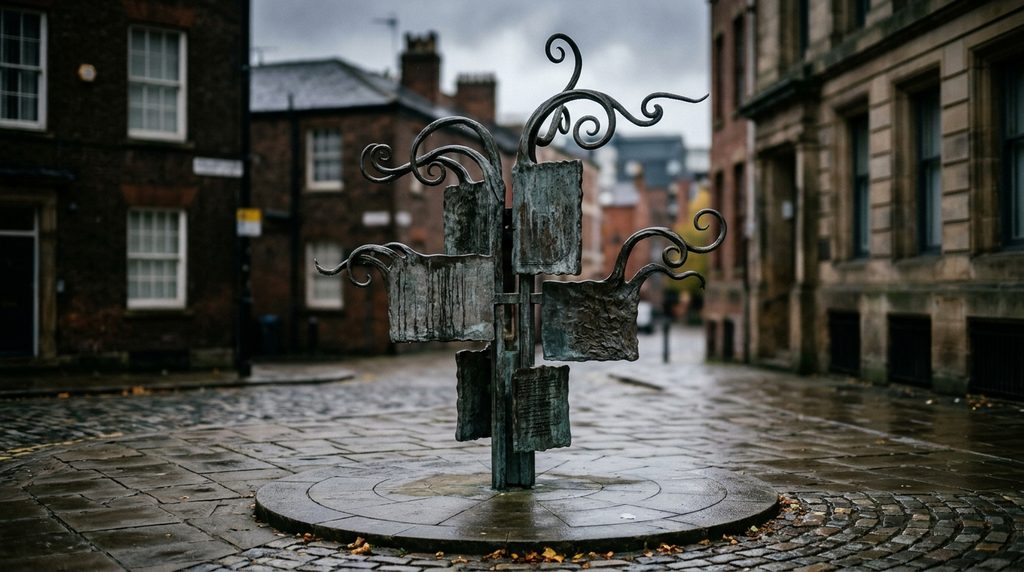
An overlooked public sculpture that originally rose from a disc in the pavement. Strange tendrils curl from the tops of its plaques.
→ Three more weird outdoor & roadside oddities in Manchester, UK — never the same twice
The story
In 1990, the Central Manchester Development Corporation commissioned environmental arts group Partnership Art Limited to build a civic gateway monument for the entrance to Manchester Piccadilly station. The core design team—Diane Gorvin, Phil Bews, Terry Eaton, and Tracey Cartledge, working alongside art students from nearby Shena Simon College—originally dreamed up an industrial chimneystack that would cast three monumental bronze "shadows" across the retaining wall behind it. The central chimney was eventually abandoned before construction, leaving behind only the three cast-bronze panels and a metal lighting disc set into the pavement marking the exact spot where the phantom stack should have stood.
Rather than producing another celebratory monument to Victorian rail barons or local industry, the group cast something genuinely haunting. Fabricated by Castle Fine Arts Foundry, the three soot-darkened panels depict the endless flow of commuters and drifters who have passed through the terminus since Store Street station first opened here in 1842. Look closely at the textured surface and you will not find heroic pioneers: pressed directly into the metal alongside real boot treads and handprints from the local students are anguish-contorted faces and hollow-eyed figures struggling to claw free from the bronze, crowned by strange organic tendrils curling off the top edges.
Set into the flagstones at your feet is the bronze wheel, inscribed in the centre as a dedication to everyone who ever passed through Piccadilly. Encircling the rim is a verse penned by Cartledge evoking "expressionless faces" and travelers "confused by directions, subject to regulations." As decades passed and the Development Corporation wound down, the city did what it often does with uncomfortable public art: it ignored it. The pavement up-lighters died, street grime settled into every pore, and telecoms contractors eventually dumped grey utility cabinets right against the panels, turning a dark psychological meditation on modern commuting into overlooked station background noise.
What it's like
You will find the panels mounted against the concrete retaining wall along London Road, tucked directly underneath the sloping roadway of Station Approach where taxis peel up toward Piccadilly's main concourse. There are no spotlights or interpretive signs—just the roar of London Road bus traffic at your shoulder and utility boxes crowding the plinths. The bronze disc embedded in the pavement is unlit and scuffed dull by passing feet, but take a few quiet minutes to study the bronze relief up close. The depth of the casting—with its screaming faces, actual shoe treads, and creeping tendrils—feels startlingly eerie in broad daylight.
The move: Stand beneath the Station Approach roadway on London Road to trace the strange bronze tendrils curling from these overlooked concrete-wall plaques and locate the forgotten disc set in the pavement.
- 📍 Manchester
- 💸 Free
- ⚡ Up for anything
- 🌗 Outdoors
Where: London Road, Manchester (near Manchester Piccadilly station / Station Approach)
Hours: Added 2026-11-20 — confirm current hours before you go.
Pair it with
- A Monument to Vimto — A ten-minute walk south past the railway arches brings you to Granby Row, where you can trade Piccadilly's bleak existential bronze for an absurd, oversized carved wooden bottle honoring Manchester's favourite fruit cordial.
- Dreadnowt — Keep following Manchester's weirdest outsider sculptures north to Collyhurst, where a massive steel submarine hull appears to sink nose-first into the lawn outside a paint factory.
- Chetham's Library & Medieval Cloister — Hop on the train or tram across the city centre to trade the roar of London Road's commuter traffic for the sandstone cloisters of Britain's oldest public reference library.
More weird in Manchester, UK

Good to know
Where exactly is the Journey sculpture located?
It is mounted directly to the concrete retaining wall on London Road, positioned right beneath Station Approach—the ramp that carries vehicles and pedestrians up to Manchester Piccadilly station's main entrance.
Who created the sculpture and when?
It was commissioned in 1990 by the Central Manchester Development Corporation and created by Partnership Art Limited (Diane Gorvin, Phil Bews, Terry Eaton, and Tracey Cartledge) in collaboration with students from Shena Simon College, cast by Castle Fine Arts Foundry.
What does the text on the pavement disc say?
The inner circle dedicates the artwork to everyone who has passed through Piccadilly, while the outer rim reads: 'PATHS AND PACES. EXPRESSIONLESS FACES. FRAMED IN TIME. CONFUSED BY DIRECTIONS. SUBJECT TO REGULATIONS. EACH CHOOSE YOUR OWN LINE. BUT THERE’S NO PRESSING OBLIGATION. OBSERVE YOUR INCLINATION. TOWARD WHATEVER DESTINATION. THIS IS YOUR PASSAGE THROUGH TIME.'
Why does the installation look neglected?
After the Central Manchester Development Corporation dissolved in 1996, the sculpture fell between institutional jurisdictions. The built-in pavement lights were never rewired, roadside ivy temporarily covered sections, and roadside utility boxes were later installed directly in front of the panels.
Plan a visit & invite your people →
Further reading: Atlas Obscura · whatdotheyknow.com · traceycartledge.co.uk · gerwyn.uk
last checked: 2026-11-20