Entry No. 35 — the Montreal, QC file — filed under: miscellanea
Church of the Madonna della Difesa
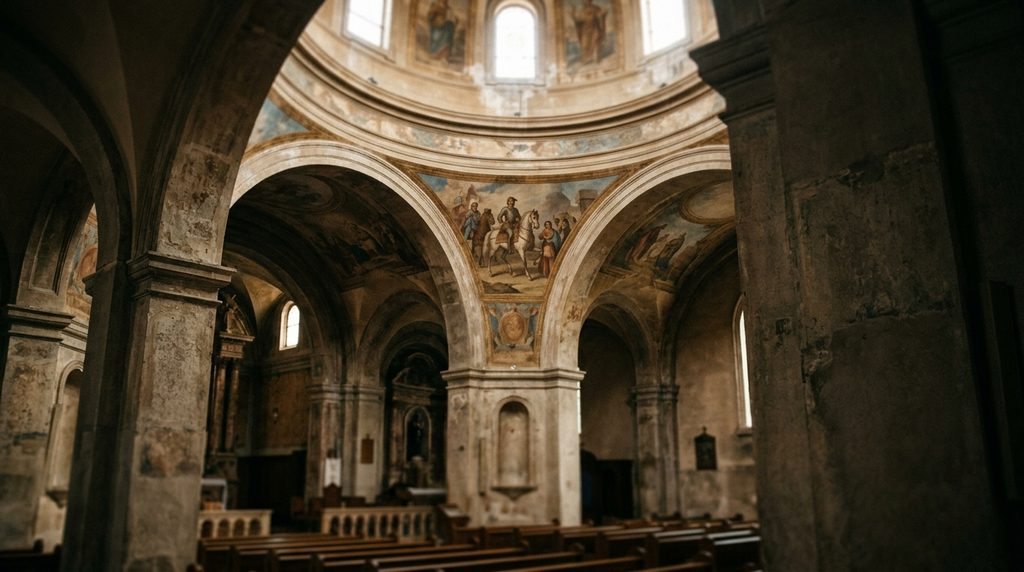
The dome fresco has a striking historical detail: Benito Mussolini appears on horseback alongside some of his associates.
→ Three more weird outdoor & roadside oddities in Montreal, QC — never the same twice
The story
In 1919, Italian immigrants from the Molise region consecrated the Church of the Madonna della Difesa on the corner of Henri-Julien and Rue Dante. To adorn the soaring interior, the parish turned to Guido Nincheri, a Florentine-trained immigrant dubbed 'the Michelangelo of Montreal' for his mastery of traditional wet-plaster fresco. Between 1927 and 1933, Nincheri covered the apse vault with sweeping theological and historical scenes, culminating in a tribute to the 1929 Lateran Treaty—the landmark accord that reconciled the Kingdom of Italy with the Holy See and established Vatican City as an independent sovereign state.
At the insistence of the parish priest and church building committee—and over Nincheri’s reported personal resistance—the artist was instructed to incorporate the secular signatories into the sacred composition. Looming in the lower-right quadrant of the apse vault, sitting rigidly astride a dark horse in full military uniform, is Benito Mussolini, surrounded by the fascist quadrumvirs of the 1922 March on Rome and radio pioneer Guglielmo Marconi. In 1933, years before World War II and the Axis alliance, many diaspora Italians and Quebec church leaders viewed Il Duce not as a pariah, but as the statesman who had restored dignity and legal independence to the Pope.
The depiction proved disastrous for Nincheri once war arrived. In 1940, after Canada declared war on Italy, the RCMP arrested the artist and interned him at Camp Petawawa in Ontario under suspicion of fascist sympathies; he was only released after three months when his wife unearthed original preparatory sketches proving the church elders had compelled him to paint the dictator. For the duration of the war, federal authorities kept a canvas tarp pinned over Mussolini's likeness. Despite recurring public debate, the painting was never scrubbed, and the building was designated a National Historic Site of Canada in 2002—preserving one of North America's most jarring geopolitical artifacts directly over a Catholic altar.
What it's like
This is an active neighborhood Catholic parish, so time your visit outside of Sunday masses and slip in quietly through the heavy brick Romanesque facade on Rue Dante. The church interior is remarkably luminous, rich with Nincheri's stained glass and ornate plasterwork, but spotting the dictator requires craning your neck toward the apse behind the main altar: scan the lower-right curve of the great half-dome below Pope Pius XI, where Mussolini sits on horseback. You will not find interpretive plaques directing your gaze to him, and the surrounding neighborhood treats the fresco with matter-of-fact familiarity, often paired with a post-visit stop for cannoli across the street at Pasticceria Alati-Caserta.
The move: Slip in quietly from Rue Dante outside Sunday Mass, then crane your necks toward the lower-right curve of the fresco behind the main altar and see who spots Mussolini on horseback first.
- 📍 Little Italy, Montréal
- 💸 Free
- ⚡ Up for anything
- 🌗 Outdoors
Where: 6800 Henri-Julien Avenue, Montréal, QC H2S 2V4, Canada
Hours: Added 2026-11-20 — confirm current hours before you go.
Pair it with
- Crocodile — Follow an inspection of contentious ecclesiastical art with a cocktail hidden behind a false door inside Little Italy's Alambika boutique, just a five-minute walk away.
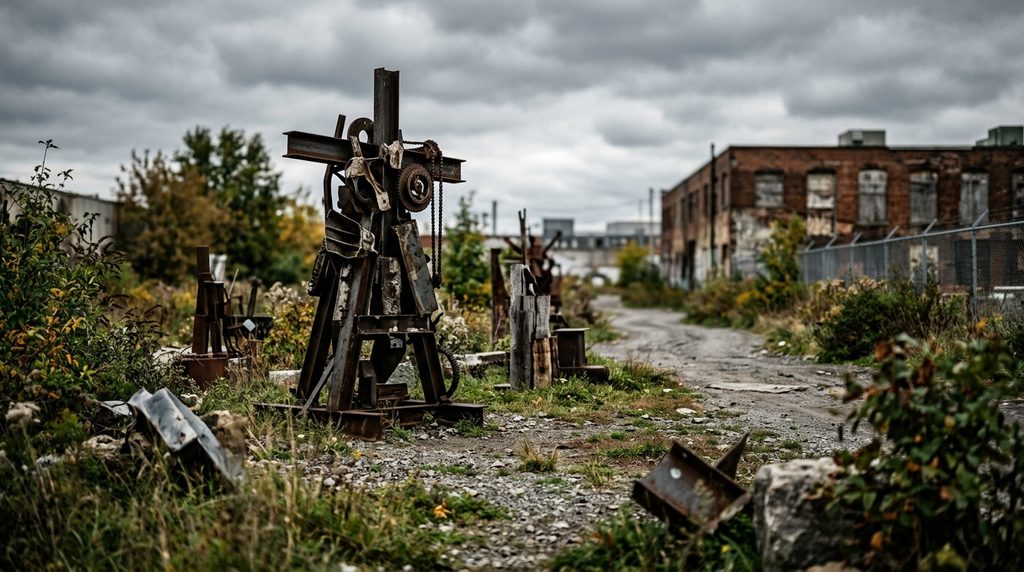
- Twilight Sculpture Garden — Walk six blocks west across the railway line to trade gilded church vaults for Glen LeMesurier’s dense, open-air labyrinth of reclaimed scrap-metal sculptures.
- Spa Ovarium — Clear the cognitive dissonance of spotting an Italian dictator above an altar by floating in an Epsom-salt egg capsule four blocks east near Beaubien métro.
More weird in Montreal, QC
Good to know
Why is Benito Mussolini painted inside a Catholic church?
The fresco commemorates the 1929 Lateran Treaty, which established Vatican City as an independent sovereign state. When the mural was completed in 1933, prior to World War II, the Italian diaspora and church authorities viewed Mussolini favorably for restoring church-state peace.
Did the artist get arrested for painting the fresco?
Yes. In 1940, following Canada's entry into World War II against Italy, the RCMP arrested Guido Nincheri and interned him at Camp Petawawa in Ontario. He was released after three months when his family produced design drafts proving the parish trustees had mandated the portrait.
Was the painting ever covered or removed?
During World War II, authorities hung a blank canvas over Mussolini's figure to suppress pro-Axis sentiment. Despite post-war petitions calling for its removal, it was never erased and is now protected under the church's National Historic Site designation.
Where in the sanctuary do you look to see it?
Look up at the vault of the apse directly behind and above the high altar. Mussolini is shown on horseback in the lower-right area of the painting, underneath the seated figure of Pope Pius XI.
Plan a visit & invite your people →
Further reading: mtl.org · pc.gc.ca · ville.montreal.qc.ca · lonelyplanet.com · thecanadianencyclopedia.ca · cbc.ca
last checked: 2026-11-20