Entry No. 34 — the Orlando file — filed under: railroad-ephemera
Central Florida Railroad Museum
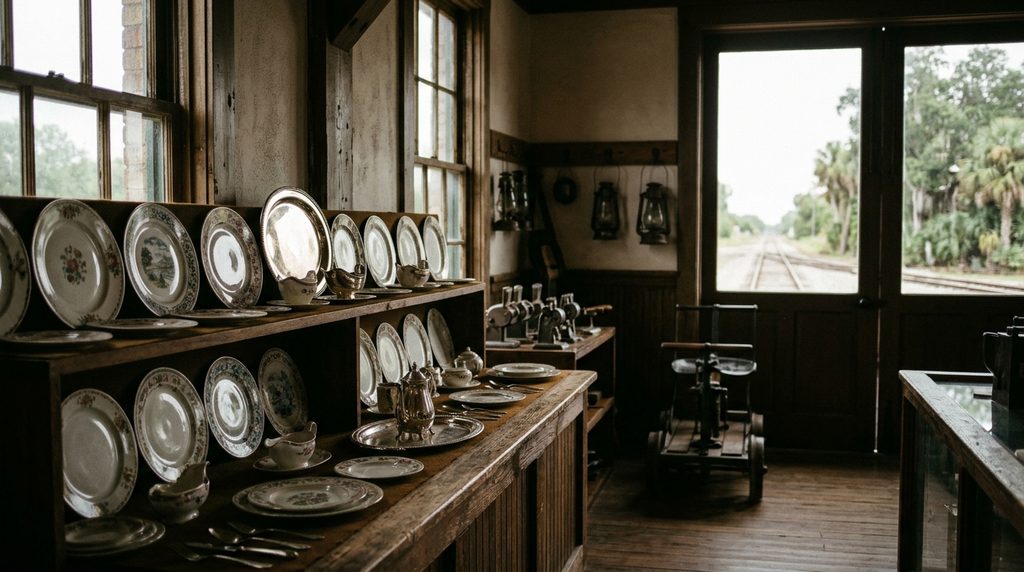
Operated by volunteer rail historians inside a restored 1913 Tavares & Gulf train depot, this unassuming museum houses a massive, hyper-niche collection of authentic dining car china and silver service from over 25 vanished rail lines. The displays also pack in historic ticket-punchers, kerosene signal lanterns, hand-pump speeder carts, and Florida citrus rail logistics archives.
→ Three more unusual museums & collections in Orlando — never the same twice
The story
In 1913, the Tavares & Gulf Railroad—affectionately nicknamed the 'Tug & Grunt' by locals for its wheezing, unhurried pace through West Orange citrus groves—opened a utilitarian depot on Boyd Street. When passenger traffic vanished and the orange crates stopped rolling onto the freight docks, the depot was abandoned to the Florida humidity. In 1979, the local chapter of the National Railway Historical Society bought the rotting shell from Seaboard Coast Line, poured four years of elbow grease into the pine floors and freight doors, and opened the Central Florida Railroad Museum in 1983.
What makes this depot deeply peculiar isn't just the rusted track spikes or the 1938 Fairmont motorcar parked in the room. The real obsession here is porcelain. Inside sits one of the country's largest public assemblies of dining car china and silver service, largely donated from the private hoard of Chapman S. Root, whose family made their fortune patenting the iconic contoured Coca-Cola bottle. Root spent decades chasing down the branded ceramic patterns of dead railroads, amassing plates, finger bowls, and heavy silver pots engineered with weighted bottoms so soup wouldn't slosh onto passengers barreling down the line at seventy miles per hour.
Behind the display vitrines, the volunteer docents preserve an era when rail logistics governed the entire Florida interior. Alongside telegram keys and ticket punches with proprietary line cutouts, you will find archives tracking the citrus routing wars and fragile survivors of passenger fleets whose names—like the Atlantic Coast Line and Florida East Coast—have long since been swallowed by corporate mergers.
What it's like
Step off Plant Street and leave the craft-brewery crowds behind; the depot is a block south, smelling faintly of creosote and aged timber. A volunteer docent—often an impassioned local historian or retired railhand—will likely greet you the moment the screen door creaks shut and happily spend twenty minutes decoding signal lanterns or explaining why dining car china had to be twice as thick as normal earthenware. Outside on the rails sits red Clinchfield caboose #1073, while inside holds a working telegraph desk and a velocipede handcar. The entire footprint takes under an hour to explore, but keep an eye on the clock: they shut the doors sharply at 3:00 PM.
The move: Browse the intricate porcelain plate patterns once used on historic luxury streamliners, then step outside to walk the adjacent rails along Plant Street in historic downtown Winter Garden.
- 📍 Winter Garden
- 💸 $
- ⚡ Up for anything
- 🌗 Indoors
Where: 101 S. Boyd St, Winter Garden, FL 34787
Hours: Added 2026-11-07 — confirm current hours before you go.
Pair it with
- The Stillroom — Walk one block north from the depot tracks to find an old-world herbal apothecary tucked quietly on the second floor above Plant Street.
- Maya SpeakTiki (inside Agave Bandido, Hamlin) — Head south down into Hamlin to trade vintage locomotive silver for tropical tiki drinks concealed behind a faux tequila shelf.
- The Presidents Hall of Fame — Drive fifteen minutes west on Highway 50 to follow small-town rail history with a surreal, vintage roadside shrine of presidential wax figures and miniatures.
More weird in Orlando
Good to know
How much does it cost to enter?
Admission is completely free, though the volunteer-run society relies on cash donations and memberships to maintain the collection and the 1913 depot.
What are the operating hours?
The museum is open Tuesday through Friday from 11:00 AM to 3:00 PM, and Saturday from 10:00 AM to 3:00 PM. It is closed Sunday and Monday.
Are there real trains on display, or is it just ephemera?
Both. Inside you can examine an antique velocipede handcar and a 1938 Fairmont motor speeder, while Clinchfield Railroad cupola caboose #1073 sits on display on the tracks outside.
What is the story behind the china collection?
It features nearly thirty distinct patterns representing dozens of defunct North American rail lines, largely gifted by the Chapman S. Root family of Coca-Cola bottling fame.
Plan a visit & invite your people →
Further reading: cfrhs.org · Atlas Obscura · downtownwg.com · wgfl.gov · orangeobserver.com
last checked: 2026-11-07