Entry No. 50 — the Orlando file — filed under: observatory
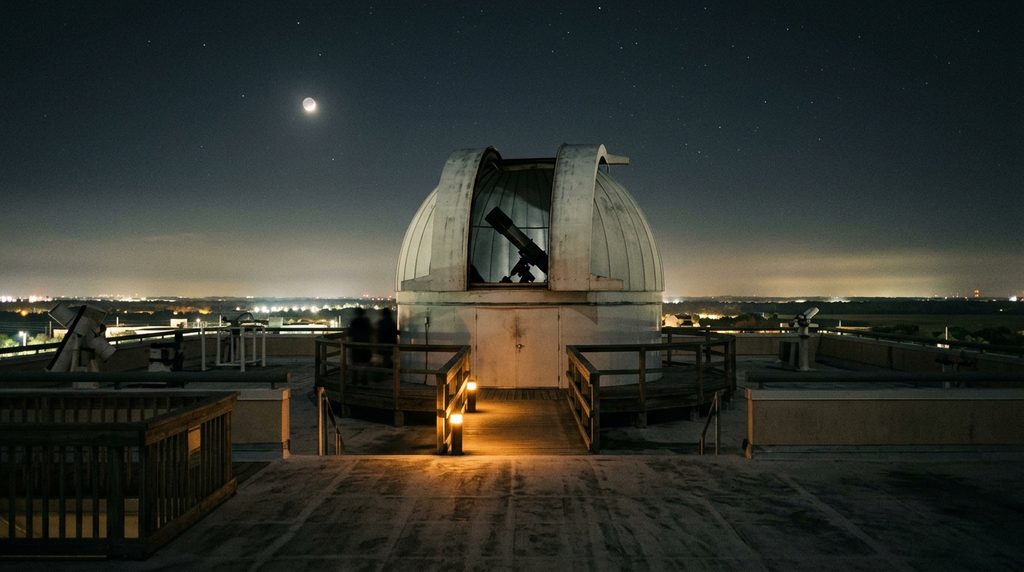
Crosby Observatory at Orlando Science Center
Perched atop the Science Center, this rooftop observatory houses Florida’s largest publicly accessible 10-inch refractor telescope for viewing planets, galaxies, and deep-sky objects after dark.
→ Three at a time, never the same twice — explore weird Orlando
The story
Most visitors know the Orlando Science Center as a weekend daytime hive of school field trips and hands-on physics exhibits. But if you take the elevator all the way up to Level 6 after dark, the building sheds its family-museum patina. Out on the open roof deck sits the Crosby Observatory, an honest-to-god astronomical dome housing a custom-built 10-inch Byers refractor—the largest refracting telescope in Florida that the public can actually touch an eye to.
Refractor telescopes are mechanical throwbacks. While modern research facilities favor mirrors, this instrument relies on an unbroken column of optics: incoming light strikes a heavy glass lens at the aperture and travels the entire length of a massive steel tube before hitting the eyepiece. Because it relies on focal length rather than folded light paths, the telescope dominates the dome, balanced by counterweights and mounted on a motorized Byers drive that slowly tracks target coordinates across the sky.
While Orlando's urban light pollution washes out faint deep-space nebulae, glass refractors excel at high-contrast planetary and lunar optics. Pointed through the opened dome slit, the 10-inch lens easily slices through Central Florida humidity to resolve the razor-thin rings of Saturn, the shifting cloud belts of Jupiter, and bright binary star systems. When the dome is spinning, staff also roll out an auxiliary battery of 8-inch and 10-inch reflector scopes onto the open-air sky terrace, giving you a wider lens on the night sky against the glowing backdrop of the downtown skyline.
What it's like
Arrive during a scheduled after-hours event—like Stellar Nights or the 21-and-up Science Night Live—and bypass the dark, quiet museum floors to head straight up to Level 6. The rooftop terrace is dimly lit with red-filtered safety lights to protect night vision, with visitors mingling outside around portable reflector telescopes while taking turns entering the rotating dome. The catch is Florida weather: the observatory operates strictly weather-permitting, and high humidity, cloud ceilings, or passing rain will shut the dome slit immediately to protect the optics. Check the satellite feed before heading out, and line up for the primary refractor eyepiece early in the evening, as staff deliberately recalibrate the tracking between viewers.
The move: Attend a Stellar Nights or Science Live evening (open until 10pm on select Fridays/Saturdays) to peer through the refractor at Jupiter’s moons or nebulae, then catch a laser show in the newly renovated 8K Dome planetarium.
- 📍 Loch Haven
- 💸 $
- ⚡ Low-key
- 🌗 Outdoors
Where: 777 E Princeton St, Orlando, FL 32803
Hours: Added 2026-11-07 — confirm current hours before you go.
⚠ Seasonal or scheduled — always check before you go.
Pair it with
- The Imperial at Washburn Imports — A four-minute hop south in Ivanhoe Village, this working Southeast Asian import showroom transforms after dusk into an eccentric neighborhood watering hole tucked among teak daybeds.
- The Mennello Museum of American Art — Located right across Loch Haven Park on the shore of Lake Formosa, it pairs contemplative outdoor sculpture walking with the world's largest collection of Earl Cunningham folk paintings.
- NOIR (hidden inside Talay) — Drive a mile south into the North Quarter after the telescope deck closes to grab a late drink behind an unmarked door inside a Thai restaurant.
More weird in Orlando

Good to know
When can the public actually use the telescope?
The observatory does not operate on an everyday walk-in schedule. Viewing takes place during ticketed evening programs like Stellar Nights and adult Science Night Live dates, as well as daytime 'SunWatch' sessions on select first Saturdays using protective solar filters.
What happens if the weather turns cloudy or it rains?
All observatory viewings are weather-permitting. If heavy cloud cover rolls in or rain threatens, the dome slit stays shut to protect the 10-inch glass optics, and the evening's programming shifts inside to the planetarium dome or lower exhibit halls.
Can you actually see stars through Orlando's city lights?
You won't spot faint deep-sky galaxies, but refractor telescopes excel at bright, high-contrast objects. You will routinely get sharp views of lunar crater rims, the rings of Saturn, and Jupiter's four Galilean moons right through the urban glow.
Can I visit just the observatory without museum admission?
No. Access to the Crosby Observatory is bundled into specific evening events or daytime general admission on dates when SunWatch programs run.
Plan a visit & invite your people →
Further reading: Official site · littleastronomy.com · Wikipedia · attractionsmagazine.com
last checked: 2026-11-07