Entry No. 18 — the Orlando file — filed under: artist-built environment
Maitland Art Center
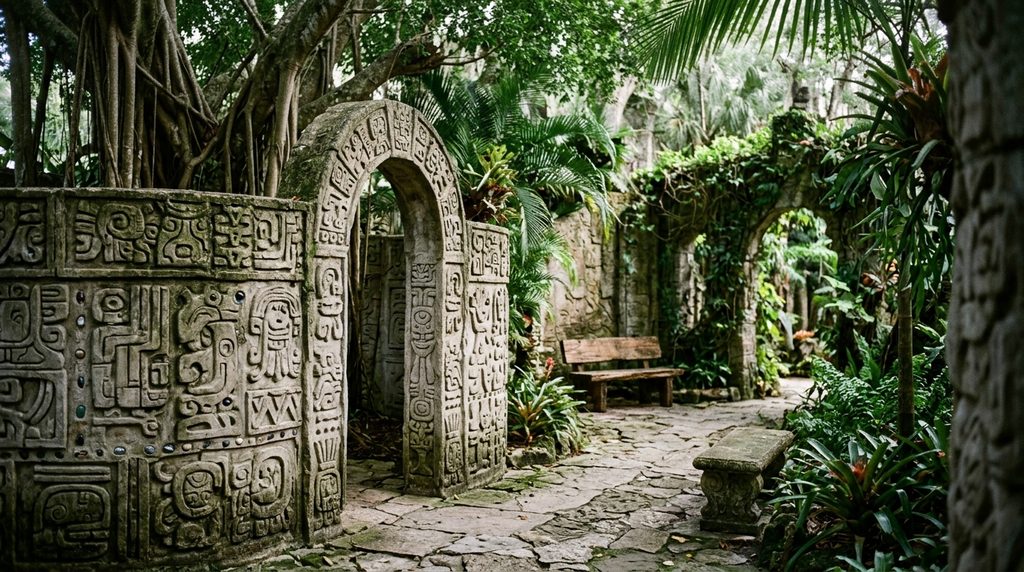
Founded in 1937 by visionary architect and artist Jules André Smith as an experimental art colony, this National Historic Landmark is one of the nation's few surviving compounds of Mayan Revival fantasy architecture. Visitors can walk through secluded courtyards and an open-air chapel covered in more than 200 hand-carved concrete reliefs, Aztec glyphs, and embedded gemstones.
→ Three more immersive & offbeat art in Orlando — never the same twice
The story
In the 1930s, Jules André Smith—a World War I army combat artist who literally designed the Distinguished Service Cross—decided Central Florida needed an escape hatch from conventional academic art. Backed by the deep pockets of Philadelphia philanthropist Mary Louise Curtis Bok, Smith bought up land in quiet Maitland in 1937 to establish 'The Research Studio.' His mandate to visiting winter residents like Milton Avery and Ralston Crawford was blunt: discard mainstream European influences and spend months experimenting in uninterrupted isolation.
To house them, Smith bypassed the region's ubiquitous Mediterranean Revival stucco and built an idiosyncratic compound ripped straight from Mesoamerican fantasy. He, his team, and resident artists poured concrete on-site, carving wet cement directly by hand into hundreds of geometric reliefs, stepped Aztec glyphs, and Mayan totems, accented with embedded stones and experimental paints. The compound culminates in the open-air Chapel of the Primitive Arts, a roofless courtyard framed by carved concrete relief walls and an austere altar, designed not for orthodox liturgy but as a contemplative sanctuary for the colony.
Smith lived and worked on the grounds until his death in 1959. While speculative development devoured much of the surrounding orange groves, the City of Maitland acquired the property in 1969, and it achieved National Historic Landmark status in 2014—one of the only surviving examples of fantasy Mayan Revival architecture in the Southeast. The complex still hosts working studio spaces and resident artists, maintaining the experimental quiet Smith designed it for nearly a century ago.
What it's like
Tucked into a shady residential block off Packwood Avenue, the compound catches you off guard; one minute you're passing standard Florida bungalows, and the next you're hemmed in by mossy live oaks, bamboo groves, and concrete lintels carved with Mesoamerican serpents. Visiting feels more like exploring an abandoned Yucatán ruin garden than touring a sterile white-cube gallery. You can wander freely through narrow breezeways, open-air courtyards, and past the screened windows of active artist studios. The outdoor chapel is the highlight—silent, dappled in tree shade, and filled with intricate bas-relief panels. Note that because the chapel and courtyard are beloved local wedding venues, outdoor access is frequently cordoned off for private events on Friday afternoons and weekends; aim for a weekday morning if you want the ruins to yourself.
The move: Wander the secluded outdoor chapel to trace the mystical geometric reliefs carved directly into the courtyard walls, then grab a quiet stone bench beneath the subtropical trees.
- 📍 Maitland
- 💸 $$
- ⚡ Up for anything
- 🌗 Indoors
Where: 231 W. Packwood Ave., Maitland, FL 32751
Hours: Added 2026-11-07 — confirm current hours before you go.
Pair it with
- Telephone Museum (Art & History Museums — Maitland) — Just steps away on the same museum network campus, pivot from Smith's mystical concrete carvings to a collection of vintage local switchboards and antique crank telephones.
- Permanent Vacation — Located barely half a mile away, chase a daylight stroll through 1930s Mayan fantasy architecture with tropical rum drinks hidden behind the kitchen doors of a neighborhood sports bar.
- Enzian Theater — Less than a mile down the road, follow an afternoon of shaded courtyard exploration with an indie feature or cult screening beneath Enzian's moss-hung oak grove.
More weird in Orlando
Good to know
Why is there Mayan Revival architecture in Central Florida?
Founder Jules André Smith was captivated by indigenous Mesoamerican geometry and pre-Columbian motifs, deliberately rejecting European classical architecture in favor of an indigenous, mystical aesthetic for his winter arts laboratory.
Can I see working artists on site?
Yes. The center continues its original mission as a working art colony through its Artist-in-Residence and Studio Residency programs, meaning you'll often see modern painters, sculptors, and ceramists at work in the courtyard outbuildings.
Is the outdoor chapel always accessible?
Not always. The open-air chapel is one of the area's most sought-after outdoor wedding and private event spaces. If an event is scheduled, access to the chapel courtyard will be closed to general visitors, so check the museum calendar or call ahead before dropping in on a weekend.
Plan a visit & invite your people →
Further reading: artandhistory.org · nps.gov · irmadev.nps.gov · orlandoarchitecture.org · Wikipedia
last checked: 2026-11-07