Entry No. 62 — the Pensacola & Emerald Coast file — filed under: miscellanea
Big Lagoon State Park
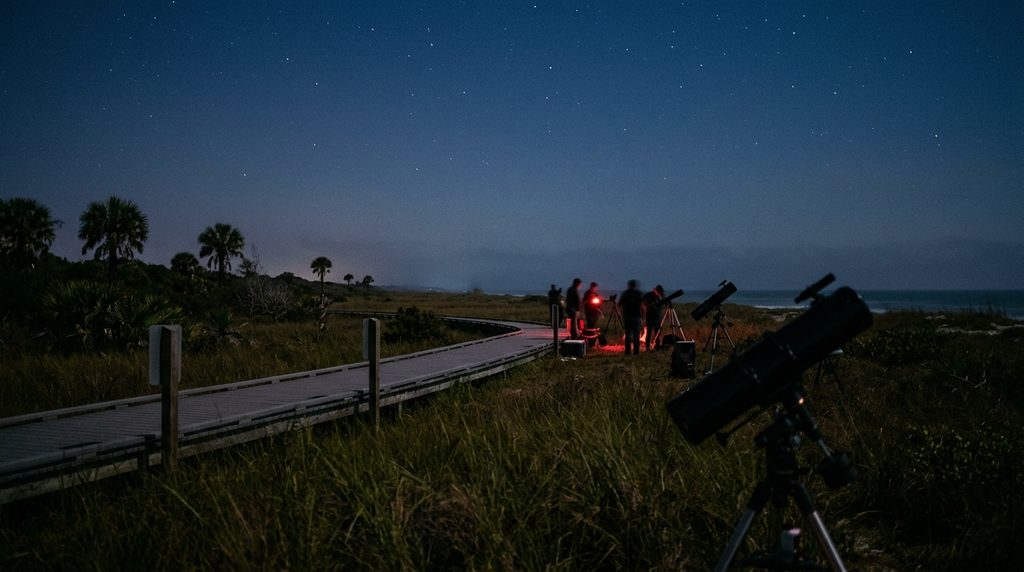
Recognized as one of the darkest sites on the Gulf Coast reachable by car, the park hosts public summer star gazes with the Escambia Amateur Astronomers Association.
→ Three more after-dark & night-sky spots in Pensacola & Emerald Coast — never the same twice
The story
Most of the Florida Panhandle is an uninterrupted wash of beachfront high-rises and sodium vapor lights, but the southern fringe of Escambia County keeps an accidental dark-sky refuge. Big Lagoon State Park sits on the mainland shore just north of Perdido Key, wrapped in 705 acres of pine flatwoods, saltwater marshes, and historical dune ridges. Because its shoreline gazes directly south over open tidal waters rather than resort strips, it ranks among the darkest coastal skies on the northern Gulf you can reach on four wheels.
That natural light shield has made the park home turf for the Escambia Amateur Astronomers Association. On moonless or third-quarter moon weekends from spring through autumn, club members roll into the boat ramp parking lot hauling big Dobsonians, solar telescopes, and computerized trackers. Instead of keeping their optics private, they host free public deep-sky sessions—pointing green lasers at nebulae and star clusters, handing out star maps, and showing visitors how to capture the Milky Way on ordinary smartphone cameras.
By day, the park doubles as the western terminus—Mile 0—of the 1,515-mile Florida Circumnavigational Saltwater Paddling Trail, marked near the kayak launch by the bow of a sea kayak buried upright in the sand. But once night falls and daytime kayakers clear out, the pine scrub turns pitch-black, leaving the boat basin illuminated only by red headlamps and starshine reflecting off the lagoon.
What it's like
Arrive well before dusk, because the ranger gate locks promptly at sunset and tardy drivers get shut out, astronomy event or not. You'll pay the state park entry fee, motor down toward the boat ramp, and find club members balancing heavy tripods on the asphalt while the sun drops behind the marsh. The atmosphere is quiet, nerdy, and welcoming: expect seasoned observers sharing eyepieces and pointing out Saturn's rings or globular clusters to anyone who asks. Coastal bugs in the marsh do not mess around, so slather on insect repellent before stepping out of the car. Bring a folding lawn chair and a flashlight equipped with a red filter or red-light setting so you don't ruin everyone's night vision.
The move: Get through the gate before sunset for a public stargaze, watch the light drop behind the marsh, then take turns at a Dobsonian eyepiece in the boat ramp lot.
- 📍 Pensacola
- 💸 $
- ⚡ Low-key
- 🌗 Outdoors
Where: 12301 Gulf Beach Highway, Pensacola, FL 32507
Hours: Added 2026-11-17 — confirm current hours before you go.
Pair it with
- Tarkiln Bayou Preserve State Park — Just four miles north, trade night skies for daytime botanical oddities along boardwalks protecting endangered carnivorous white-topped pitcher plants.
- Pensacola Lighthouse & Maritime Museum — Climb 177 spiral cast-iron steps for elevated daytime views of the coast before heading to Big Lagoon's boat ramp after sunset.
- Bamahenge — Cross the Alabama state line to inspect a full-scale fiberglass replica of Stonehenge hidden in the pine woods before settling in for evening astronomy.
More weird in Pensacola & Emerald Coast
Good to know
When do the public star gazes take place?
The Escambia Amateur Astronomers Association generally schedules sessions once a month from spring through autumn, specifically targeting weekends around the third-quarter or new moon to ensure the darkest skies.
Can I enter the park after dark if the event is underway?
No. The main park gate closes at sunset. You must arrive and pass through the gate before closing time to attend; staff will let vehicles exit when the event wraps up.
Do I need to own a telescope to participate?
Not at all. EAAA astronomers bring high-powered scopes for the public to look through and will teach you how to spot constellations or take long exposures on your phone.
How much does it cost?
The stargazing sessions are free, but standard Florida State Park admission applies at the gate ($6 per vehicle with two to eight passengers, or $4 for single-occupant vehicles).
Plan a visit & invite your people →
Further reading: skyandtelescope.org · Official site · visitpensacola.com · wuwf.org · sites.google.com
last checked: 2026-11-17