Entry No. 35 — the Pensacola & Emerald Coast file — filed under: miscellanea
Man in the Sea Museum
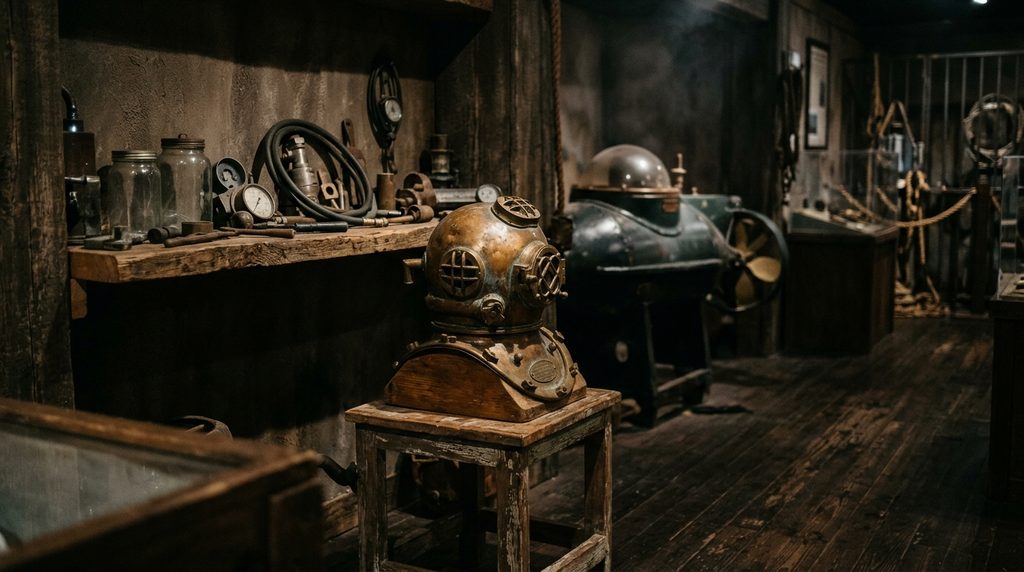
This hyper-focused museum explores the history and evolution of diving technology. Its quirky underwater collection features submarines, vintage diving equipment, and historic undersea artifacts.
→ Three more unusual museums & collections in Pensacola & Emerald Coast — never the same twice
The story
Panama City Beach is better known for airbrushed t-shirts and spring break debauchery than deep-sea engineering, but just off Highway 98 sits a strange, quiet compound that tells an entirely different story. The Naval Support Activity base and the Navy Experimental Diving Unit just down the road made this corner of the Panhandle the de facto capital of military and experimental deep saturation diving. In 1977, a cadre of Navy aquanauts and commercial divers formed the Institute of Diving, opening the Man in the Sea Museum five years later in 1982 to house the bizarre machines they had used to conquer the benthic abyss.
The crown jewel of the collection is parked right outside on the grass: SEALAB I. In 1964, Navy doctor Capt. George F. Bond bolted two surplus anti-submarine net floats together into a 40-foot steel cylinder, submerged it 193 feet beneath the waves off Bermuda, and sent four aquanauts inside to live and work for eleven days. It proved humans could survive saturation diving under immense atmospheric pressure, and today, you can duck inside its claustrophobic, fully restored hull. Next to it sits the Beaver IV, a canary-yellow deep-sea work submersible from the late 1960s with robotic manipulator arms that you can actually climb through.
Inside the unassuming main hall, the collection ditches museum polish in favor of raw, obsessive provenance. Glass cases crowd each other with heavy copper-and-brass Mark V diving helmets, experimental rebreathers, 16th-century shipwreck treasure, and the U.S. Navy Deep Dive System Mark 1. It is a tactile, unpretentious monument to the extreme mechanical ingenuity required to keep fragile human lungs from collapsing hundreds of feet beneath the surface.
What it's like
You will pull into a nondescript gravel and paved lot right off Panama City Beach Parkway, greeted immediately by giant decompression chambers and retired submersibles sitting in the Florida sun. Inside, the single-story building smells faintly of old rubber, hydraulic oil, and paper. It is completely self-guided and low-stress, staffed largely by knowledgeable volunteers who often have personal ties to Navy or commercial diving. Don't skip trying to lift the weighted deep-sea diving boots on display, and budget forty minutes to watch the archival documentary on the SEALAB project before you walk outside to explore the actual pod.
The move: Size up the giant decompression chambers in the sun, then stand beside the 40-foot steel SEALAB I and imagine sharing that cylinder 193 feet below the surface.
- 📍 Panama City Beach
- 💸 $
- ⚡ Up for anything
- 🌗 Indoors
Where: 17314 Panama City Beach Parkway, Panama City Beach, FL 32413
Hours: Added 2026-11-17 — confirm current hours before you go.
Pair it with
- Underwater Museum of Art — After touring the dry, experimental habitats where aquanauts pioneered saturation diving, hire a dive boat out of Grayton Beach to explore an actual art museum resting 60 feet down on the Gulf floor.
- Panama City Publishing Company Museum — Cross the bridge to downtown Panama City to trade deep-sea pressure valves for clanking 19th-century letterpress machines in another fiercely preserved machinery archive.
- El Weirdo — Decompress after hours of industrial military diving history with cold craft brews and tacos in a chaotic, neon-drenched Panama City art compound.
More weird in Pensacola & Emerald Coast
Good to know
Can you actually go inside the submersibles and underwater habitats?
Yes. Visitors can step inside the historic SEALAB I habitat and climb into the Beaver IV submersible, though anyone uncomfortable with tight, industrial hatches and narrow steel corridors should proceed with caution.
How long does a visit usually take?
Plan on 90 minutes to two hours. That leaves enough time to browse the indoor artifacts, try on the vintage gear, and watch the archival documentary detailing the Navy's saturation diving experiments.
Is the museum accessible for people with mobility challenges?
The main indoor museum exhibits and restrooms are on a single level with paved access, but climbing inside the outdoor submersibles like SEALAB I and Beaver IV requires navigating narrow ladders, steep steps, and tight marine hatches.
Plan a visit & invite your people →
Further reading: scenicsir.com · wjhg.com · panamacity.gov · Official site · YouTube · florida-backroads-travel.com
last checked: 2026-11-17