Entry No. 41 — the San Angelo & Abilene file — filed under: miscellanea
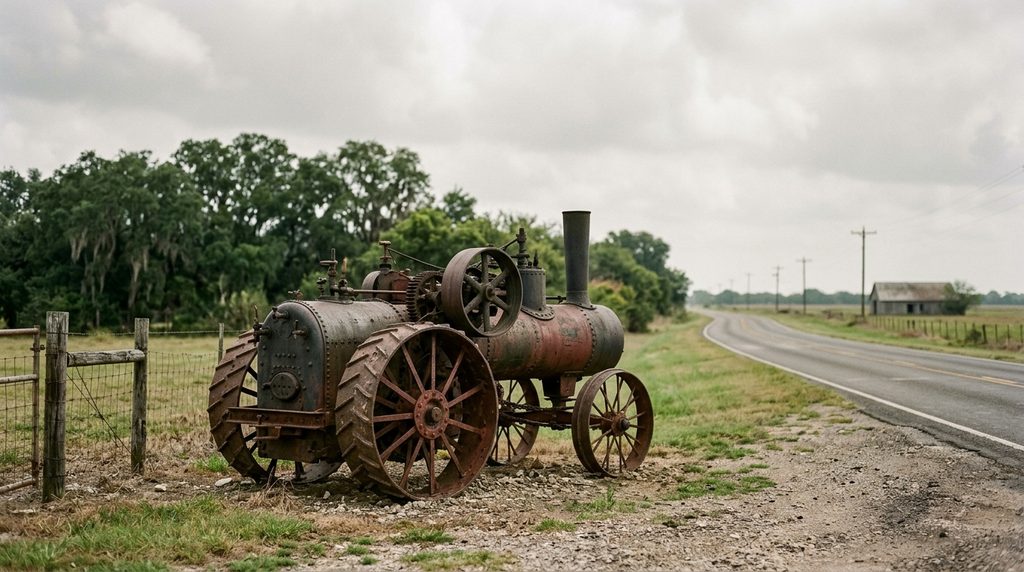
1909 Advanced Rumley Tractor
A tractor dating to 1909 sits on display along U.S. Highway 67.
→ Three more weird outdoor & roadside oddities in San Angelo & Abilene — never the same twice
The story
Ripping down U.S. Highway 67 between San Angelo and Ballinger, you're traversing typical Runnels County cotton country when a hulking, soot-green iron leviathan rises out of the scrub right at the town limits of Miles. This is an authentic 1909 Advance-Rumely OilPull tractor, a 24,470-pound mechanical monster that once lumbered across these open fields at a breakneck top speed of precisely 2.5 miles per hour.
At the dawn of internal combustion, most tractors were cantankerous contraptions prone to seizing or boiling over under the blistering Texas sun. The Rumely solved this with an ingenious, patented cooling design: its massive front radiator circulated heavy oil instead of water, allowing the engine to run scorching hot without boiling dry or freezing during a winter norther, while drinking a crude mix of cheap kerosene and injected water. This specific brute was owned by Frank Schwertner—an Austrian immigrant who arrived in Texas in the 1870s, established the Williamson County town of Schwertner, and later farmed the Runnels County plains. Schwertner didn't just use its crushing torque to break tough caliche sod and thrash grain; locals routinely hitched it to chains to grade public dirt roads and literally haul entire wooden houses across town.
The tractor took its last working gulp of kerosene in 1925, three years before Schwertner died. After decades rusting away in open pastures, town preservationists dragged the 12-ton beast up to the blacktop shoulder, where it now sits permanently parked as a silent, monolithic testament to the raw muscle that dragged West Texas farming out of the horse-drawn era.
What it's like
This is roadside Texas at its most unvarnished: there are no turnstiles, ticket booths, or museum ropes, just a dirt-and-gravel pull-off on the northern shoulder of Highway 67 where you can park your car right next to the machine. You can walk right up to the massive cleated steel wheels and examine the square exhaust-cooling tower up close, but keep in mind that the iron gets skin-blisteringly hot by midday in the summer. Traffic blows past at 70 miles per hour just yards away, so watch your car doors and keep a tight grip on children and dogs.
The move: Pull off Highway 67 in Miles, take turns posing beside the cleated steel wheels, and picture all 24,470 pounds of the 1909 OilPull barreling along at 2.5 miles per hour.
- 📍 Miles
- 💸 Free
- ⚡ Up for anything
- 🌗 Outdoors
Where: U.S. Highway 67, Miles, TX 76861
Hours: Added 2026-11-17 — confirm current hours before you go.
Pair it with
- 1886 Olde Park Hotel — Continue 17 miles east along Highway 67 into Ballinger to explore a preserved 1886 boarding house and former brothel notorious for paranormal investigations.
- Gonzalez Restaurant — Drive 17 miles east to downtown Ballinger for a plate of Tex-Mex inside a creaky historic storefront rumored to host a wandering cowboy ghost.
- Paint Rock Pictographs (Concho River Bluffs) — Head 16 miles south into Concho County to swap early 20th-century iron for hundreds of ancient Native American red-ochre paintings along the river bluffs.
- Old Central Firehouse — Head 17 miles west into San Angelo to grab a pie topped with sliced pickles inside a converted vintage municipal fire station.
More weird in San Angelo & Abilene


Good to know
Where exactly is the tractor located?
It sits in the open on the northern right-of-way of U.S. Highway 67 on the west side of Miles, Texas, near the entrance to town.
What are the hours and admission costs?
It is completely free to view and accessible 24 hours a day, 365 days a year, though daylight is best if you want to inspect the gearing.
Why did it use oil in the radiator instead of water?
Advance-Rumely's OilPull tractors used oil as a coolant because it operates at higher temperatures without boiling off, kept cylinder walls evenly heated to efficiently burn heavy kerosene fuel, and never froze during winter freezes.
Can you climb up into the operator's platform?
There are no posted guards, but it is an untreated, century-old historic artifact with rusted edges and structural wear; respect the machine, keep your boots on the dirt, and take your photos from the ground.
Plan a visit & invite your people →
Further reading: milestexas.com · texasescapes.com · texashistory.unt.edu · farmshow.com
last checked: 2026-11-17