Entry No. 21 — the San Jose & South Bay file — filed under: miscellanea
Foothill College Observatory
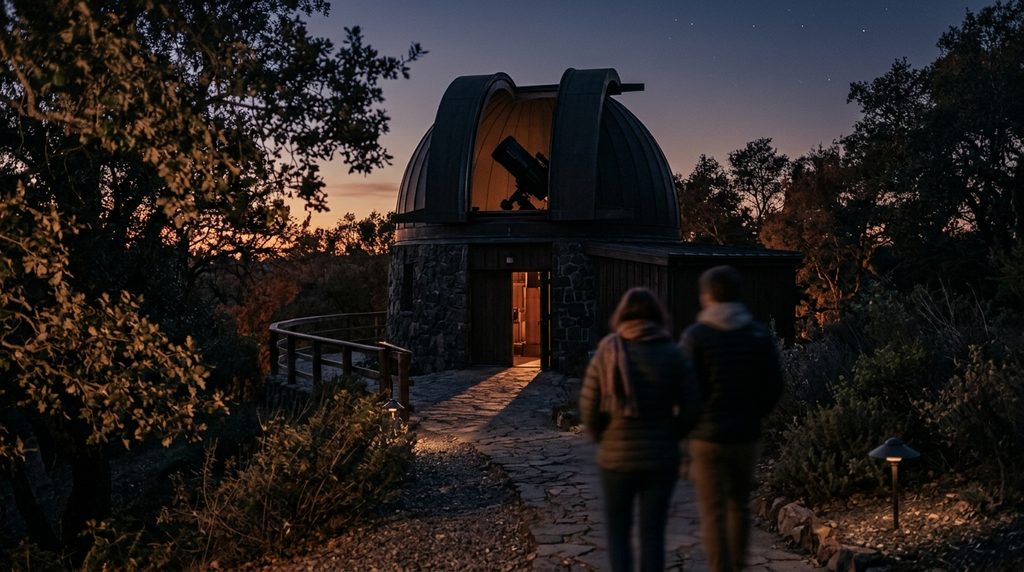
This college observatory opens its dome to the community for free telescope viewing of celestial targets from 9 to 11 p.m. every clear Friday night.
→ Three at a time, never the same twice — explore weird San Jose & South Bay
The story
Perched along the perimeter of Foothill College's mid-century brick-and-redwood campus, this solitary white dome has quietly survived by community stubbornness. Established in 1965, the observatory nearly went dark during 1970s community college budget cuts. Rather than let the campus shutter the facility, the Peninsula Astronomical Society—an obsessive collective of local amateur skywatchers founded in 1949—struck a deal: the society's volunteers would maintain the hardware and run public viewing nights at no charge, keeping the dome in commission for both astronomy students and curious locals.
This is no dusty static museum exhibit; it is a working celestial station with legitimate discovery pedigree. On a chilly November night in 1986, society vice president Bill Sorrells was scanning through the Foothill eyepiece when he spotted an unidentified faint streak that was ultimately cataloged as Comet Sorrells. Today, the centerpiece inside the rotating dome is a computer-guided 16-inch Meade Schmidt-Cassegrain reflector, operated not by paid campus curators, but by devoted amateur astronomers who know every crater on the lunar terminator and every band of Jupiter by heart.
What it's like
You will navigate the quiet, winding campus roads after dark, leave your car in Lot 4 (don't skip the $3 parking permit kiosk or campus security will ticket you), and follow the faint crimson flashlights toward the observatory dome near the Krause Center. Inside, the space is unvarnished, chilly, and illuminated only by soft red safety lights to preserve night vision. As the dome slit groans open to track deep-space targets, volunteer operators direct the 16-inch optics toward the moon's jagged edges, Saturnian rings, or faint open star clusters, happily talking focal lengths and planetary science with anyone in line. If the coastal fog rolls over the Santa Cruz Mountains, call it off—the dome never opens under heavy marine cloud cover.
The move: Go on a clear Friday night, follow the red flashlights from Lot 4 to the white dome, and take turns at the telescope after the dome slit groans open.
- 📍 Los Altos Hills
- 💸 $
- ⚡ Low-key
- 🌗 Outdoors
Where: 4100 Perimeter Road, Los Altos Hills, CA 94022
Hours: Added 2026-11-18 — confirm current hours before you go.
Pair it with
- Rengstorff House — Pair an afternoon walking the preserved, reputedly haunted 1867 Victorian estate in Mountain View with a late-night gaze into deep space from the Los Altos hills.
- South Bay Salt Ponds — Watch the sunset glow across the surreal neon-pink evaporation flats along the bay shoreline before heading into the foothills to peer through the telescope.
- Rosicrucian Egyptian Museum & Alchemy Garden — Spend the afternoon exploring ancient Egyptian star lore, ritual tombs, and alchemy in San Jose before joining modern volunteer astronomers under a working dome.
More weird in San Jose & South Bay
Good to know
How much does it cost to visit?
Public observing sessions are entirely free. Your only expense is a $3 campus parking permit, purchased at the automated machines in Lot 4.
How do I confirm the observatory is open before heading up?
Everything is weather dependent; if there is heavy cloud cover, rain, or thick fog, the dome remains shut. Check the Peninsula Astronomical Society's live Foothill webcam online around 9 p.m. before driving out.
What equipment is used during public viewings?
Night sessions rely on a computer-controlled 16-inch Schmidt-Cassegrain reflector housed inside the dome, occasionally supplemented by members' personal scopes set up outside on the apron.
Do they only operate at night?
No. On clear Saturday mornings from 10:00 a.m. to noon, volunteers open the observatory for public solar viewing using a specialized hydrogen-alpha telescope that reveals sunspots, prominences, and solar flares.
Plan a visit & invite your people →
Further reading: Official site · paloaltoledger.com · Wikipedia · skyandtelescope.org · sfgate.com · pastro.org
last checked: 2026-11-18