Entry No. 34 — the Sierra Vista & Fort Huachuca file — filed under: miscellanea
Camp Naco
Constructed during the 1910 Mexican Revolution under commanders from Fort Huachuca, this historic border site preserves the secret military history of the Buffalo Soldiers.
The story
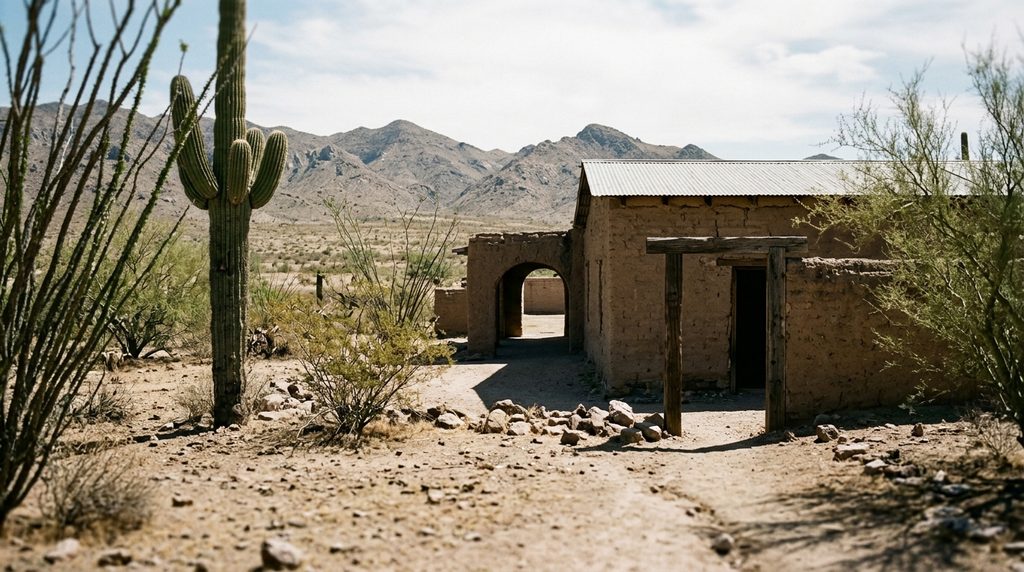
Six hundred yards north of the Mexican border wall sits a cluster of sun-baked adobe buildings that outlived the entire military network they were built to anchor. Between 1910 and 1920, the U.S. War Department established 35 outposts across a 1,200-mile line from Brownsville to Nogales, rattled by Mexican Revolution skirmishes, Pancho Villa's cross-border raids, and the intercepted Zimmermann Telegram proposing a German-Mexican alliance. When the border conflict cooled in 1923, the Army deactivated the camps and tore down virtually every structure to salvage the lumber. Camp Naco alone survived the purge—largely because it was built from sun-dried mud, straw, and caliche rather than dimensional timber, making it entirely pointless to scrap.
The troops stationed here weren't ordinary border sentries. Camp Naco was manned by the segregated 9th and 10th Cavalry and 25th Infantry regiments—the Buffalo Soldiers—operating out of Fort Huachuca roughly 35 miles to the west. While enduring rigid racial segregation in the surrounding territory, these Black regiments patrolled the borderline on horseback and guarded the El Paso & Southwestern railroad corridor, which ferried copper from American-owned mines in Cananea, Sonora, to Arizona smelters. After years of living in a miserable tent city on the desert flat, they finally saw 23 permanent adobe structures completed in 1919, complete with officer quarters, barracks, mess halls, and a hospital.
Decommissioned in 1923, the camp slipped into private hands and began a century-long fight against decay, brushfires, and neglect. It held on thanks to a tenacious twenty-year preservation campaign led by local historians and the Naco Heritage Alliance. In 2022, the National Trust placed Camp Naco on its list of America's 11 Most Endangered Historic Places, unlocking millions in grant funding to save the disintegrating walls. Today, it stands as the only intact, surviving military camp from the Mexican Border Defense Project anywhere in the United States.
What it's like
Camp Naco sits at the quiet edge of the Naco street grid on Newell Street, just north of the railroad tracks and within clear sight of the border boundary. Because the site is undergoing active adobe stabilization and restoration led by the City of Bisbee and preservation teams, the interior buildings and courtyard grounds are typically secured behind a perimeter fence. You can easily pull up and inspect the sprawling layout, barracks lines, and weathered mud brickwork from the surrounding roads without trespassing. If you want to set foot inside the historic compound rather than observing it through the fence line, check the Naco Heritage Alliance schedule in advance for scheduled open houses, history lectures, and volunteer workdays.
The move: Drive up to the perimeter fence six hundred yards from the Mexican border to view the rare sun-dried mud, straw, and caliche barracks built for the historic Buffalo Soldiers.
- 📍 Naco
- 💸 $$
- ⚡ Up for anything
- 🌗 Indoors
Where: Junction of Willson Rd. & Newell St. (or 2118 W Newell St.), Naco, AZ 85620
Hours: Added 2026-11-18 — confirm current hours before you go.
Pair it with
- Bisbee Mining & Historical Museum (Smithsonian Affiliate) — This museum preserves archival photos of Camp Naco and details the Cananea-Bisbee mining connection that prompted the U.S. Army to dispatch cavalry to the border tracks.
- The Oliver House — Trade the quiet adobe parade grounds along the border fence for the sinister corridors and notorious fatality count of Bisbee's most paranormally active boarding house.
- St. Elmo Bar in Brewery Gulch — Follow up your border exploration with a cold draft at Arizona's oldest continuously operating dive bar, pouring in Brewery Gulch since 1902.
- Copper Queen Mine Underground Tour — Pull on a hard hat and head deep into the underground drifts that generated the copper empire Camp Naco was originally garrisoned to protect.
More weird in Sierra Vista & Fort Huachuca
Good to know
Why was Camp Naco constructed out of adobe?
The Army initially planned standard wood-frame cantonments, but post-World War I lumber shortages and the logistical headache of shipping lumber to the border led commanders to hire local builders to mold and lay native adobe bricks instead.
Can visitors tour inside the buildings right now?
Interior access is restricted to official open house events, organized walking tours, and special community programming while major stabilization and rehabilitation work continues. The exterior of the complex remains fully visible from the public streets.
Who were the Buffalo Soldiers stationed at the camp?
They were African American servicemen serving in the segregated 9th and 10th U.S. Cavalry and 25th Infantry regiments, dispatched from Fort Huachuca to patrol the international border and guard vital rail lines.
How close is the camp to the border?
The compound is located roughly 600 yards north of the international boundary and the Naco Port of Entry, in the open desert between the Mule and Huachuca mountains.
Plan a visit & invite your people →
Further reading: Official site · Wikipedia · legendsofamerica.com · savingplaces.org · loc.gov
last checked: 2026-11-18