Entry No. 21 — the Sierra Vista & Fort Huachuca file — filed under: miscellanea
Garden Canyon Pictograph Site
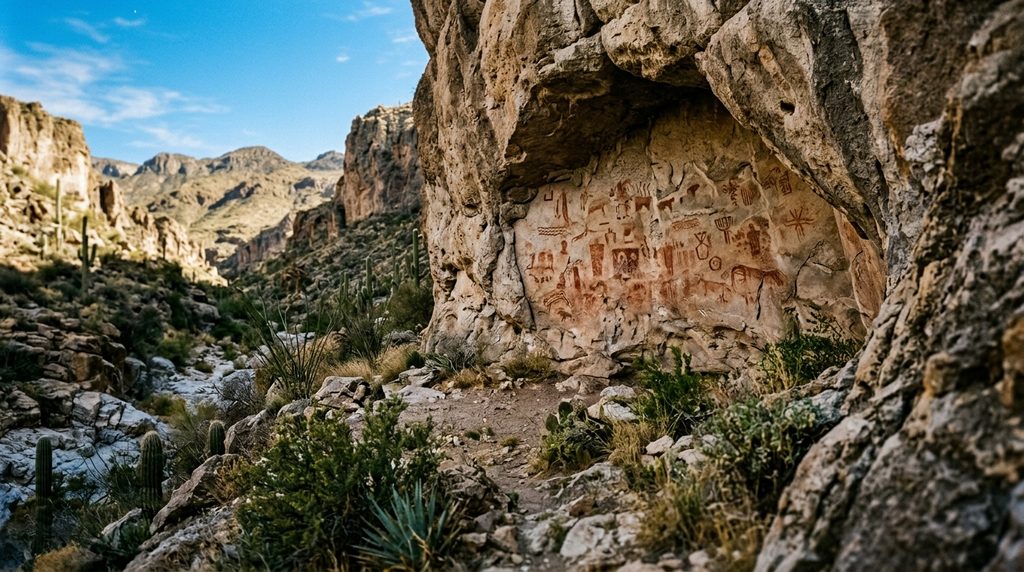
Located within Garden Canyon on the military installation, this outdoor archaeological site features 53 distinct pictographs (painted rock art) created by prehistoric inhabitants.
The story
You don't expect an ancient sacred rock shelter to sit behind an armed military checkpoint, but that is the paradox of Fort Huachuca. Tucked into the steep limestone overhangs of Garden Canyon—a lush sky-island corridor of oak, sycamore, and cool mountain water cutting into the Huachuca Mountains—are two rock shelters preserving 53 distinct prehistoric pictographs. Unlike petroglyphs, which are chiseled or pecked into stone varnish, these are delicate mineral paintings that have somehow survived centuries of wind and mountain freeze.
The artwork represents a rare visual overlap of distinct cultures centuries apart. The oldest pictographs were rendered around 1300 C.E. in deep red iron pigments, created by pre-Columbian farmers who lived in a village near the canyon mouth and traded along Mogollon and Hohokam routes. Roughly four hundred years later, around 1700 C.E., Apache hunting parties and travelers sheltered under the same stone roofs, applying their own iconography in contrasting charcoal black and chalky white. Look closely at the shelter ceiling: ghost-like white Apache figures were painted right over the older red prehistoric motifs, turning the natural rock ceiling into a multi-generational palimpsest.
Because the canyon sits within the perimeter of an active U.S. Army post, it avoided the urban encroachment and vandalism that ruined rock art elsewhere in southern Arizona. The Army enclosed the main shelter behind a protective security fence and installed a wooden viewing boardwalk, allowing you to stand just feet away from the pigments without degrading them. A short scramble further up the canyon road leads to Rappel Cliffs Rock Shelter, an even quieter alcove featuring faded geometric dots, lines, and anthromorphs that fade into the cliff face.
What it's like
Visiting requires patience with military protocol: you must pull into the Van Deman Gate Visitor Control Center, present your REAL ID, vehicle registration, and proof of insurance, and wait for a background check to obtain a civilian day pass. Once through the gate, the pavement eventually terminates past the Upper Picnic Area into a single-lane, severely rutted dirt road. You will want high clearance to negotiate the rocks and washouts for the last two miles, though many visitors simply park at the picnic grounds and hike up the road (~700 feet of elevation gain). The canyon is eerily silent save for mountain birds, but the entire area is subject to sudden closures during live military exercises or monsoon flooding.
The move: Clear the military checkpoint, bounce past the picnic area up the rutted canyon road, and hike beneath sycamores to limestone shelters hiding 53 ancient, red-pigment pictographs.
- 📍 Fort Huachuca / Sierra Vista
- 💸 $$
- ⚡ Up for anything
- 🌗 Indoors
Where: Garden Canyon Road, Fort Huachuca, AZ (access via Van Deman Gate / Visitor Control Center; address restricted)
Hours: Added 2026-11-18 — confirm current hours before you go.
Pair it with
- Fort Huachuca Museum & Old Post Cemetery — Since you have already cleared the checkpoint and hold a valid base pass, make a stop at the post's historic 1877 frontier cavalry outpost and Old Post Cemetery.
- Ramsey Canyon Preserve & Hummingbird Sanctuary — Continue exploring the Huachuca sky islands just outside the base fence at this famously cool, spring-fed canyon known for sheltering over a dozen hummingbird species.
- Carr Canyon & Reef Townsite Overlook — Double down on rugged mountain tracks by tackling Carr Canyon's narrow switchbacks up to an abandoned 1880s gold mining reef perched over the valley.
- The Hoppin’ Grapes Wine & Craft Beer Bar — Decompress back in civilian Sierra Vista after the canyon washboard road with self-serve beer taps and local Arizona wine flights.
More weird in Sierra Vista & Fort Huachuca
Good to know
How do civilians get onto Fort Huachuca to see the pictographs?
You must stop at the Fort Huachuca Visitor Control Center at the Van Deman Gate on Fry Boulevard. All adult U.S. citizens must show a valid REAL ID driver's license or passport, plus vehicle registration and insurance, to receive a temporary base pass. Foreign nationals are generally restricted unless sponsored and escorted.
Can a standard passenger car make the drive up Garden Canyon?
You can drive a sedan as far as the Upper Picnic Area, but the remaining two miles to the pictograph site are rough, rocky dirt prone to severe monsoon washouts. High clearance is strongly recommended; otherwise, park at the picnic lot and walk up.
Can you touch the rock art?
No. The main pictograph shelter is enclosed behind a chain-link fence to protect the fragile mineral paints from skin oils and vandalism. You view all 53 paintings from a wooden boardwalk platform placed a few feet back.
Are the pictographs petroglyphs?
No. Petroglyphs are carved or scratched into the rock face, while pictographs are painted using organic binders and pigments—in this case red ochre, charcoal, and white clay.
Plan a visit & invite your people →
Further reading: visit.sierravistaaz.gov · mccuration.com · southernarizonaguide.com · core.tdar.org · arizonabirdingtrail.com
last checked: 2026-11-18