Entry No. 44 — the Tacoma & South Sound file — filed under: miscellanea
Hood Canal Adventures
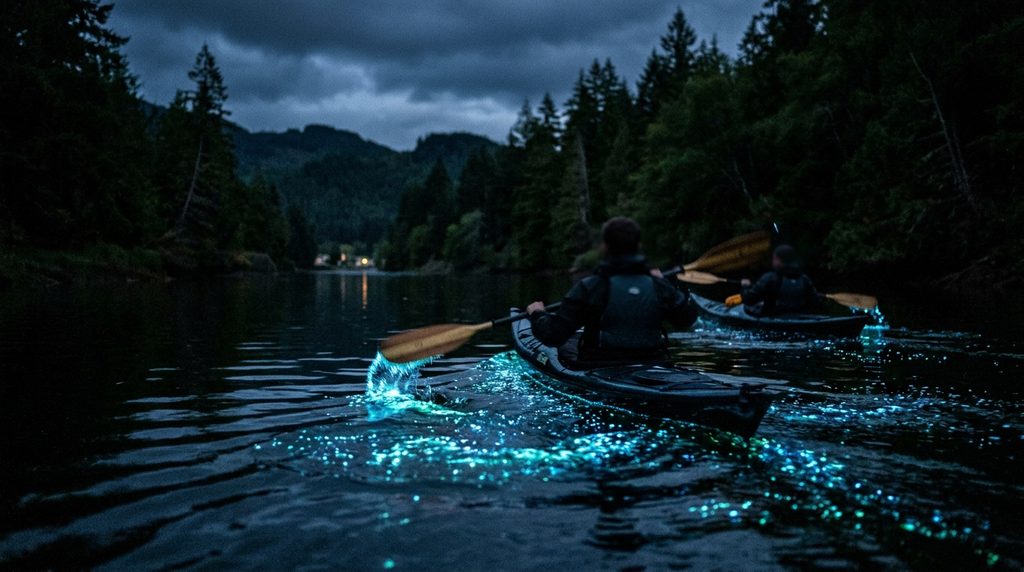
An adventure outfitter running two-hour guided night kayak excursions along the canal waters, where bioluminescent plankton light up in the wake of the paddles like underwater fireflies.
→ Three more after-dark & night-sky spots in Tacoma & South Sound — never the same twice
The story
The Hood Canal is not an open sea; it is a glacier-carved, narrow saltwater fjord pinched between the Kitsap and Olympic Peninsulas. Because water circulation in the canal's sheltered bays is sluggish and the summer sun warms the upper water layer, colonies of bioluminescent dinoflagellates bloom in massive concentrations. Marine biologist Christina Maloney operates Hood Canal Adventures out of a small basecamp post along Highway 101 in Brinnon, staging nocturnal launchings off Yelvik’s Beach—a quiet gravel turnoff where rural darkness drops heavily the moment highway traffic thins out.
What you are paddling out into is essentially an enzymatic defense reflex: single-celled marine plankton triggering mechanical flashes of cold light whenever their cell walls are sheared by movement. By daylight, the water looks like ordinary green Puget Sound brine. But slice a paddle blade through the black surface on a summer night, and the wake erupts in electric blue-green sparks that wash over the blades and cling to the hull. Far enough from city lights, the canal gets quiet enough to hear water sloshing against the hull before you register the glow, while summer bats dip out of the treeline to skim insects off the surface right beside the boats.
What it's like
You will meet the guides down at Yelvik’s Beach rather than at the Highway 101 shop, pulling onto the gravel near the campground as twilight dies over the foothills. The outfitter supplies sit-inside or sit-on-top kayaks, paddles, and life vests, but you need to bring layers: even in July, sitting an inch above fjord water in the dead of night will leech your warmth quickly. Once the group clears the shore, headlamps go off and your pupils need a solid fifteen minutes to adjust to the dark. The trick is to stop paddling hard and let the boat drift, trailing your fingers or swirling a paddle tip to disturb the water. Book your outing as close to a new moon as you can—a full moon washes out the cold sparks, while deep pitch black turns every eddy into liquid neon.
The move: Meet the guides at Yelvik's Beach as twilight fades, bring warm layers, then paddle out in the dark and slice your blades through the water to spark cold, glowing plankton like underwater fireflies.
- 📍 Brinnon
- 💸 $
- ⚡ Low-key
- 🌗 Outdoors
Where: 306146 US Highway 101 N, Brinnon, WA 98320 (office/store); kayak launch/beach: Yelvik’s Beach, 251 Hjelvicks Rd, Brinnon, WA 98320
Hours: Added 2026-11-17 — confirm current hours before you go.
Pair it with
- University of Puget Sound Observatory — Follow an evening staring down into cold biological light on the canal with an outing peering upward through campus telescopes into deep space.
- Gig Harbor BoatShop at Eddon Boatyard — Pair a quiet nocturnal paddle on the fjord with an afternoon watching shipwrights hand-build traditional wooden craft along the Gig Harbor waterfront.
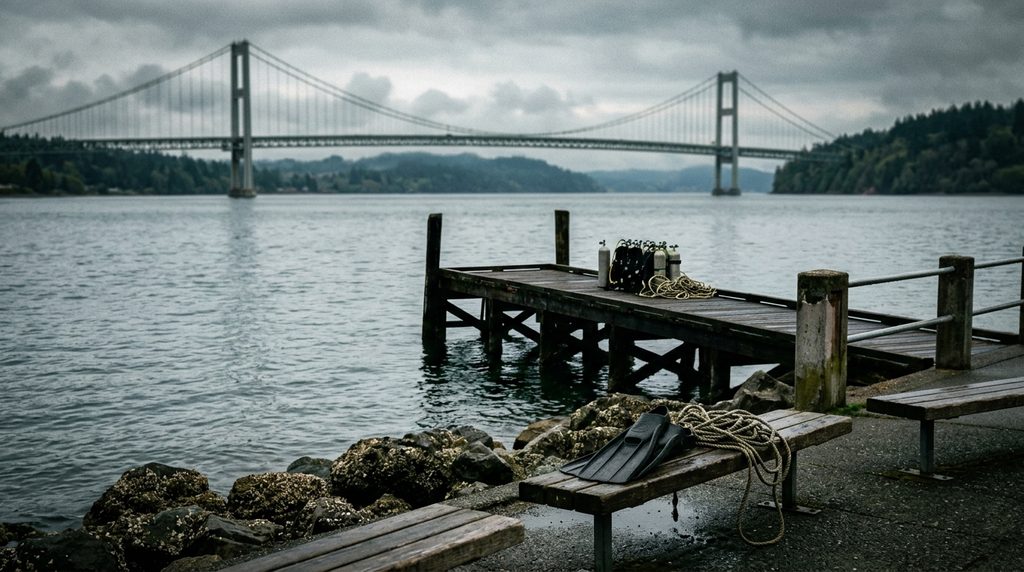
- Titlow Park — Connect two very different ways to encounter the Sound's dark water, contrasting surface plankton trails with the shoreline launch point above the sunken ruins of the Narrows Bridge.
More weird in Tacoma & South Sound

Good to know
When does the bioluminescence tour run?
Tours are scheduled seasonally from June through September when water temperatures peak and plankton blooms are most active.
Where does the tour meet?
Tours depart from Yelvik's Beach at 251 Hjelvicks Road in Brinnon, not from the retail basecamp on Highway 101.
What is the age requirement?
Paddlers must be at least 10 years old. Minors typically paddle in tandem kayaks alongside an adult.
Can I photograph the glow on my phone?
Almost certainly not. The luminescence consists of brief, faint chemical flashes that phone sensors cannot capture from a shifting kayak without long exposure blur. Keep phones stashed in dry bags and simply watch.
Plan a visit & invite your people →
Further reading: Official site · stateofwatourism.com
last checked: 2026-11-17