Entry No. 25 — the Tacoma & South Sound file — filed under: miscellanea
Mima Mounds
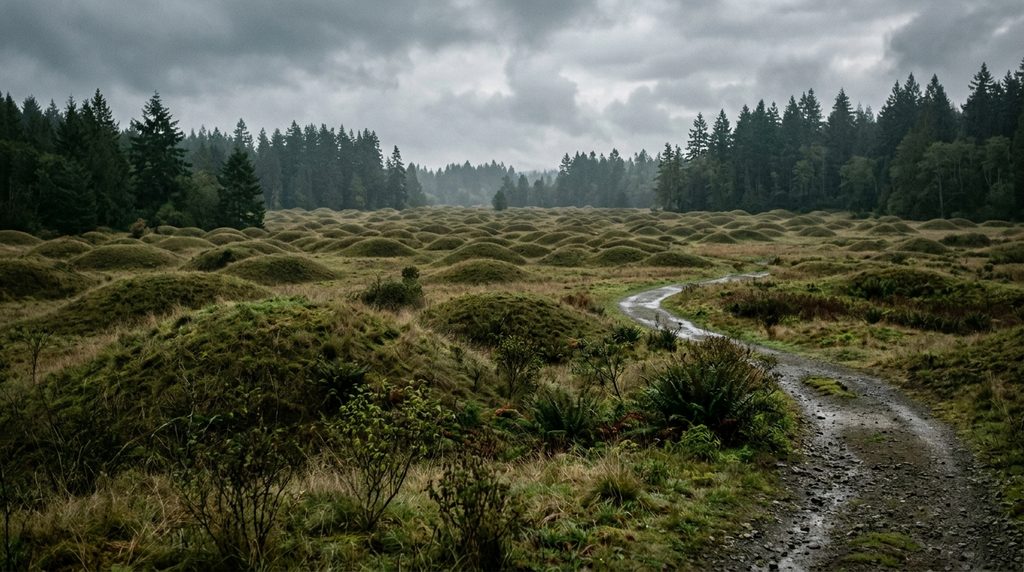
Located about 20 miles south of Olympia, this eerie and unexplained natural phenomenon features vast fields where the ground is covered in strange, uniform earthen mounds.
→ Three more weird outdoor & roadside oddities in Tacoma & South Sound — never the same twice
The story
In 1841, Lieutenant Charles Wilkes of the U.S. Exploring Expedition marched out onto this open prairie south of Puget Sound, stared at the landscape, and ordered his men to start digging. Convinced that thousands of near-identical, dome-shaped earthen mounds had to be Indigenous burial barrows, they carved three of them wide open. They found nothing inside except unstratified gravel, black loam, and loose sand. Wilkes left empty-handed, and nearly two centuries and more than thirty published scientific papers later, geology still cannot give you a definitive answer on who—or what—piled them up.
The preserve protects a surviving patch of these symmetrical blisters, each measuring two to eight feet high and up to forty feet wide, resting on glacial outwash gravel deposited when the ice sheet melted roughly 16,500 years ago. Over the years, the scientific debate has spiraled into turf wars. One stubborn camp insists generations of pocket gophers pushed sediment inward toward their nests over millennia. Another claims sun-melt pits in retreating ice or permafrost freezing cycles did the work. Our personal favorite remains the 1980 seismic theory, hatched when a local geologist noticed his hammer vibrations while building a doghouse caused loose surface dirt to clump into tidy, evenly spaced piles. Walk through the field today and you will realize the best part of the mystery is that every single rational explanation feels just preposterous enough to doubt.
What it's like
Pull up to the gravel lots off Waddell Creek Road and the landscape immediately sets off your uncanny valley radar: an orderly sea of grass-covered bumps rolling out toward the evergreen wall of the Capitol State Forest. Head straight for the concrete observation deck by the interpretive shelter to get an elevated angle on the geometry before choosing a path. A half-mile paved ADA loop cuts near the center, while dirt-and-gravel loops spool out for roughly three miles through the open prairie. In late spring, blue camas lilies blanket the trenches between the hills; year-round, the distant cracking of gunfire from the neighboring private gun range breaks the quiet. You need a Washington Discover Pass to park and there is no pay station on-site, so buy one online before you lose cell service. Leave the dog and the mountain bike at home—both are strictly barred to keep the fragile mounded soil from being ground down to flat dirt.
The move: Climb the concrete observation deck to watch the sea of identical grassy mounds roll toward the evergreens, then argue your own theory, since scientists still can't say who or what piled them up.
- 📍 South of Olympia
- 💸 Free
- ⚡ Up for anything
- 🌗 Outdoors
Where: 12315 Waddell Creek Road SW (access off Waddell Creek Road near Littlerock), Thurston County, WA 98512
Hours: Added 2026-11-17 — confirm current hours before you go.
Pair it with
- Monarch Sculpture Park — Drive ten miles southeast to trade baffling geological earthworks for quirky, human-made fantasy sculptures hidden across an open meadow.
- Bucoda — Follow Waddell Creek Road eleven miles south into a 500-person timber town that drops its quiet front every fall to rebrand officially as 'Boo-coda.'
- Odds & Ends — Head twelve miles north into downtown Olympia to balance out an afternoon in nature with glass display cases full of osteology, pinned insects, and anatomical oddities.
More weird in Tacoma & South Sound



Good to know
Why are dogs and bikes forbidden on the trails?
Because Mima Mounds is designated as a fragile Washington Natural Area Preserve, domestic pets and bikes are barred to prevent the erosion of the delicate mound formations and to protect rare native plant species and prairie butterflies.
Do I need a parking pass to visit?
Yes. A Washington State Discover Pass is required on your dashboard. There is no automated pay machine or ranger booth on site, so you must purchase and print it in advance.
What is the best season to see the mounds?
May and early June are prime, when native camas wildflowers bloom in thick purple swaths between the green knolls. Summer turns the prairie golden, while winter can leave the dirt trails slick.
How long does a visit usually take?
Give it 45 to 90 minutes. That leaves enough time to climb the observation deck, browse the interpretive panels, and walk either the half-mile paved trail or the full unpaved loop through the prairie.
Plan a visit & invite your people →
Further reading: discovery.com · Reddit · dnr.wa.gov · wta.org · wa100.dnr.wa.gov · nationalgeographic.com
last checked: 2026-11-17