Entry No. 18 — the Toronto, ON file — filed under: miscellanea
Stanley Barracks
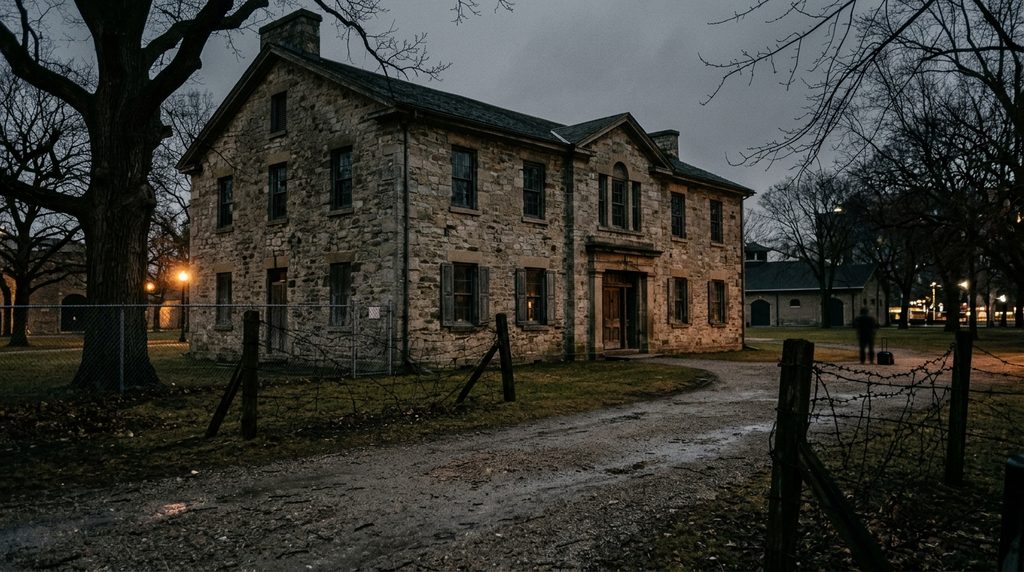
The last major surviving building of Toronto’s New Fort dates to 1840–41. German and Austrian prisoners were held behind barbed wire during the First World War, and the rarely entered barracks have hosted after-dark investigations from basement to top floor.
→ Three at a time, never the same twice — explore weird Toronto, ON
The story
In 1841, the British Royal Engineers built the New Fort at York out of solid limestone, positioned a kilometre west of the crumbling wooden stockade at Fort York to guard the lake approach. What sits today at 115 Princes' Boulevard—loomed over by the mirrored tower of Hotel X—is only the Officers' Quarters, the lone survivor of a sprawling seven-building military installation. In 1893, the base was renamed Stanley Barracks in honour of Governor General Frederick Stanley (the very same administrator who handed over hockey's most fought-over cup). By the early 1950s, the Canadian National Exhibition’s relentless demand for asphalt and exhibition halls saw the rest of the fort’s stone and brick structures razed to the ground, leaving this solitary two-storey block marooned in an event park.
The barracks survived because the city kept finding awkward, stopgap uses for it. During the First World War, the site was cordoned off with barbed wire as an internment receiving station, holding hundreds of Canadian residents of Austro-Hungarian and German heritage classified as 'enemy aliens.' After World War II, facing an acute municipal housing emergency, the federal government turned the vacant quarters over to house eighteen homeless families. It had mid-century stints housing the original Hockey Hall of Fame, the Sports Hall of Fame, and the Marine Museum of Upper Canada before the doors were locked in the late 1990s, leaving its interior to accumulate peel, damp, and layers of dust while the city forgot it was there.
What it's like
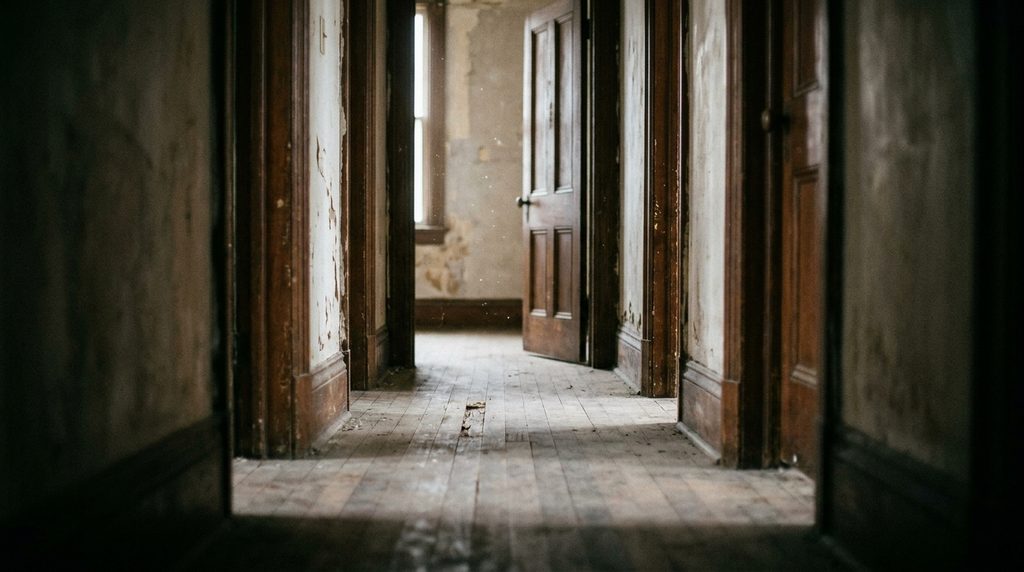
By daylight, the barracks presents a closed face to Princes' Boulevard, hemmed in by manicured turf, reproduction iron gates, and Hotel X's glass-floored pavilion (under which the excavated stone foundations of the demolished Enlisted Men's Barracks remain visible). The heavy limestone doors stay firmly locked to casual walk-ups. The only regular way across the threshold is by booking one of the seasonal, small-group paranormal investigations run after dark in the autumn by The Haunted Walk. If you secure a spot, you are handed an electromagnetic meter and led through pitch-black corridors from the cold cellar up to the top floors, where peeling paint, yellow warning tape, and drafty silence replace the usual hotel luxury next door.
The move: Peer through the pavilion’s glass floor at the demolished barracks’ stone foundations, then join an after-dark investigation of the surviving limestone quarters from basement to top floor.
- 📍 Exhibition Place, Toronto
- 💸 $$
- ⚡ Up for anything
- 🌗 Indoors
Where: 115 Princes' Blvd, Toronto, ON M6K 3C3
Hours: Added 2026-11-18 — confirm current hours before you go.
Pair it with
- Canada Malting Silos — Walk fifteen minutes east along the shoreline to compare the barracks' military limestone with the massive, floodlit industrial concrete of the 1928 malting silos at Bathurst Quay.
- Little Ghosts — Pair an after-dark trek through an 1840s military ruin with a trip north to Dundas for indie horror novels and dark weird fiction at this dedicated genre bookshop.
- Goodnight Cocktail Club — Head one mile east up to Wellington Street West to trade the chilly stone basement of the barracks for an unmarked subterranean 1970s lounge.
More weird in Toronto, ON
Good to know
Can you go inside the barracks year-round?
No. The building is closed to the public on an everyday basis and does not operate as a walk-in museum. Entry is strictly restricted to ticketed after-hours events, such as the seasonal Haunted Walk investigation sessions in October and November.
What is the steel frame structure next to the barracks?
It is an interpretive pavilion built as part of Hotel X. It traces the exact footprint of the demolished 1841 East Enlisted Men's Barracks, with an elevated glass walkway allowing you to look straight down onto the original excavated foundations.
Was Stanley Barracks an internment camp?
Yes. Between 1914 and 1916, the fort compound operated as Toronto's receiving station for wartime internees, confining hundreds of civilian men categorized by the British Empire as 'enemy aliens' before shifting them to permanent remote camps.
How do you reach the barracks by transit?
Take the 509 Harbourfront streetcar from Union Station or the 511 Bathurst streetcar from Bathurst Station directly to the Exhibition Loop, then walk two minutes south toward Princes' Boulevard.
Plan a visit & invite your people →
Further reading: hauntedwalk.com · truecitytourism.com · Instagram · explace.on.ca · insauga.com · tvo.org
last checked: 2026-11-18