Entry No. 36 — the Toronto, ON file — filed under: miscellanea
Toronto’s First Post Office
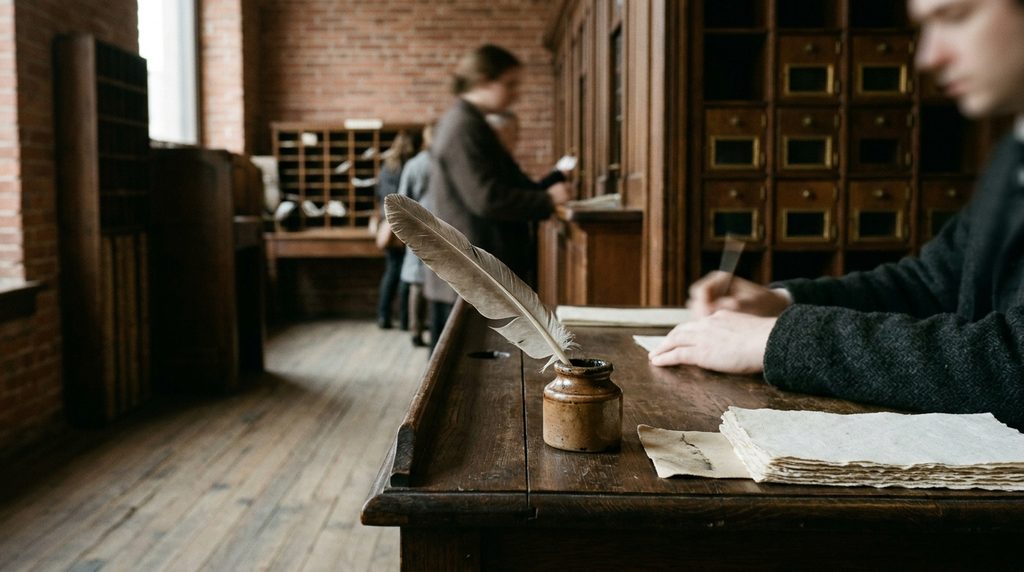
Toronto’s first post office doubles as a museum and a working post office. Visitors can write letters with quill pens and ink.
→ Three more unusual museums & collections in Toronto, ON — never the same twice
The story
In 1833, when Toronto was still called the Town of York and Adelaide Street went by the name of Duke, Postmaster James Scott Howard erected a modest red-brick Georgian building to serve as both his residence and the central postal depot. When York officially incorporated as the City of Toronto the following year, Howard’s front office became the municipality's very first post office. In those days, home delivery was non-existent; every letter arriving in the muddy settlement of roughly 9,000 residents was sorted onto open shelves or into painted glass-fronted boxes right here until someone showed up to claim it.
Howard's tenure ended abruptly during the Upper Canada Rebellion of 1837. Despite maintaining strict political neutrality, he fell under suspicion of harboring rebel sympathies and was cashiered from his post without formal charges or an inquiry. Successor Charles Albert Berczy took over the operation and moved postal headquarters to Front Street by 1839. The Duke Street building spent the next 140 years drifting through utilitarian incarnations—a hardware merchant's residence, the De La Salle Christian Brothers' boys' school, and a commercial cold-storage facility—before an aggressive 1978 fire tore through the upper levels and nearly prompted demolition.
Historical research sparked during the aftermath revealed what the soot was hiding: this was the oldest surviving purpose-built post office in Canada and the only intact British Royal Mail post office left in the country. Rebuilt and reopened in 1983 by the Town of York Historical Society, the space now runs as an impossible double act: part interpretive museum preserving 1830s postal cabinetry and town artifacts, and part fully functional Canada Post dealership where modern mail is sorted and processed.
What it's like
Stepping inside feels like stumbling through an unadvertised tear in the downtown grid: local condo dwellers drop off routine courier parcels and buy padded mailers at the counter while visitors next to them sit at wooden desks dipping goose quills into inkwells. The room is quiet, smelled faintly of parchment and hot wax, and rarely packed. Writing with a feather nib requires patience—hesitate on the page and you will leave a blot—but staff will happily walk you through heating sealing wax over an open candle flame and pressing the seal. Expect to spend 20 to 30 minutes if you are only looking at the 1837 town model and antique postal boxes, or closer to an hour if you sit down to pen a letter.
The move: Sit at the wooden desks, dip goose quills into inkwells, and write each other a letter while the room smells faintly of parchment and hot wax.
- 📍 Toronto
- 💸 $
- ⚡ Up for anything
- 🌗 Indoors
Where: 260 Adelaide Street East, Toronto, ON M5A 1N1
Hours: Added 2026-11-18 — confirm current hours before you go.
Pair it with
- Elgin and Winter Garden Theatre Centre — Pair an 1830s postal desk with the world's last operational double-decker Edwardian theater for an afternoon of downtown architecture hidden in plain view.
- Distillery Historic District & Ghost Tours — Walk ten minutes southeast to keep pulling on 19th-century Toronto threads among the preserved Victorian brickworks of the former Gooderham and Worts complex.
- Friar’s Music Museum — Double down on bizarre heritage spots masquerading inside modern retail spaces by hitting a free music archive stashed inside an ordinary drugstore.
More weird in Toronto, ON

Good to know
Is this an actual working post office or just a historic reproduction?
It is a fully authorized, operational Canada Post dealership run by the Town of York Historical Society, handling routine domestic and international mail alongside its museum duties.
Can you actually mail a letter using the quill and wax seal?
Yes. Visitors can sit at the period desks, write on stationery with quill pens and ink, seal the paper with hot red sealing wax, and mail it with modern postage stamped using a reproduction of Toronto's original 1830s red postmark.
How much does admission cost?
General entry to view the museum displays is free, with voluntary donations strongly encouraged to support the historical society. Using the quill-and-wax letter-writing kit carries a small fee for materials.
How long does a visit usually take?
Browsing the exhibits takes roughly 20 to 30 minutes; writing and sealing a letter with quill and wax will stretch your visit to around 45 to 60 minutes.
Plan a visit & invite your people →
Further reading: Atlas Obscura · gofundme.com · townofyork.com · Wikipedia
last checked: 2026-11-18