Entry No. 13 — the Vancouver, BC file — filed under: miscellanea
Granville Island Broom Co.
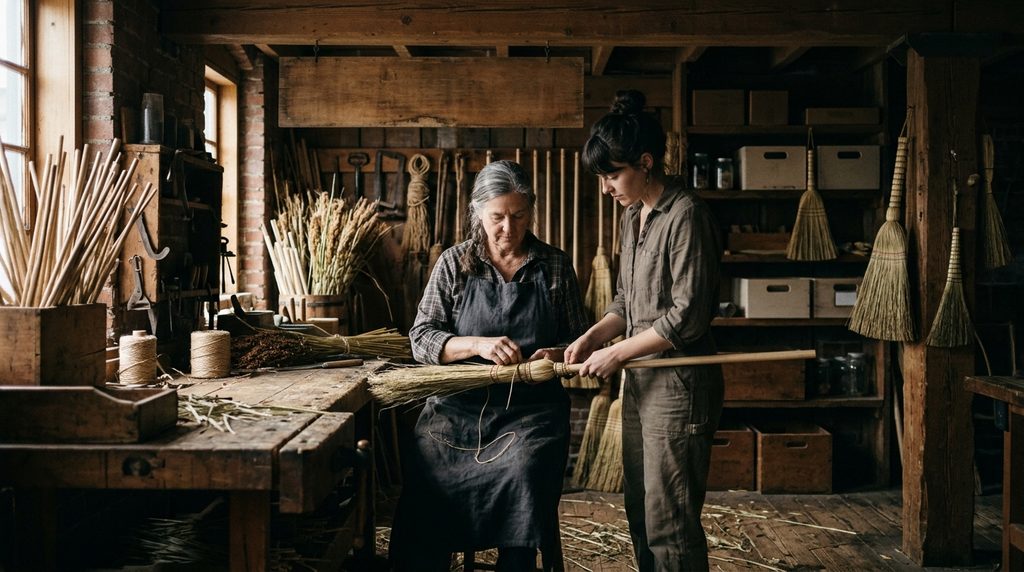
Mary and Sarah Schwieger make brooms by hand in the Shaker tradition, using a craft they learned from their family.
→ Three at a time, never the same twice — explore weird Vancouver, BC
The story
You don't think about brooms until you see someone make one using a foot-powered tension winder from the 1800s. Mary and Sarah Schwieger grew up on the east shore of Kootenay Lake in Crawford Bay, where their parents operated North Woven Broom Co. and shaped raw sorghum broomcorn entirely by hand. After testing the waters of university degrees in geography and creative writing, neither sister had an appetite for fluorescent office life. In 2010, they hauled the family trade to Vancouver, opening a narrow shopfront on Old Bridge Street to keep Shaker-style craft alive inside an urban industrial park.
The craft is practical folk history preserved almost by stubbornness. The bristles are not straw or synthetic plastic—they are broomcorn, a rigid, fibrous variety of sorghum grown in northern Mexico that artisans have favored since the late 18th century for its natural spring and flexibility. In the shop, bundles are soaked, wound under cable tension onto twisted desert manzanita or bark-on eastern British Columbia birch, and hand-stitched into form. Along with flat brooms—an innovation popularized by the Shakers to cover wide floorboards with minimal effort—they turn out untrimmed round besoms based on pre-1800s designs, which regularly get snatched up by fantasy film crews and seekers of traditional hearth tools.
What it's like
Old Bridge Street sits just off Granville Island's loudest footpaths, and you will smell the dry sorghum straw and freshly shaved birch the moment you pull open the door. Inside, the shop is a dense, bristling thicket hung with cobwebbers, miniature whisks, hearth sweepers, and floor brooms with wild, branching handles. This is an active production floor rather than a hands-off boutique: you can expect fine chaff floating in the air, the creak of foot pedals and wire reels, and one of the Schwiegers or their assistants actively lashing bundles at the bench. Visit on a weekday morning if you want to lean in and watch the binding process without fighting through weekend market crowds.
The move: Follow the smell of dry sorghum and freshly shaved birch into the shop and watch the foot-powered tension winder from the 1800s at work among the hanging cobwebbers.
- 📍 Vancouver, Granville Island
- 💸 $$
- ⚡ Up for anything
- 🌗 Indoors
Where: 1406 Old Bridge Street, Vancouver, BC V6H 3S6
Hours: Added 2026-11-18 — confirm current hours before you go.
Pair it with
- Engine 374 — Hop an Aquabus across False Creek to Yaletown to chase 19th-century Shaker hand tools with the monumental 1887 steam locomotive that pulled Vancouver's first transcontinental passenger train.
- Hycroft Manor — Head south up into Shaughnessy to follow hearthside besom traditions with a stroll past an ornate 1911 Edwardian mansion notorious for its resident ghosts.
- Lonsdale Leather — Head east to 6th Avenue to stay inside Vancouver's hands-on material subculture, swapping raw sorghum straw for uncut hides, specialist leathercraft tools, and oddity taxidermy workshops.
More weird in Vancouver, BC
Good to know
Are these brooms meant for display, or can you sweep with them?
They are fully functional tools built for daily use. Unprocessed broomcorn fibers naturally split at the ends to grip dust, and as long as you hang them by their loops rather than resting them on their bristles, they typically last for years of floor work.
What makes a Shaker broom different from older broom styles?
Before the Shakers began using flat vises in the early 1800s, brooms were bound exclusively in the round—fine for swirling hearth ashes, but terrible for corners. Flattening and stitching the sorghum bundle created the wide, chisel sweep that became the standard modern broom.
Where do the unusual wooden handles come from?
The sisters use traditional smooth dowels alongside naturally harvested woods: dark, rustic birch collected in eastern British Columbia with the bark kept intact, and twisted manzanita branches gathered from the desert.
Can you watch brooms being made on-site?
Yes. The winding and stitching benches are set up directly behind the retail counter, where the makers work the foot-treadles and stitchers in full view of visitors throughout the day.
Plan a visit & invite your people →
Further reading: Official site · cbc.ca · vancouversun.com · bcbusiness.ca
last checked: 2026-11-18