Entry No. 29 — the Watertown & Fort Drum file — filed under: miscellanea
Happy Valley Ghost Town
An abandoned, desolate ghost settlement tucked away in rural Oswego County that draws curious explorers and seekers of haunting local history.
→ Three at a time, never the same twice — explore weird Watertown & Fort Drum
The story
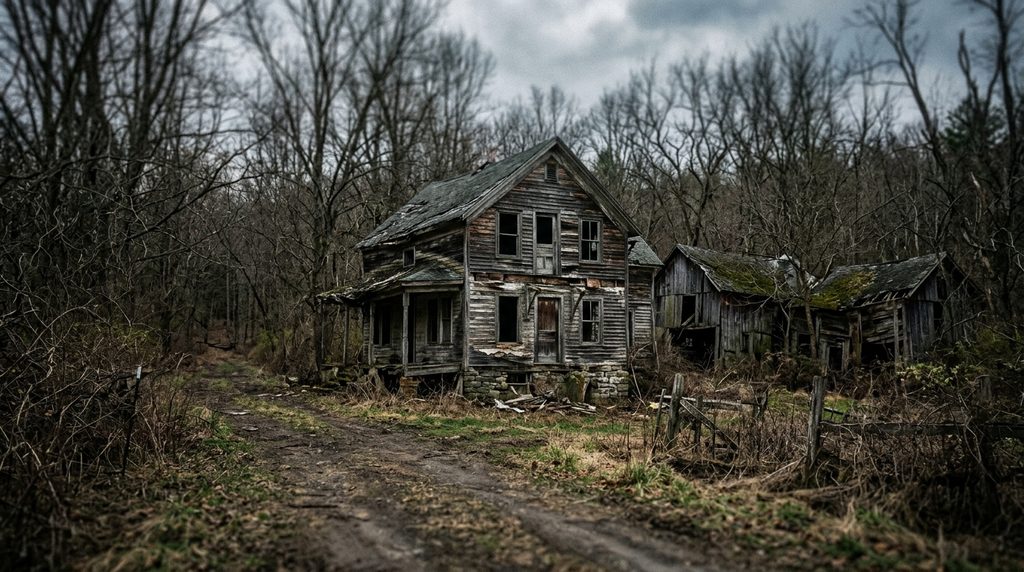
The name is pure dark comedy. Happy Valley was never particularly joyous, and by the 1930s, it had ceased to exist entirely. First cleared in the mid-19th century—known early on to French settlers as Fraicheur and later as Fraser—the settlement drew hop growers and dairy farmers who spent decades attempting to wring a living out of Oswego County’s thin, acidic Tug Hill soils. It was doomed from the jump. The one-room schoolhouse opened in 1867; the local post office lasted a mere ten years before closing in 1902 due to depopulation; and when back-to-back crop failures collided with the 1929 stock market crash, the banks foreclosed on what remained. Families didn't pack up neatly—they simply walked away.
In the late 1930s, the state stepped in to acquire the foreclosed, depleted acreage for next to nothing, cobbling together the nearly 8,900-acre Happy Valley Wildlife Management Area. Reforestation programs and aggressive native growth moved fast. Today, the entire community has been reduced to mossy fieldstone foundations, sunken cellar holes, dry-stone wells, and feral apple trees that bloom in dense stands of hemlock, spruce, and yellow birch. On Happy Valley Road, the old hamlet cemetery remains, its weathered slabs marking the graves of families and Civil War veterans swallowed by the woods.
Because human beings hate mundane economic collapse, local campfire folklore steadily invented stranger causes for the valley's demise: sudden epidemics, witchcraft curses, and the ghost of an amputee soldier with a hook for a hand wandering the dirt lanes (a myth sparked by an actual Civil War veteran with an amputated arm buried in the cemetery plot). But the real weirdness is how efficiently the Tug Hill scrub obliterated eighty years of human sweat, leaving only stone footprints where a bustling crossroads once stood.
What it's like
Arriving on Happy Valley Road feels like rolling off the edge of civilization into a silent, marshy wilderness where your cell reception disappears almost instantly. The unpaved dirt lanes are rutted, seasonal corridors that turn into unnavigable mud troughs during spring thaw and are left entirely unplowed during winter. If you visit in late spring or summer, douse yourself in bug spray—the low-lying bogs breed clouds of biting deer flies and mosquitoes. The best window to visit is late autumn, when the leaves have fallen, making the hidden cellar holes, stone pasture walls, and the wrought-iron arch of the old cemetery visible through the bare timber.
The move: Douse yourselves in bug spray and navigate the rutted dirt lanes of Happy Valley Road into the silent marshland to scout the remnants of this foreclosed 19th-century settlement.
- 📍 Oswego County
- 💸 $$
- ⚡ Up for anything
- 🌗 Indoors
Where: Happy Valley Road, Williamstown, NY 13493 (within Happy Valley Wildlife Management Area, Oswego County)
Hours: Added 2026-11-18 — confirm current hours before you go.
Pair it with
- Gray Road — Continue your deep-woods Oswego County folklore run along this desolate Minetto stretch, known locally for eerie train track tales and total isolation.
- Burrville Cider Mill & 30-Foot Waterfall — Warm up after exploring damp cellar holes with fresh cider and fried donuts at an 1801 water-powered stone mill built over a 30-foot waterfall.
- Black River Gorge Trail & Whitewater Chasm — Pivot from vanished Tug Hill farm ruins to Watertown's limestone gorge, where massive 19th-century paper mills sit half-swallowed by Class IV whitewater.
More weird in Watertown & Fort Drum


Good to know
Are there any standing buildings left in the ghost town?
No standing buildings survive intact. Decades of state reforestation, fires, and harsh weather have leveled the homes, church, and schoolhouse down to moss-covered stone foundations, cellar pits, and overgrown wells.
Can you drive Happy Valley Road year-round?
No. The roads cutting through the Wildlife Management Area are unpaved, unimproved dirt tracks that receive no winter maintenance, making them impassable in snow and treacherous during early-spring mud season.
Is Happy Valley open to the public?
Yes. It is public state land managed by the New York State Department of Environmental Conservation, open year-round for exploration, hiking, and wildlife viewing from sunrise to sunset.
Is it safe to explore off the dirt roads?
Tread carefully. The forest undergrowth conceals sudden stone cellar holes, loose fieldstones, rusted farm debris, and abandoned open wells.
Plan a visit & invite your people →
Further reading: michaelkleen.com · newyorkupstate.com · dec.ny.gov · wibx950.com · tughilltomorrowlandtrust.org
last checked: 2026-11-18