Entry No. 45 — the Augusta & Fort Eisenhower file — filed under: miscellanea
Badwell Cemetery
The burial place of the Huguenot Petigru family, whose surname also appears as Pettigrew.
→ Three more haunted places & dark-history spots in Augusta & Fort Eisenhower — never the same twice
The story
In 1764, Reverend Jean Louis Gibert led a congregation of French Huguenot refugees into the South Carolina backcountry to escape religious persecution, establishing the frontier settlement of New Bordeaux and his personal homestead, Badwell Plantation. Gibert died in 1773 and was buried in the red dirt beneath a canopy of hardwoods, enclosed by raw fieldstone walls. Two generations later, the plantation passed to his grandson, James Louis Petigru. Petigru rose to become South Carolina's Attorney General and the state's most unapologetic Unionist, famously quipping as the state prepared to secede in 1860 that South Carolina was 'too small for a republic and too large for an insane asylum.'
The irony is that Petigru is not actually here. When he died in 1863 in the middle of the Civil War, he was buried in Charleston at St. Michael's Churchyard. Instead, Badwell Cemetery holds the rest of the dynasty: his grandfather Jean Louis Gibert, his parents William and Louise, his sister Jane Petigru North (who managed the plantation while James practiced law in the Lowcountry), and members of the allied Allston family. The plantation manor burned to the ground in the 1920s, and commercial timber operations eventually cut down Petigru's prized mile-long avenue of white oaks. Today, the surrounding woods have swallowed the estate whole, leaving only this dry-stacked stone enclosure and a nearby stone springhouse marooned in the timber.
What it's like
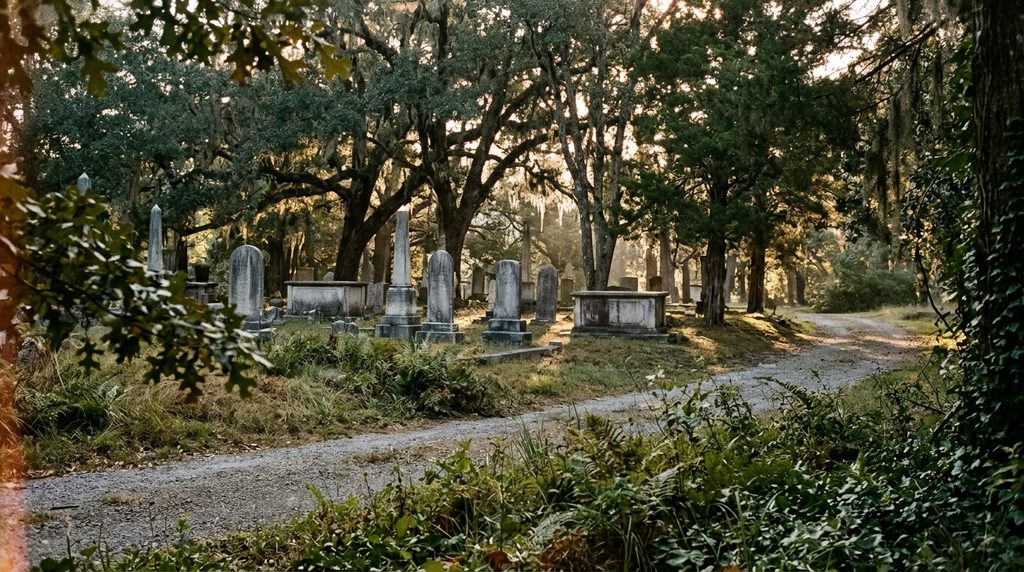
You reach the cemetery down a red dirt and gravel road off Huguenot Parkway in the Sumter National Forest area near the Savannah River. There is a small unpaved turnaround near the cemetery where you pull off, followed by a short walk to a low, mortarless fieldstone wall enclosing roughly twenty weathered graves. It is silent and deeply secluded, shaded under dense pine and hardwood canopy. Watch your footing around loose stone slabs and briars, check yourself thoroughly for ticks after visiting, and take a moment to look for the plantation's lone surviving stone springhouse tucked away down the nearby trail.
The move: Follow the red dirt and gravel off Huguenot Parkway, then walk together to the mortarless fieldstone wall and see which names you can still read on the weathered graves.
- 📍 McCormick, SC
- 💸 $$
- ⚡ Up for anything
- 🌗 Indoors
Where: Badwell Cemetery, off Badwell Cemetery Road / near Huguenot Parkway (roughly at GPS 33.92638, -82.37705), McCormick, SC 29835
Hours: Added 2026-11-17 — confirm current hours before you go.
Pair it with
- The Fitzpatrick Hotel — Cross the Savannah River into Washington, Georgia, to trade Badwell's quiet forest ruins for an ornate, reportedly haunted 1898 Victorian hotel.
- Old Rock House — Pair Badwell's 18th-century dry-stacked cemetery walls with Thomson's 1785 stone house, one of the oldest surviving masonry structures in the Georgia Piedmont.
- Savannah Rapids Pavilion & Canal Headgates — Head downstream along the river corridor to explore Columbia County's 1875 granite canal headgates and locktender's cottage.
More weird in Augusta & Fort Eisenhower

Good to know
Is James Louis Petigru buried at Badwell Cemetery?
No. Although Badwell was his family home and bears his name on historical markers, Petigru died in Charleston in 1863 and is buried in the churchyard of St. Michael's Episcopal Church.
Who is buried in the cemetery?
The walled plot holds approximately twenty members of the Gibert, Petigru, North, and Allston families, including French Huguenot patriarch Reverend Jean Louis Gibert, William and Louise Petigru, and plantation manager Jane Petigru North.
What remains of the original Badwell Plantation?
Only the dry-stacked stone cemetery enclosure and a detached stone springhouse survive. The main residential house was destroyed by fire in the 1920s.
How do you access the site?
The cemetery is reached via Badwell Cemetery Road off Huguenot Parkway, or on foot via a spur off the Savannah Valley Railroad Trail. The access roads are unpaved forest service routes best navigated in dry weather.
Plan a visit & invite your people →
Further reading: scpictureproject.org · mccormickscchamber.org · hmdb.org · cemeteryscgs.scgen.org · stephpurk.com
last checked: 2026-11-17