Entry No. 48 — the Edinburgh, UK file — filed under: miscellanea
Quaker Meeting House (Site of Major Weir's House)
Partially incorporates the remains of the demolished West Bow home of Major Thomas Weir, executed for witchcraft and dark crimes in 1670, whose spirit has allegedly been spotted walking through walls.
→ Three more haunted places & dark-history spots in Edinburgh, UK — never the same twice
The story
Major Thomas Weir was the golden boy of Edinburgh's strict Presbyterian establishment: an ardent Covenanter, former commander of the City Guard, and a preacher so revered for spontaneous prayer that locals called him "Angelical Thomas." He cut a grim, imposing figure in a dark cloak, never seen without a carved thornwood staff topped with grinning satyr heads. Then, in 1670, approaching his seventieth year and gripped by a sudden crisis of conscience, Weir stood before an astonished congregation and unburdened himself of sins no one had accused him of. He confessed to decades of incest with his sister Jean and his stepdaughter, habitual bestiality, and compacts with the Devil. Jean promptly backed up every word, adding that his sinister cane was a magical conduit and that they had traveled in a phantom coach drawn by six fiery horses. In April 1670, the magistrates had Thomas throttled and burned at the stake at Gallowlee on the road to Leith, tossing his staff into the flames with him, while Jean was hanged in the Grassmarket.
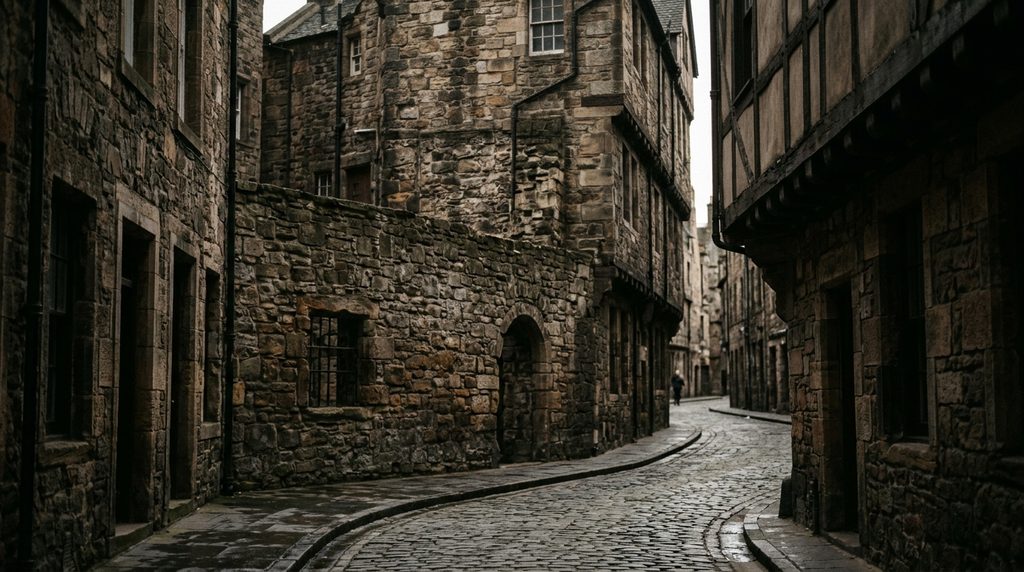
For nearly two centuries afterward, Weir's tall stone house at the head of the West Bow was the most shunned address in Scotland. Nobody dared live there; an ex-soldier and his wife took the tenancy in the late 1700s and reportedly fled screaming before dawn after waking to demonic shapes. Walter Scott wrote about the site in his letters on demonology, Robert Louis Stevenson's father warned his son to hurry past it, and everyone assumed the cursed masonry had been wiped from the earth when Victorian planners carved out Victoria Street. But in 2014, medical historian Dr. Jan Bondeson unearthed architectural evidence proving the house was never wholly leveled. When architects Paterson and Shiells erected a three-storey Italian Gothic chapel here in 1865, they simply incorporated the surviving shell of Weir's residence into the new structure.
The building changed hands from secessionist Presbyterians to the Boys' Brigade before being purchased in 1987 by the Religious Society of Friends. That creates one of Edinburgh's strangest spiritual paradoxes: Scotland's most notorious alleged necromancer is physically sealed inside a Quaker meeting house. Surviving remnants of Weir's home align with the ground floor and restroom area, where staff and caretakers have over the years reported catching glimpses of a tall figure walking silently through solid walls—pacing through rooms whose floor plans vanished over 150 years ago.
What it's like
Victoria Terrace is the quiet, raised stone walkway elevated directly above the bustling, colorful shops of Victoria Street. The Quaker Meeting House sits at No. 7 behind a dignified sandstone Gothic exterior, and you could easily walk past without a second glance. Step inside and the tourist chatter vanishes into deep, intentional silence; this is an active place of Quaker worship, quiet library study, and community gatherings, not a commercial ghost attraction. There are no spooky plaques or guided tours on the premises. Keep your voice down, walk gently around the ground floor Bow Room and foyer where the old 17th-century stone sits beneath the plasterwork, and savor the unsettling contrast between profound Quaker peace and the physical footprint of Edinburgh's darkest folk legend.
The move: Climb up to Victoria Terrace, step into the silence of No. 7 behind its sandstone Gothic front, then swap theories outside about Major Weir, whose spirit allegedly strolls through walls.
- 📍 Victoria Terrace / West Bow
- 💸 $$
- ⚡ Up for anything
- 🌗 Indoors
Where: 7 Victoria Terrace, Edinburgh, EH1 2JL
Hours: Added 2026-11-17 — confirm current hours before you go.
Pair it with
- The Witchery by the Castle — Walk 150 yards uphill to Castlehill, where this candlelit dining den takes its name from the hundreds of accused witches burned at the stake during the same 17th-century zealotry that claimed Thomas and Jean Weir.
- The Real Mary King's Close — Head down the Royal Mile to walk the preserved underground closes that reveal the cramped, multi-storey 17th-century street level Weir actually lived in before Victorian road redevelopments.
- Mr. Wood's Fossils — Head down the stone steps onto the Grassmarket, where Jean Weir was executed in 1670, to browse meteorites and rare prehistoric specimens in Edinburgh's sharpest oddities outpost.
More weird in Edinburgh, UK
Good to know
Can I tour the Quaker Meeting House as a tourist?
The building is not a commercial ghost attraction, but a working place of worship and community space. Visitors are welcome during regular open hours to visit quietly or view the architecture, but you must respect the hush and any meetings in progress.
Where are the actual remains of Major Weir's house located?
Architectural research indicates the footprint of Weir's demolished West Bow home aligns with the ground floor of the current building, particularly the area around the Bow Room and the lower-level facilities.
Did Thomas Weir actually practice witchcraft?
Historians view Weir's sudden, unsolicited confession as the product of severe religious mania, dementia, or a mental breakdown late in life, though 17th-century Scottish courts took witchcraft and sexual transgressions as literal capital crimes.
When was the Quaker Meeting House built?
The current Italian Gothic building was designed by architects Paterson and Shiells and completed in 1865–1866 as a church before the Quakers acquired it in 1987.
Plan a visit & invite your people →
Further reading: dickins.co.uk · scotlands-stories.com · myscottishpass.com · edinburghnews.scotsman.com · Wikipedia · portal.historicenvironment.scot
last checked: 2026-11-17