Entry No. 30 — the El Paso & Fort Bliss file — filed under: miscellanea
Sunland Park Dinosaur Tracks
A prehistoric outdoor site where visitors can search for genuine fossilized tracks left by dinosaurs that roamed the area over 90 million years ago.
→ Three more weird outdoor & roadside oddities in El Paso & Fort Bliss — never the same twice
The story
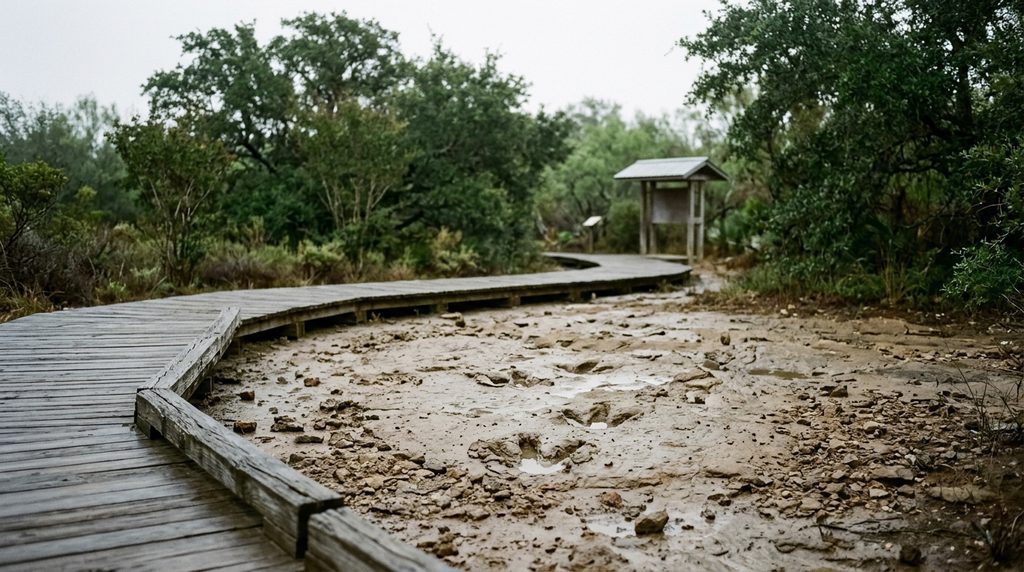
In May 2002, a UTEP geology student named Eric Kappus was out doing field work along the slopes of Cerro de Cristo Rey—an isolated volcanic dome pinned right where New Mexico, Texas, and Chihuahua collide. He wasn't hunting monsters, but he found them pressed directly into the sandstone: fossilized footprints, some measuring nearly two feet across, stamped into the earth roughly 97 million years ago. Back in the Cretaceous period, this sun-scorched patch of the Chihuahuan Desert was a muddy tidal flat along the margins of the Western Interior Seaway, trampled by heavy duck-billed ornithopods and three-toed theropods stalking the shoreline.
Rather than surrendering the fossil field to industrial rock crushing from nearby quarries, local businessman Stanley Jobe donated over 200 acres of the land to the INSIGHTS El Paso Science Center to keep the trackways intact. What makes the terrain genuinely strange isn't just the sheer age of the stone—which preserves everything from prehistoric ripple marks to deep foot impressions known as undertracks—it is the heavy collision of deep time and modern border politics. You are tracking herd migrations across exposed rock shelves just yards away from the corrugated steel border fence and the towering mountaintop cross of Cristo Rey.
What it's like
Do not show up expecting a polished state park with paved ramps, interpretive kiosks, or restrooms. There is no official visitor center or street-numbered public gate; the site is raw desert arroyo, and INSIGHTS manages access primarily through scheduled weekend docent hikes. The trek covers about two miles of uneven rock, gravel, and unshaded scree. The essential trick you wouldn't know otherwise: an untrained eye will walk right over fifty fossilized prints thinking they are ordinary stone dimples. Guided tours carry squirt bottles to spray water on the stone, which instantly deepens the contrast and makes the faded claw tips and footprint contours leap out against the glare.
The move: Join a scheduled weekend docent hike across two miles of rock and scree, and scan the sandstone together for fossilized footprints, some nearly two feet across, stamped there roughly 97 million years ago.
- 📍 El Paso metro
- 💸 Free
- ⚡ Up for anything
- 🌗 Outdoors
Where: Cristo Rey Road, Sunland Park, NM 88063 (DinoTracks site at base of Mount Cristo Rey; no street-numbered public entrance)
Hours: Added 2026-11-17 — confirm current hours before you go.
Pair it with
- Mount Cristo Rey Shrine & Trail — The 29-foot limestone Christ statue looms directly above the dinosaur flats, allowing you to follow a morning of tracking prehistoric beasts with a climb up the border-hugging switchbacks.
- Rosa’s Cantina — Just a five-minute drive across the state line onto Doniphan Drive, this storied western dive is the obvious spot to shake off the trail dust with a cold longneck and a green-chile burger.
- Scenic Drive Overlook & Murchison Park — After spending the morning studying the desert floor at ground level, head up the Franklin Mountain rim to view the entire urban basin stretch across El Paso and Ciudad Juárez.
More weird in El Paso & Fort Bliss
Good to know
Can you visit the dinosaur tracks without a guided tour?
It is not recommended and much of the area is privately held by the science center without trail markers. INSIGHTS El Paso Science Center owns the property and hosts scheduled tours (often the first Saturday of the month), emailing pin drops and driving instructions only to registered participants.
What kinds of dinosaur prints are out here?
Researchers have identified multiple distinct trackways, most notably wide, blunt-toed footprints left by iguanodontian ornithopods (classified under the Caririchnium ichnogenus) and sharp, three-toed theropod predator tracks (such as Magnoavipes), alongside fossilized marine worm burrows and ancient tidal ripple marks.
How physically demanding is the trek?
It is a moderate desert hike covering roughly two to two-and-a-half miles over loose gravel, exposed wash beds, and sun-baked inclines. You will be out in direct borderland sun for two to three hours with zero shade, so sturdy hiking boots and ample water are mandatory.
Why is water sprayed on the rocks during tours?
Because decades of wind erosion and intense desert glare bleach the sandstone, wetting the surface alters the rock's light refraction, dramatically revealing the dark contours of toes, heel pads, and underwater mud displacement.
Plan a visit & invite your people →
Further reading: Atlas Obscura · Official site · geoinfo.nmt.edu · kisselpaso.com · utep.edu
last checked: 2026-11-17