Entry No. 30 — the Great Lakes & North Shore file — filed under: miscellanea
McCormick Bridgehouse & Chicago River Museum
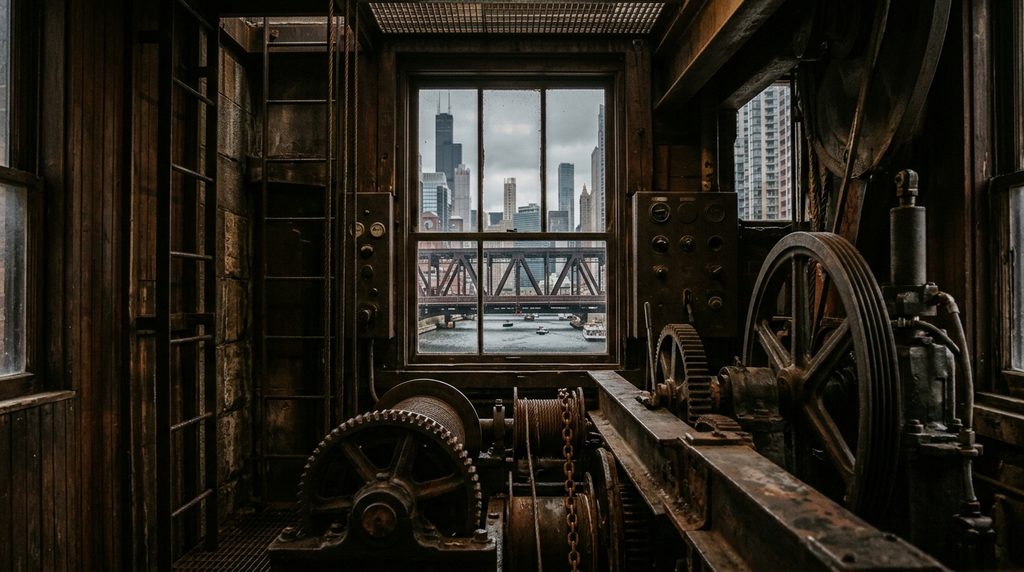
Set inside the only Chicago bridgehouse open to the public, this niche site provides an insider look into the mechanical operations and history of the Chicago River's bridges.
→ Three more unusual museums & collections in Great Lakes & North Shore — never the same twice
The story
Millions of tourists and commuters trudge across the DuSable Bridge at Michigan Avenue every year, completely oblivious that one of the four Beaux-Arts limestone towers flanking the crossing is hollowed out and entirely climbable. Conceived in Daniel Burnham's 1909 Plan of Chicago and designed by Edward Bennett, the crossing opened to traffic in 1920 as the world's first double-deck, double-leaf fixed-trunnion bascule bridge. Functionally, the structure only ever required two operator bridgehouses; the city erected four purely to satisfy Burnham's obsession with monumental civic symmetry. In 1928, sculptor Henry Hering slapped a bas-relief called 'Defense' onto the southwest tower to memorialize the 1812 Battle of Fort Dearborn, which played out nearby. In 2006, the advocacy group Friends of the Chicago River turned that southwest tower into a museum, cracking open an active piece of municipal infrastructure to anyone willing to duck off the street.
Inside, you are standing directly in the belly of an operating bascule machine. The lowest floor drops you inches away from colossal cast-iron drive gears, pinions, and racks engineered by Thomas Pihlfeldt and Hugh Young. The setup operates as an asymmetric, counterbalanced seesaw: a massive 4,100-ton road leaf hangs over the river, counterweighted by roughly 12,000 tons of concrete buried out of sight. Because the weight is nearly balanced, two modest 108-horsepower electric motors generate all the force required to swing the entire steel street deck up toward the sky. As you climb through five cramped vertical stories of exposed brick and steel, the museum traces the unapologetically brute-force history of the river, from the 1900 reversal that forced Lake Michigan water backwards to flush city sewage, up to modern riverfront ecology.
What it's like
You access the entrance directly down on the Chicago Riverwalk, tucked under the concrete underbelly of Michigan Avenue. The museum operates seasonally (May through late October) and feels remarkably intimate—more like poking around an engineer's private workshop than visiting a downtown institution. Self-guided general admission is pay-what-you-can, but the insider move is booking a ticket for an official bridge lift day during spring or fall boat runs. On those select mornings, you stand inside the gear room as the teeth engage and the mechanism heaves the road open above you. On ordinary weekdays, expect a quiet vertical hike up narrow stairs that tops out in the tower operator room, delivering eye-level views straight into the urban river canyon. The catch: there is no elevator, so only the riverwalk-level gear room is accessible for wheelchairs; reaching floors two through five takes five flights of stairs.
The move: Slip off the Riverwalk beneath Michigan Avenue into the hollowed-out limestone bridgehouse to inspect the massive mechanical gears of the historic bascule bridge.
- 📍 Chicago, Illinois
- 💸 $
- ⚡ Up for anything
- 🌗 Indoors
Where: 99 Chicago Riverwalk, Chicago, IL 60601 (southwest bridgetower at Michigan Ave & Wacker Dr)
Hours: Added 2026-11-18 — confirm current hours before you go.
Pair it with
- The Chicago Brand Museum — Trade the heavy cast-iron gears and civil engineering of the river for an eccentric archive of vintage packaging and brand ephemera just under three miles away.
- Hubbard's Woods — After climbing through the 1920 machinery that reshaped downtown, head up the North Shore to wander wooded ravines steeped in century-old phantom folklore.
- Fort Sheridan Historic District & Lake Bluffs — Follow the trail of historic lakefront engineering north to Holabird & Roche's 1887 yellow-brick army installation set high on the bluffs.
More weird in Great Lakes & North Shore

Good to know
When is the Bridgehouse Museum open?
It operates on a seasonal schedule from roughly early May through late October, typically open Wednesday through Sunday from 10:00 a.m. to 5:00 p.m., closing for the winter months.
Can you see the bridge gears actually moving?
Only during designated bridge lift events in the spring and fall boat-run seasons, when the city lifts the spans for tall sailboats traveling to and from winter boatyards. These viewings require a paid reservation in advance.
Is the museum accessible for strollers or wheelchairs?
Only the ground-level gear room off the Riverwalk is wheelchair accessible. Exploring the remaining four stories requires climbing tight staircases inside the historic tower.
How much does general admission cost?
General self-guided admission operates as a pay-what-you-can donation (with a suggested donation around $8), though special guided bridge-lift viewing tickets carry a set fee.
Plan a visit & invite your people →
Further reading: Atlas Obscura · enjoyillinois.com · wbez.org · Official site
last checked: 2026-11-18