Entry No. 26 — the Honolulu & Oahu file — filed under: miscellanea
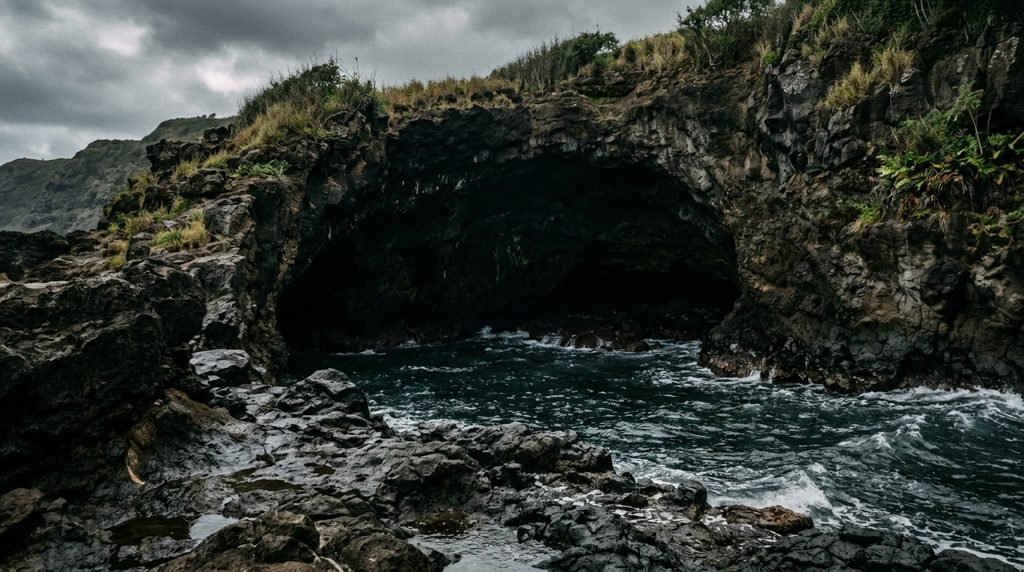
Mākua Cave (Kaneana Cave)
In local legend, the cave is home to Nanaue, a shark god who disguises himself as an old man and offers travelers food before killing them. Storyteller Lopaka Kapanui calls the cave a hotspot for the spirits of people said to have died there.
→ Three more haunted places & dark-history spots in Honolulu & Oahu — never the same twice
The story
Right where Farrington Highway begins running out of pavement before Kaʻena Point, Kāneana Cave gapes out from the basalt ridge between ʻŌhikilolo and Mākua Valleys like a throat. Geologists date the hollow back about 150,000 years, carved by Pleistocene wave action when the sea stood high above the modern roadway. In Hawaiian cosmology, however, the cavern carries a far older weight: named for Kāne, the god of creation, oral tradition holds this dark vault as the womb of the earth goddess from which human life was first birthed into the daylight. Yet the stories that still give Waiʻanae locals chicken skin belong to the darker spirits who took up residence in the shadows.
The cavern is infamous as the sanctuary of Kāmohoaliʻi, the king shark god and elder brother of Pele, and his shape-shifting son Nanaue. Born a kupua with the jaws of a man-eating shark concealed between his shoulders beneath a kapa cloak, Nanaue stalked the desolate leeward coast disguised as an ordinary man. Local lore tells of him setting campfires by the sea to entice passing travelers with food before ambushing them, hauling their bodies into the black depths of the cave, and devouring them upon a slimy stone slab. Master storyteller Lopaka Kapanui of Mysteries of Hawaiʻi has documented the cavern for decades as an intense spirit hotspot, where modern visitors routinely report sudden temperature plunges, an overwhelming sense of dread, and the uncanny feeling of being hemmed in by unseen crowds the moment flashlights go dark.
What it's like
Pull onto the unpaved dirt shoulder across from the unmarked entrance along Farrington Highway—there are no signs, admission booths, or trail staff out here. Crossing the asphalt from the blast-furnace heat of the leeward coast into the hundred-foot-tall archway brings an immediate twenty-degree chill and the smell of damp, cold basalt. The main chamber slopes downward roughly two hundred feet into pitch blackness; a smartphone light will barely scratch the void, so bring a genuine high-lumen flashlight and wear footwear with real tread for the slick, loose scree. Do not try squeezing into the unmaintained rear crevasses or side chutes, which are notoriously unstable and prone to rockfalls. Treat the space as an active sacred site—keep your voice down and leave rocks undisturbed—and do not leave a single visible item in your car, as vehicle break-ins along this remote highway stretch are very frequent.
The move: Stand together at the mouth of Kāneana Cave, feel the highway heat give way to the chill of damp basalt, and trade tellings of Nanaue, the shark god who posed as an old man.
- 📍 Waiʻanae Coast
- 💸 $$
- ⚡ Up for anything
- 🌗 Indoors
Where: Along Farrington Highway near Mākua Beach / Kaʻena Point, Mākua (Waiʻanae Coast), Oʻahu, HI — no formal street number (sea-cave at the makai base of the ridge between ʻŌhikilolo and Mākua Valleys)
Hours: Added 2026-11-17 — confirm current hours before you go.
Pair it with
- Mokulēʻia Beach — While on the North Shore side of the impassable Kaʻena Point trail, Mokulēʻia shares the same windswept, edge-of-the-island isolation and chilling lore of phantom night marchers.
- Kaukonahua Road — Cutting through the central gulches toward the north, this serpentine, pitch-black road matches Mākua's supernatural weight with its own legacy of haunted night drives.
- Wahiawā Botanical Garden Gulch — After the baking heat and ancient shark legends of the Waiʻanae cliffs, this central plateau rainforest gulch hidden fifty feet beneath street level offers a lush, daylight breather.
More weird in Honolulu & Oahu
Good to know
How do you reach Mākua Cave?
Drive west on Interstate H-1 until it transitions into Farrington Highway (Route 93) along the Waiʻanae Coast, continuing past Mākaha toward Kaʻena Point. The massive opening is carved directly into the mountain base on your right, across from a dirt roadside shoulder.
Do you need a permit or reservation to enter?
No permits or tickets are required. The cave sits on state park boundary land and is open to the public, though it is completely undeveloped and visitors enter entirely at their own risk.
Is it safe to explore deep into the cave's tunnels?
No. You should stay within the open main cavern. While the primary chamber is spacious and safe to stand in, the interior offshoot tunnels are extremely narrow, completely dark, and structurally dangerous due to past cave-ins and loose boulders.
Why is the cave culturally significant?
Beyond the moʻolelo of the shark-man Nanaue, Hawaiian tradition honors Kāneana as a creation site associated with Kāne where humanity first came into being, giving the cave enduring religious mana that demands strict respect.
Plan a visit & invite your people →
Further reading: honolulumagazine.com · dlnr.hawaii.gov · malamamakua.org · mysteries-of-hawaii.com · to-hawaii.com
last checked: 2026-11-17