Entry No. 31 — the Honolulu & Oahu file — filed under: miscellanea
Mokulēʻia Beach
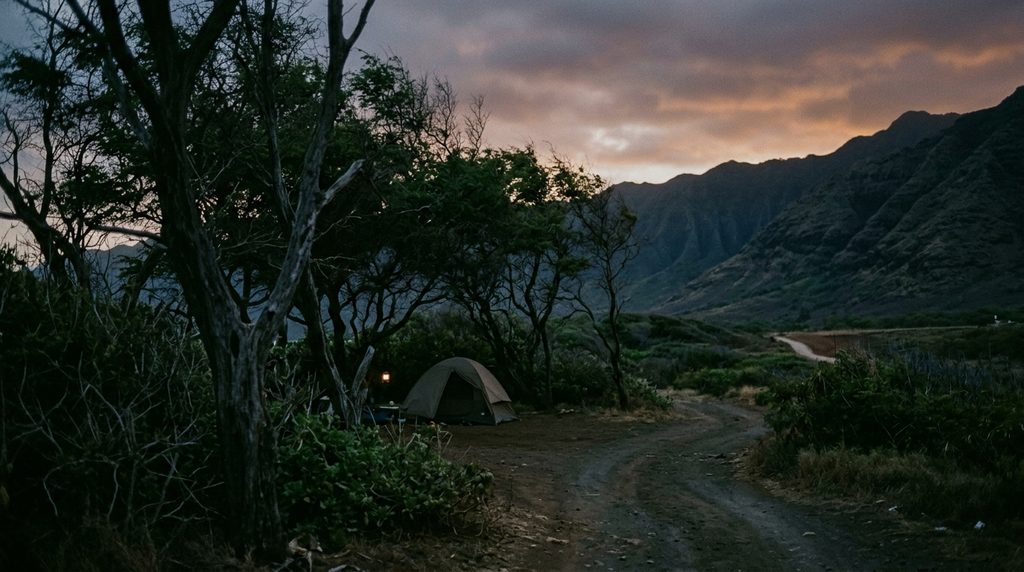
A man camping here with his son reported seeing an endless line of torches disappear beyond the ridge by Dillingham Airfield. Honolulu Magazine recounts it as a Night Marchers story.
→ Three more haunted places & dark-history spots in Honolulu & Oahu — never the same twice
The story
Mokulēʻia is where Farrington Highway begins to run out of civilization on Oʻahu's North Shore, squeezed between a thundering shorebreak and the sheer, fluted ridges of the northern Waiʻanae Range. By day, it is an exposed playground for glider pilots banking out of Dillingham Airfield, kiteboarders riding the tradewinds, and television fans retracing where the wreckage of Oceanic Flight 815 was dragged across the sand for the pilot of Lost. By night, when the wind howls through the ironwood groves and the last skydive plane touches down, the coast turns completely pitch-black and unsettlingly quiet.
That isolation is what draws campers, but it also leaves you exposed to older things. In an account documented by Honolulu Magazine, a local security guard named Ricky recalled an encounter from July 5, 1995. He and his girlfriend drove out to Mokulēʻia between 10 and 11 p.m. to meet a friend and his son who were camping on the sand. Looking inland toward the mountain cliffs behind Dillingham Airfield, a flicker in the dark caught their attention. It looked like an endless line of fire ants marching down the face of the mountain. Ricky initially thought he was watching pig hunters, until he realized the line of bright, moving torches stretched endlessly down the steep ridge before vanishing into nowhere.
As a child attending camp down the road at YMCA Camp Erdman, Ricky had been warned by a counselor about an ancient procession path crossing that exact slope: the route of the huakaʻi pō, or Night Marchers. In Hawaiian tradition, these are ancestral spirit armies marching along sacred trails between ancient heiau, burial sites, and Kaʻena Point—the westernmost tip of the island, revered as a leina a ka ʻuhane (a soul's leaping place into the afterlife). Meeting their gaze without an ancestral protector in their ranks is believed to be fatal. Ricky and his friends didn't wait to test the old protocol; they packed up their site and never returned after dark.
What it's like
Driving west past Waialua, the strip malls disappear and the landscape opens into vast coastal fields flanked by the dramatic wall of the Waiʻanae mountains. Mokulēʻia Beach Park provides a paved lot, basic restrooms, and outdoor showers, but the shore itself is unmanicured, windy, and bordered by a shallow, jagged limestone reef with treacherous rip currents. Visit during the late afternoon to watch sailplanes glide silently into Dillingham Airfield across the asphalt, then stay through sunset as twilight turns the ridge into a sharp black silhouette. Once darkness sets in, the lack of lighting is disorienting, so keep a reliable flashlight on hand and avoid wandering mauka onto active airfield or private ranch terrain.
The move: Walk the windy sand in late afternoon with the shorebreak thundering beside you, then look toward the ridge by Dillingham Airfield and picture the line of torches said to vanish beyond it.
- 📍 Mokulēʻia, North Shore
- 💸 $$
- ⚡ Up for anything
- 🌗 Indoors
Where: Mokulēʻia Beach / Mokulēʻia Beach Park — Farrington Highway (approx. 68-849 Farrington Hwy), Mokulēʻia, Oʻahu, HI 96791
Hours: Added 2026-11-17 — confirm current hours before you go.
Pair it with
- Kaukonahua Road — Farrington Highway links directly back toward Kaukonahua Road, famous locally for its dizzying 80 turns and its own notorious nighttime ghost lore cutting through the Waialua gulches.
- Mākua Cave (Kaneana Cave) — Resting on the opposite, leeward side of the Waiʻanae Range, Kaneana Cave shares Mokulēʻia's ancient cultural geography tied to the spirit leap at Kaʻena Point.
- Wahiawā Botanical Garden Gulch — Before venturing out to the windswept Mokulēʻia coast, descend into this 50-foot-deep prehistoric rainforest gulch tucked quietly beneath the Wahiawā plateau.
More weird in Honolulu & Oahu

Good to know
Is Mokulēʻia Beach safe for swimming?
Generally no. The water is fronted by a shallow, sharp limestone reef and subject to strong shorebreaks and dangerous rip currents, especially during winter swells. It is favored by beachcombers and advanced windsurfers rather than casual swimmers.
Where did the Night Marchers sighting occur?
Witnesses reported seeing the line of torches descending the mountain ridge directly mauka (inland) behind Dillingham Airfield, viewed from the beach campgrounds along Farrington Highway.
Was Mokulēʻia Beach used to film Lost?
Yes. Mokulēʻia was the primary crash site filmed for Oceanic Flight 815 in the show's 2004 pilot episode, and YMCA Camp Erdman just down the highway served as the Dharma Initiative village (the Others' compound).
Can you camp overnight at Mokulēʻia Beach Park?
Camping requires a pre-issued City and County of Honolulu park permit, typically restricted to weekend nights (Friday evening to Monday morning) and subject to gate lockups. Always confirm permitting status before pitching a tent.
Plan a visit & invite your people →
Further reading: honolulumagazine.com · files.hawaii.gov · dlnr.hawaii.gov · home.army.mil · lostpedia.fandom.com
last checked: 2026-11-17