Entry No. 44 — the Jacksonville & Mayport file — filed under: miscellanea
Mayport Railway Depot
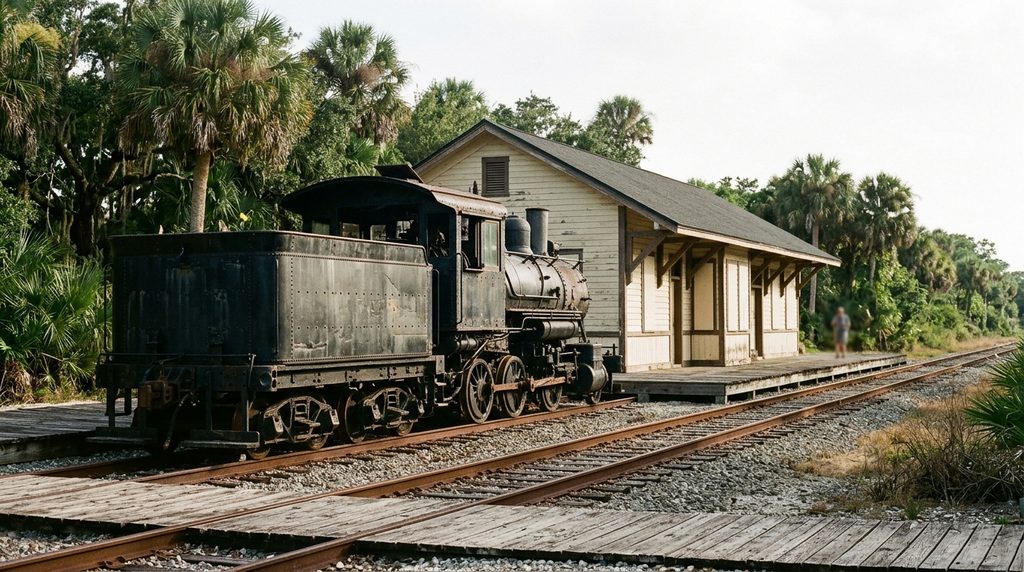
The named railway depot is now an outdoor museum exhibit alongside the once-working Old #7 Locomotive.
→ Three more unusual museums & collections in Jacksonville & Mayport — never the same twice
The story
In 1900, railroad baron Henry Flagler bought up an old seaside narrow-gauge line, widened the tracks to standard gauge, and drove them north to the fishing docks of Mayport. He was not doing it out of civic charity; he needed a deep-water river wharf to unload sea-delivered coal, both to fire his Florida East Coast Railway locomotives and to power the boilers of his luxury Hotel Continental up in Atlantic Beach. At the end of that spur sat this utilitarian, two-story depot, designed so incoming ocean freight could be dragged directly through sliding upper cargo doors while passengers waited out the salt humidity in the ground-floor waiting room.
When the passenger and freight spur folded in 1932, the depot entered a strange half-century of secular recycling. Hauled over to Pearl Street in Mayport Village, the building survived decades of coastal wear by serving successively as a private home, an offbeat local drinking hole, and a seafood restaurant. In 1981, preservationists jacked the wooden building onto a flatbed, hauled it down the peninsula to Jacksonville Beach, and anchored it in Pablo Historical Park, recoating it in Flagler Yellow—the Florida East Coast Railway's mandated corporate shade.
Directly outside sits Old #7, a squat, 25-ton 2-6-0 steam engine built in March 1911 by Pittsburgh’s H.K. Porter Company. In classic roadside heritage fashion, the engine is a bit of historical sleight of hand: it never actually ran the beach passenger rails. It spent its working life hauling pine and cypress logs through the interior swamplands of Pasco County for Cummer Lumber Co. before languishing on outdoor display in St. Augustine for twenty-one years. Brought here in 1982, it now serves as a scenic companion to the depot, which houses an operating model train layout replicating the early 1900s beach line.
What it's like
Pablo Historical Park sits directly behind the Beaches Museum along Beach Boulevard, looking like a manicured pocket yard where stray bits of early beach civilization were washed ashore and anchored. Between the towering cab of Old #7 and the yellow-painted outbuildings, the vibe is low-key, unhurried, and refreshingly void of typical theme-park polish. You can wander the exterior grounds freely at any hour, but if you want to inspect the depot's interior ticket office, luggage carts, and model train layout, you need to visit during museum hours when docents unlock the doors.
The move: Slip behind the Beaches Museum, look up at Old #7’s towering cab, and find the depot’s upstairs sliding doors where ocean freight once came in.
- 📍 Pablo Historical Park, Jacksonville Beach
- 💸 Free
- ⚡ Up for anything
- 🌗 Outdoors
Where: 381 Beach Boulevard, Jacksonville Beach, FL 32250
Hours: Added 2026-11-17 — confirm current hours before you go.
Pair it with
- Singleton’s Seafood Shack — Singleton’s sits right on the working shrimp trawler docks in Mayport Village, the exact riverfront where this depot originally stood before being hauled south.
- Marine Science Education Center — Pair the rail terminus with a trip to Mayport’s tucked-away wet-lab tanks to understand the harsh salt-marsh marine ecology early rail builders had to tame.
- Boneyard Beach at Big Talbot Island — Trade turn-of-the-century coastal rail salvage for an even raw shore, where massive sun-bleached oak skeletons litter dark sands at Big Talbot Island.
More weird in Jacksonville & Mayport

Good to know
How much does it cost to visit?
Admission to both the outdoor park grounds and the Beaches Museum is free, funded through a museum endowment, though donations are accepted in the main building.
Can you go inside the Mayport Railway Depot?
Yes, but only during Beaches Museum hours (Tuesday through Saturday 10:00 a.m. to 4:00 p.m., Sunday 12:00 p.m. to 4:00 p.m.), when docents unlock the historic structures for self-guided or guided tours.
Did Old #7 actually pull trains into this depot?
No. Old #7 is a logging locomotive built in 1911 for the W.W. Cummer & Sons Lumber Company near Tampa; it was relocated here in 1982 from St. Augustine as a representative example of early 20th-century Florida steam.
Why is the building painted that specific shade of yellow?
It is painted in 'Flagler Yellow,' the official signature color required by Henry Flagler on all Florida East Coast Railway depots and company buildings in the early 1900s.
Plan a visit & invite your people →
Further reading: visitjacksonville.com · hmdb.org · thejaxsonmag.com · theclio.com · beachesmuseum.org
last checked: 2026-11-17