Entry No. 38 — the Lawton & Fort Sill file — filed under: miscellanea
Flipper's Ditch
A named historic drainage system, portions of which are included in the Fort Sill Historic District.
→ Three more haunted places & dark-history spots in Lawton & Fort Sill — never the same twice
The story
In the late 1870s, Fort Sill had an invisible enemy that was killing far more soldiers than any plains skirmish: malaria. Every rainy season, standing water pooled across the low ground, turning the post into a humid breeding ground for swarms of mosquitoes. Previous attempts to fix the post's drainage had failed or been abandoned. The solution fell to Second Lieutenant Henry Ossian Flipper, who had been born into slavery in Georgia in 1856, endured four years of total social isolation from classmates to become the first African American graduate of West Point in 1877, and arrived in Indian Territory assigned to the all-Black 10th U.S. Cavalry.
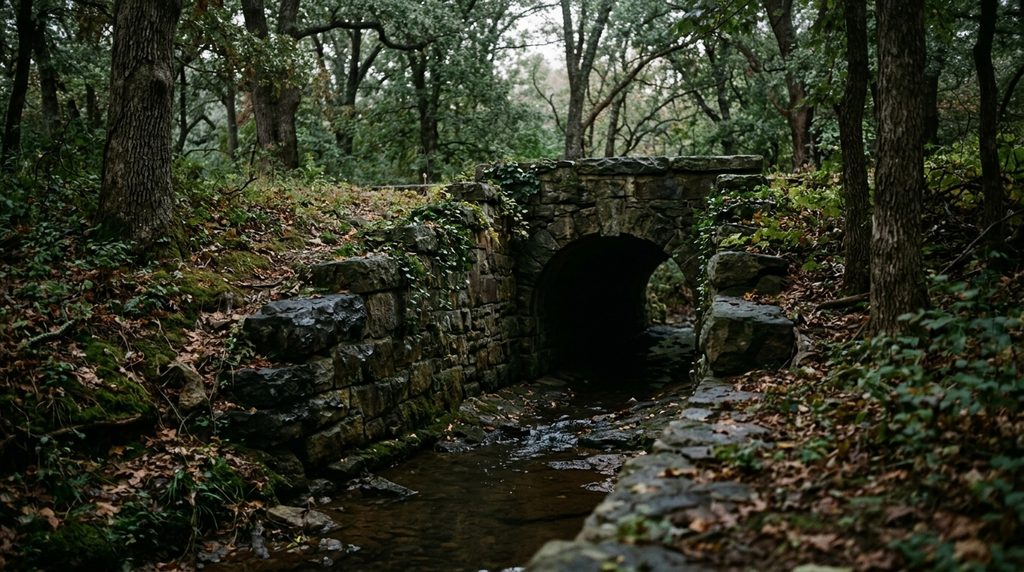
Drawing on his West Point engineering training, Flipper surveyed the swampy terrain and designed a trench network lined with hand-laid native Oklahoma limestone, cut to channel stagnant waters north toward Medicine Bluff Creek. Constructed in 1878, the canal worked with textbook precision. The swamp dried out, the mosquitoes lost their breeding grounds, and the malaria outbreaks ceased. Though Flipper would later be targeted by white superiors at Fort Davis and unjustly drummed out of the military on trumped-up charges in 1882—a record not fully cleared until an honorable discharge in 1976 and a posthumous presidential pardon in 1999—his ditch stayed right where he put it.
In 1977, Flipper's Ditch was declared a National Historic Landmark. What makes it weirdly compelling isn't a velvet rope or an admission desk, because there isn't one. It is a nineteenth-century public health miracle that never retired; nearly a century and a half later, it is still doing its original job, cutting across active military fairways and woodland walking paths as functional infrastructure.
What it's like
You are hunting for an active piece of civil engineering on an operational U.S. Army post, so there is no formal ticket booth. You'll need to secure a visitor pass at the Fort Sill Visitor Welcome Center near Bentley Gate (Sheridan Road) before driving onto base. Once on post, head toward the Fort Sill Golf Course and the quiet, lightly managed trails of Martha Songbird Park off Upton Road. You'll encounter a shallow, stone-lined ravine cutting through the grass and trees, marked with historical signage. After heavy Oklahoma rains, look down: the runoff is still flowing along Lieutenant Flipper's hand-placed limestone.
The move: Get your Fort Sill visitor passes, then head toward Martha Songbird Park and see who spots the hand-laid limestone first in Henry Flipper’s ditch.
- 📍 Fort Sill, OK
- 💸 $$
- ⚡ Up for anything
- 🌗 Indoors
Where: On Fort Sill (approx. along King Road/Upton Road near the Fort Sill Golf Course and Martha Songbird Park), Fort Sill, Comanche County, Oklahoma (no single street address)
Hours: Added 2026-11-18 — confirm current hours before you go.
Pair it with
- Fort Sill National Historic Landmark & Old Post Quadrangle — Walk through the intact 1870s stone barracks and quadrangle built in the exact frontier era when Lieutenant Flipper was stationed here engineering his canal.
- Grave of Kicking Bird — Stay inside Fort Sill's frontier borders to visit the resting place of the Kiowa chief who died under suspected poisoning just three years before Flipper arrived.
- U.S. Army Field Artillery Museum & Atomic Annie — Contrast a handmade 1878 limestone ditch with the sheer mid-century overkill of an atomic cannon parked just down the post roads.
More weird in Lawton & Fort Sill
Good to know
How do civilians visit Flipper's Ditch?
Because it sits on Fort Sill, non-military visitors must stop at the Fort Sill Visitor Welcome Center just south of Bentley Gate on Sheridan Road (or apply online in advance) with a REAL ID to undergo a background check and obtain an unescorted visitor pass.
Where can the ditch actually be seen?
Visible, limestone-lined sections run along King and Upton Roads, cutting directly through parts of Martha Songbird Park and across the greens of the Fort Sill Golf Course as it drains north toward Medicine Bluff Creek.
Why is a drainage ditch designated a National Historic Landmark?
Engineered in 1878 by Lt. Henry O. Flipper, the first African American graduate of West Point, it effectively eradicated the post's lethal malaria epidemic and represents a rare surviving nineteenth-century military civil engineering project that remains in active use.
Plan a visit & invite your people →
Further reading: npgallery.nps.gov · army.mil · nps.gov · okhistory.org · dvidshub.net
last checked: 2026-11-18