Entry No. 31 — the Lawton & Fort Sill file — filed under: miscellanea
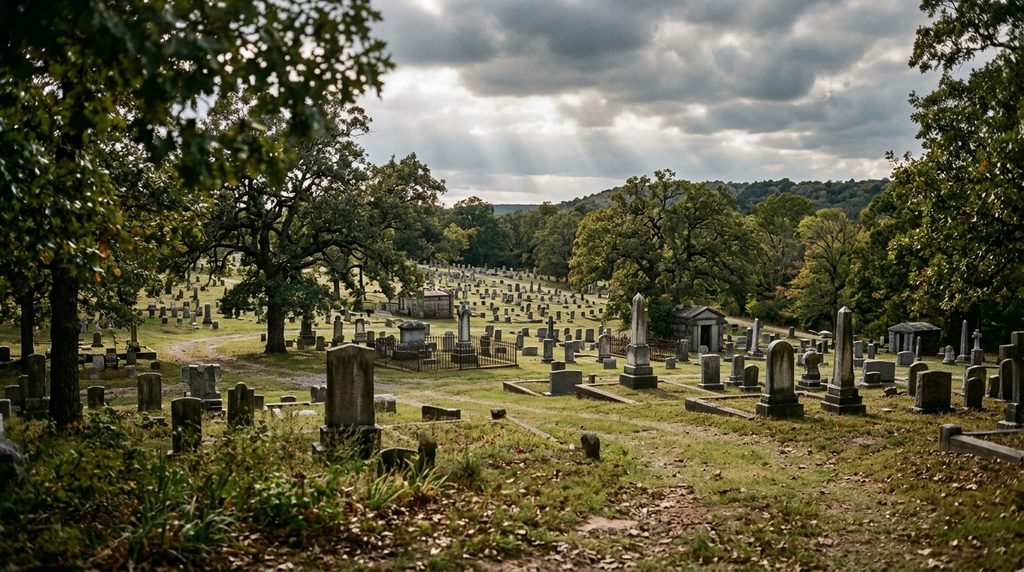
Grave of Kicking Bird
The Kiowa high chief died mysteriously after drinking a cup of coffee at Fort Sill, and poisoning was suspected. His grave went unmarked for years, so the cross on the current marker is newer than the burial.
→ Three more haunted places & dark-history spots in Lawton & Fort Sill — never the same twice
The story
In early May 1875, Kiowa high chief Kicking Bird (T'ene-angopte) was forced into an impossible corner by the U.S. Army: handpicking twenty-seven of his own tribal members to be shipped off in chains to Fort Marion in St. Augustine, Florida, ending the Red River War. To the military brass, he was an indispensable peace diplomat and reformer; to militant Kiowa traditionalists, he was a collaborator who had just condemned his own warriors to an exile they would never return from. Hours after watching the prison wagons roll out of Fort Sill, Kicking Bird took a seat, drank a cup of coffee, and immediately collapsed into agonizing spasms. He was dead before sundown at around forty years old.
Frontier authorities swept the abrupt fatality under the rug, but everyone on the post understood the stakes. Rumors pointed straight to strychnine slipped into the brew, while Kiowa lore held that a medicine man had laid a lethal curse on him for betraying the prisoners. The Army arranged a Christian burial in the post cemetery, hammered a rudimentary wooden cross into the soil, and moved on. Over the decades that followed, the wood decayed into mulch, and the precise spot where the Kiowa diplomat lay was functionally lost to the prairie.
The stone vault and marble marker you stand over today on Chiefs Knoll is a retrospective fix. As cemetery historians have pointed out, the standardized Christian cross incised into the stone belongs to a twentieth-century military mortuary design, decades newer than his 1875 burial. It stands as an official Army bookmark over a sudden frontier assassination that nobody in uniform was ever eager to solve.
What it's like
Fort Sill Post Cemetery sits on a quiet, tree-shaded rise overlooking the base, with Chiefs Knoll anchoring the southern section under low stone borders and mature canopies. Finding Kicking Bird's stone vault among neighbors like Quanah Parker and Satank is straightforward, but reaching the cemetery requires patience. Because Fort Sill is an active military post, civilian drivers without DoD identification cannot simply roll up to the gate; you must check in at the Fort Sill Visitor Control Center with a government-issued photo ID, vehicle registration, and insurance to secure a base pass before proceeding inside.
The move: Walk up to shaded Chiefs Knoll together and pause at the cross marking Kiowa chief Kicking Bird’s grave, which lay unmarked for years after his mysterious death following a cup of coffee.
- 📍 Fort Sill, OK
- 💸 $$
- ⚡ Up for anything
- 🌗 Indoors
Where: Fort Sill Post Cemetery, Macomb Rd, Fort Sill (Lawton), OK 73505
Hours: Added 2026-11-18 — confirm current hours before you go.
Pair it with
- Grave of Black Beaver — Resting within the same cemetery knoll, this relocated Delaware guide's grave features a striking marker engraved with two hands parting in farewell.
- Fort Sill National Historic Landmark & Old Post Quadrangle — Located half a mile away, this intact 1870s stone quadrangle and guardhouse formed the operational center where post commanders and chiefs negotiated during Kicking Bird's lifetime.
- Geronimo’s Grave & Apache Prisoner of War Cemetery — A short drive across the base takes you to Beef Creek, where Geronimo and fellow Chiricahua Apache prisoners of war were laid to rest beneath a stone pyramid.
More weird in Lawton & Fort Sill
Good to know
Where is Kicking Bird's plot located inside the cemetery?
He is interred in Section 4, Grave 1078B, situated within Chiefs Knoll—the elevated southern portion of the cemetery dedicated to prominent Southern Plains leaders.
Do civilians need special permission to visit Fort Sill Post Cemetery?
Yes. The cemetery is inside an active U.S. Army base. Visitors without military or DoD credentials must stop at the visitor center at the main gate, undergo a quick background check, and receive a visitor pass before entering.
Why is the cross on the headstone newer than the burial?
Kicking Bird was originally buried with only a temporary wooden marker in 1875. After the wood rotted away, the grave went unmarked for years until the Army installed a modern standardized stone vault and headstone.
Was anyone ever prosecuted for Kicking Bird's death?
No. Army physicians conducted no formal toxicology or inquest, and the poisoning was never officially investigated, leaving the cause of his sudden death unresolved.
Plan a visit & invite your people →
Further reading: hyperallergic.com · armycemeteries.army.mil · tshaonline.org · okhistory.org
last checked: 2026-11-18