Entry No. 32 — the Lawton & Fort Sill file — filed under: miscellanea
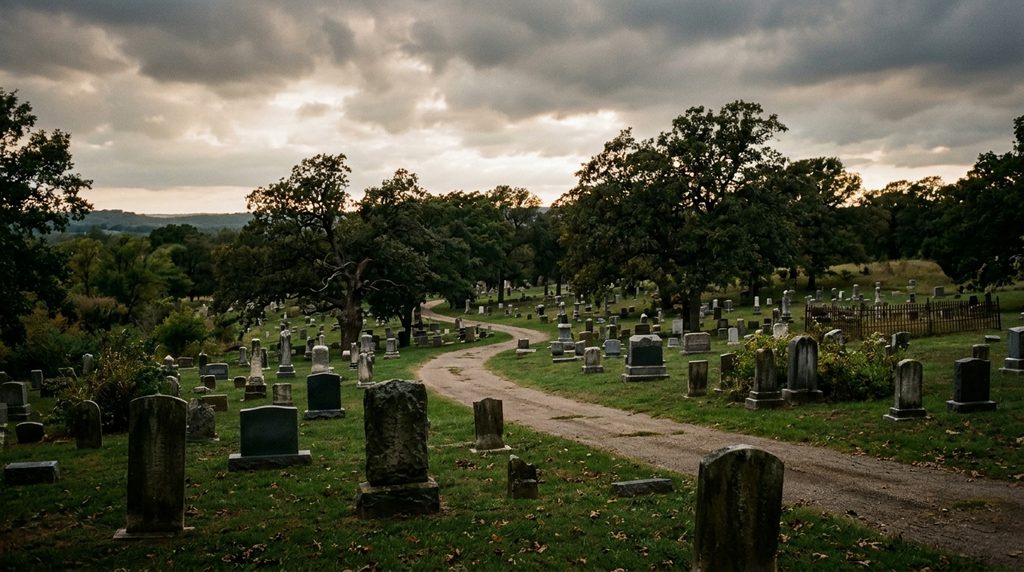
Grave of Black Beaver
The Delaware figure’s grave was moved from his Oklahoma ranch to Fort Sill in 1976. His distinctive headstone depicts two hands parting in farewell.
→ Three more haunted places & dark-history spots in Lawton & Fort Sill — never the same twice
The story
Black Beaver (Seket-tu-ma-qua) spent most of the nineteenth century outmaneuvering frontier disaster. A Delaware trapper and interpreter fluent in multiple Indigenous tongues, English, and Spanish, he guided westward survey expeditions and knew the southern Plains better than nearly any military officer of his era. In the spring of 1861, as Texas Confederate units surged into Indian Territory, Union commander William H. Emory hired Black Beaver to pull off an impossible retreat: piloting hundreds of federal troops, teamsters, and wagon trains from Forts Washita, Arbuckle, and Cobb 500 miles north to Kansas without losing a single soldier or animal. Confederates burned Black Beaver's Canadian River ranch to the dirt in revenge. Undeterred, he rebuilt a sprawling farmstead near present-day Anadarko, died there in May 1880, and was buried on his own land.
Nearly a century later, in 1976, his remains were exhumed from that Caddo County ranch and hauled south to Fort Sill's Chief's Knoll. The hilltop inside the Fort Sill Post Cemetery had become a quiet pantheon for Southern Plains leaders—men the United States military had hunted, negotiated with, or imprisoned, now assembled in close order under federal sod. Black Beaver was laid to rest alongside figures he had counseled, interpreted for, and outlasted.
His gravestone was brought from the ranch along with his remains, and it sticks out sharply among the post's standard-issue military granite. Carved into the weathered headstone is a poignant motif: two shirt-cuffed hands shown gently slipping apart at the fingers. Where typical Victorian clasped-hand carvings signaled eternal reunion, hands in the process of unclenching depicted a quiet earthly farewell—an unexpectedly tender bit of folk stonework holding court on an active artillery base.
What it's like
To get to the grave, you first have to clear active Army gate security: pull into the Fort Sill Visitor Welcome Center near the Sheridan Road gate with a valid REAL ID to clear a quick background check and grab a day pass. From there, navigate through the post to the Fort Sill Post Cemetery at Macomb and Burrill roads. Chief's Knoll rises clearly on the south slope of the burial ground beneath sprawling hardwood shade. The cemetery is self-guided and largely unstaffed, leaving you alone to scan the sandstone and granite markers while distant live-fire artillery rumbles in the Wichita Mountains background.
The move: Walk up Chiefs Knoll together and look for the two hands parting in farewell on Black Beaver’s headstone, where he was reburied after his grave was moved from his ranch in 1976.
- 📍 Fort Sill, OK
- 💸 $$
- ⚡ Up for anything
- 🌗 Indoors
Where: Fort Sill Post Cemetery (Chief's Knoll), Fort Sill Military Reservation, Lawton / Fort Sill, OK 73503
Hours: Added 2026-11-18 — confirm current hours before you go.
Pair it with
- Grave of Kicking Bird — Rests just yards away on Chief's Knoll, marking the mysterious 1875 death of the Kiowa peace chief who collapsed after drinking a cup of coffee.
- Fort Sill National Historic Landmark & Old Post Quadrangle — Half a mile south, this intact 1870s stone quadrangle and guardhouse provide direct context for the military post where the chiefs on the knoll were treated as allies or inmates.
- Geronimo’s Grave & Apache Prisoner of War Cemetery — A short drive across post to Beef Creek takes you to the stone-pyramid resting place of Geronimo, contrasting the diplomatic burials of Chief's Knoll with Fort Sill's Apache prisoner-of-war cemetery.
More weird in Lawton & Fort Sill
Good to know
How do civilians get onto Fort Sill to see the grave?
Because Fort Sill is an active military installation, anyone without DoD credentials must stop at the Fort Sill Visitor Welcome Center off Sheridan Road to show a government-issued photo ID and obtain a visitor vehicle pass before driving to the cemetery.
Why was Black Beaver's body moved to Fort Sill in 1976?
He was originally interred on his homestead in Anadarko in 1880. In 1976, his remains and original headstone were relocated to Chief's Knoll to honor his service as a Union scout and interpreter alongside other prominent Plains leaders.
Who else is buried on Chief's Knoll?
Chief's Knoll holds graves for prominent Native American leaders including Comanche chief Quanah Parker, Kiowa war leader Satank (Sitting Bear), and Chief Kicking Bird. Geronimo, however, is interred separately at the post's Beef Creek Apache Cemetery.
What does the parting hands carving on the headstone represent?
In nineteenth-century gravestone iconography, two hands releasing or pulling apart symbolized an earthly goodbye and the release of mortal life, contrasting with clasped hands that represented reunion in the afterlife.
Plan a visit & invite your people →
Further reading: hyperallergic.com · govinfo.gov · s3.amazonaws.com · okshpo-share.com · armycemeteries.army.mil · Wikipedia
last checked: 2026-11-18