Entry No. 49 — the Lawton & Fort Sill file — filed under: miscellanea
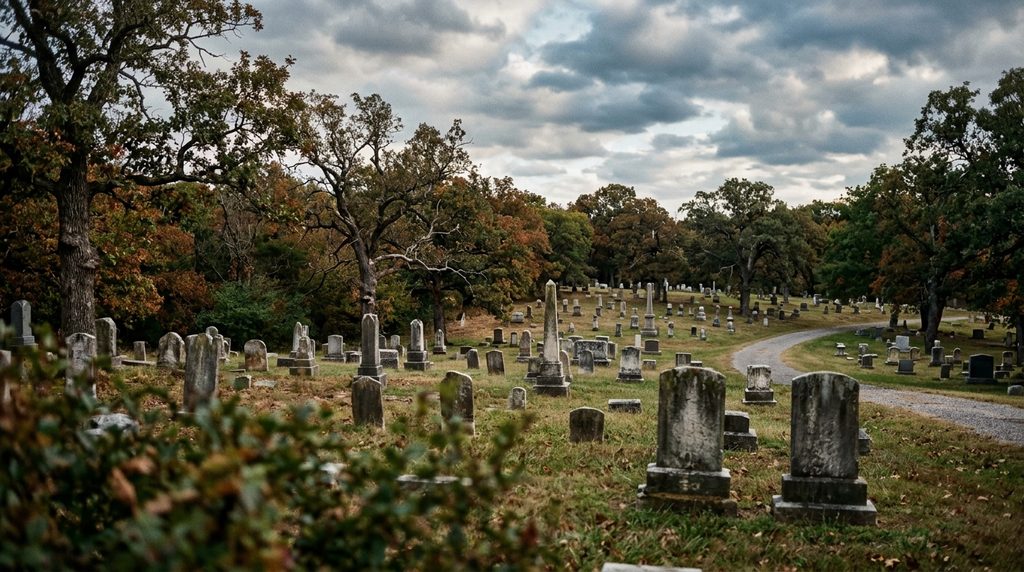
Grave of Champ White
Champ White’s tombstone reads “Civilian.” Hyperallergic uses it to illustrate how that inscription could identify a Black burial under Civil War-era segregation.
→ Three more haunted places & dark-history spots in Lawton & Fort Sill — never the same twice
The story
Scan across the uniform rows of Fort Sill Post Cemetery—established in 1869 out on the southwestern plains—and the white military stones look nearly interchangeable until you learn to read the stonecutter's shorthand. Among the frontier cavalrymen, Buffalo Soldiers of the 10th Cavalry, and interred tribal leaders, one modest marker bears the name Champ White and a single blunt descriptor: "Civilian." On paper, it looks like an ordinary bureaucratic label. On the ground in post-Civil War military burial grounds, it served a far more coded purpose.
In the era of frontier segregation, military authorities and stone carvers didn't always carve overt racial epitaphs into rock. Instead, they relied on administrative classification. Inscribing "Civilian" on a marker was frequently used to identify a Black burial, quietly signaling race and separating the deceased from white soldiers without spelling out the policy in headlines. Fort Sill's stone ledger preserves these hierarchies in plain sight: while White was categorized away under a civilian banner, nearby markers for the Black soldiers of the 10th Cavalry were carved noticeably smaller than those provided to white soldiers of the same era.
What it's like
Because the Old Post Cemetery sits inside an active Army post, you cannot drive straight through the gate. You have to stop first at the Fort Sill Visitor Control Center (Building T6701 on Sheridan Road) with a valid government ID to undergo a brief Department of Defense background check and pick up a free visitor pass. Once on base, the cemetery is exposed, quiet, and typically empty save for groundskeepers and the Oklahoma wind. Finding Champ White's stone among thousands of graves takes a patient, unhurried walk; scan the older civilian and 19th-century sections and look closely at the lettering and scale of the headstones, which reveal how 19th-century military bureaucracy ranked the dead.
The move: Walk the quiet rows of white stones together until you find Champ White’s marker, then pause over the single word beneath his name, “Civilian,” an inscription once used to mark Black burials under segregation.
- 📍 Fort Sill, OK
- 💸 $$
- ⚡ Up for anything
- 🌗 Indoors
Where: Fort Sill Post Cemetery (on Fort Sill), Fort Sill / Lawton area, Comanche County, OK — Fort Sill National Cemetery mailing/address nearby: 2648 NE Jake Dunn Rd, Elgin, OK 73538
Hours: Added 2026-11-18 — confirm current hours before you go.
Pair it with
- Grave of Kicking Bird — Located within the same post cemetery at Chiefs Knoll, marking the mysterious 1875 death of the Kiowa high chief whose military-placed cross tells its own story of frontier friction.
- Geronimo’s Grave & Apache Prisoner of War Cemetery — A short drive elsewhere on Fort Sill grounds leads to Beef Creek, where Geronimo and fellow Chiricahua Apache prisoners of war were laid to rest under native stone.
- Quanah Parker’s Star House — Comanche leader Quanah Parker is buried yards away from Champ White at Chiefs Knoll, while his 1890 star-roofed home sits just west of the base in Cache.
More weird in Lawton & Fort Sill



Good to know
Where is Champ White's grave located?
It is located inside the Fort Sill Post Cemetery (the Old Post Cemetery) on the Fort Sill military installation near Lawton, Oklahoma—not at the separate Fort Sill National Cemetery out in Elgin.
Can civilians visit without military credentials?
Yes, but you must first stop at the Fort Sill Visitor Control Center at Building T6701 on Sheridan Road, present a valid government-issued photo ID, and obtain a free daily visitor pass.
Why does Champ White's marker read 'Civilian'?
During the Civil War and Reconstruction eras, the word 'Civilian' was frequently engraved on military-cemetery headstones as an administrative code to denote a Black burial under prevailing segregation practices.
What else is significant about Fort Sill Post Cemetery?
The cemetery dates to 1869 and contains over 7,000 graves, including Chiefs Knoll (the resting place of Kiowa and Comanche leaders such as Quanah Parker and Satanta) and Buffalo Soldiers from the 10th Cavalry.
Plan a visit & invite your people →
Further reading: hyperallergic.com · interment.net · armycemeteries.army.mil · cem.va.gov
last checked: 2026-11-18