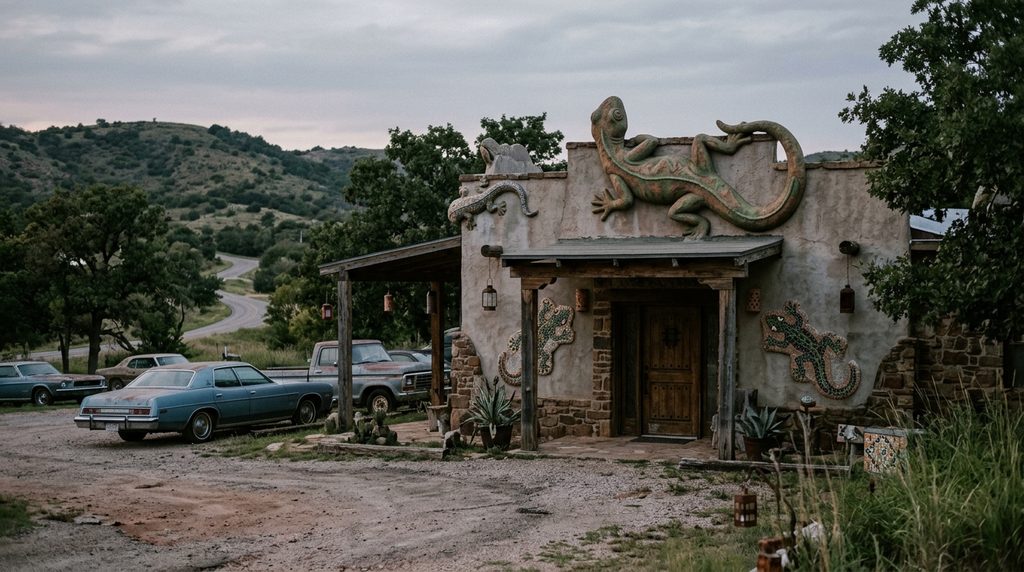
Entry No. 42 — the Lawton & Fort Sill file — filed under: miscellanea
Mountain Boomer Lizard
A named lizard-themed roadside stop cataloged by Roadside America.
→ Three more weird outdoor & roadside oddities in Lawton & Fort Sill — never the same twice
The story
Early settlers exploring southwest Oklahoma's Wichita Mountains were convinced the granite canyons were stalked by a roaring phantom. A strange, resonant booming sound echoed off the talus slopes after summer rains, and frontier locals pinned the noise on an improbable suspect: a foot-long, electric-turquoise lizard with double black neck rings and a sulfur-yellow head. They christened it the "Mountain Boomer," and in 1969 the state legislature cemented the folklore into law by making the eastern collared lizard (Crotaphytus collaris) Oklahoma's official state reptile. There was just one catch: collared lizards have no vocal cords. The booming roar was entirely acoustic misdirection, likely produced by secretive barking frogs hiding in moist rock fissures or wind funneled through boulder crevices.
Even stripped of its phantom bellow, the mountain boomer is a genuine oddity. When alarmed or hunting prey across the baking granite, the lizard drops into a sprint, lifts its front limbs off the ground, and tears across the rocks entirely on its hind legs like a pocket-sized theropod dinosaur, clocking speeds up to 16 miles per hour. While wild boomers populate the boulder fields surrounding Mount Scott, the Medicine Park Aquarium & Natural Sciences Center exhibits them in captivity right at the mountain's base, housing the state's mythic mascot alongside regional venomous pit vipers, alligator gar, and snapping turtles.
What it's like
Tucked off Oklahoma State Highway 49 on Aquarium Drive, the six-acre complex feels like an unpretentious regional science center built right into the foothills. You will navigate indoor exhibit tanks and crushed-gravel pathways framed by clear views of Mount Scott. The collared lizard habitat lets you study the neon-green scales and cat-like tail swishes of a creature that usually darts into a boulder crevice the instant you hike near it in the wild. Weekday mornings are quiet outside of the occasional rural school bus group, and you will want sturdy shoes if you plan to follow the center's outdoor botanical trails down toward Medicine Creek.
The move: Find the collared lizard habitat off Aquarium Drive and see who spots the first tail flick from the bright-scaled Mountain Boomer, a lizard with a roaring reputation and no vocal cords.
- 📍 Medicine Park, OK
- 💸 Free
- ⚡ Up for anything
- 🌗 Outdoors
Where: Medicine Park Aquarium & Natural Sciences Center, 1 Aquarium Drive, Medicine Park, OK 73557
Hours: Added 2026-11-18 — confirm current hours before you go.
Pair it with
- Mount Scott Summit Spiral Road — After seeing the collared lizard behind glass, wind two miles up the paved summit road to spot wild males sunning on the granite boulders at 2,464 feet.
- Historic Cobblestone Village & Bath Lake — Head half a mile south into town to cool off in a 1908 spring-fed swimming hole lined entirely with the same rounded red granite cobblestones found across the lizards' native habitat.
- The Old Plantation Restaurant — Walk down to this 1910 cobblestone dining room overlooking Medicine Creek, which operated as an outlaw and politician speakeasy while mountain boomer folklore was still in full swing.
More weird in Lawton & Fort Sill

Good to know
Why is it called a mountain boomer if it cannot make sound?
Frontier settlers attributed an eerie, low booming noise echoing through the mountain valleys to the conspicuous turquoise lizard; researchers later discovered the lizard is completely silent, and the sound came from barking frogs or wind channeled through granite clefts.
Do collared lizards really sprint on two legs?
Yes. When accelerating to escape predators or chase down insects, they reach speeds up to 16 mph by rearing back onto their hind feet and using their long tails as counterweights.
Where can you spot them in the wild around Medicine Park?
The sun-baked granite scree and roadside boulders along Mount Scott and throughout the Wichita Mountains Wildlife Refuge are active basking grounds between late morning and mid-afternoon on warm, sunny days.
What else is housed at the Medicine Park Aquarium?
The center exhibits around 90 species of native and non-native wildlife, including river otters, piranha, native freshwater sportfish, turtles, and venomous pit vipers in the Snake Shack.
Plan a visit & invite your people →
Further reading: Roadside America · go-oklahoma.com · Official site · kswo.com · statesymbolsusa.org · mpmns.org
last checked: 2026-11-18