Entry No. 45 — the Lawton & Fort Sill file — filed under: miscellanea
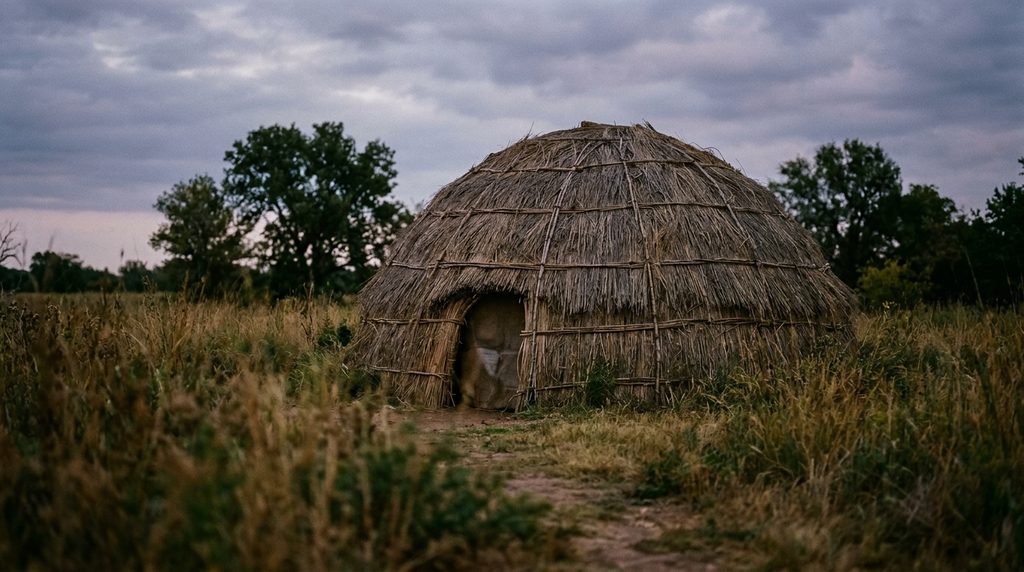
Wichita Indian Grass House
A grass house identified with Wichita traditional housing, singled out in the material as a specific example of Native American architecture.
→ Three more weird outdoor & roadside oddities in Lawton & Fort Sill — never the same twice
The story
Popular frontier myth reduced every Plains tribe to nomadic hunters living in hide tipis, but the Wichita and Affiliated Tribes—who historically referred to themselves as the Kitikiti'sh, or 'People of the Grass House'—spent centuries as settled agriculturalists. Along the river valleys of Oklahoma, Kansas, and northern Texas, they cultivated corn, beans, and squash, living in permanent villages centered around massive, conical, beehive-shaped thatched dwellings that could reach thirty feet high and house multi-generational families.
Constructing a traditional grass house was a community engineering feat led primarily by tribal women. Builders erected a circle of heavy forked cedar posts, bent slender poles inward into a vaulted dome, lashed horizontal sapling ribs across the skeleton, and thatched the entire exterior from ground to peak with overlapping bundles of wild prairie bluestem grass. Outfitted with an east door to catch the sunrise, a west door to greet the dusk, and elevated interior sleeping benches flanking a central hearth, the resulting thatch was naturally insulating and waterproof, durable enough to withstand Southern Plains gales and prairie summers for ten to fifteen years.
As forced relocation, allotment, and federal assimilation policies took hold in the late nineteenth and early twentieth centuries, frame houses replaced thatched lodges, and the vernacular craft came close to extinction. Today, at the Wichita Tribal History Center complex just north of Anadarko, the tribe preserves that architectural lineage in three dimensions with a full-scale reconstructed grass house and adjacent open-air summer arbor standing directly on tribal land.
What it's like
You will find the grass house standing outdoors on the grounds of the Wichita Tribal History Center, just over a mile north of downtown Anadarko along Highway 281. Walking up to the structure, the first thing you notice is the dense, woven texture of the cured prairie grass and its surprisingly massive scale against the open Oklahoma sky. Admission to the center is free, and the indoor galleries offer Wichita language recordings, historical photographs, and ethnographic displays that contextualize the structure; just keep in mind that the complex operates on tribal administrative hours (Monday through Friday, 10 a.m. to 4 p.m.) and locks its doors daily for lunch between noon and 1 p.m.
The move: Walk up to the Wichita grass house together, get close enough to see the overlapping bundles of prairie bluestem, then look up to where the beehive-shaped roof meets the open Oklahoma sky.
- 📍 Anadarko, Oklahoma
- 💸 Free
- ⚡ Up for anything
- 🌗 Outdoors
Where: 32210 County Street 2670, Anadarko, OK 73005
Hours: Added 2026-11-18 — confirm current hours before you go.
Pair it with
- Wichita Mountains Free-Roaming Bison Loop — While the Wichita lived in permanent thatched agricultural villages most of the year, their men left each winter for extended hunts across these very plains to harvest buffalo.
- Dinosaur Roadside Ranch — Located roughly twenty-five miles southeast in Rush Springs, this quirky expanse of welded scrap-metal beasts offers an amusing, high-contrast detour through Southern Plains roadside creativity.
- The Holy City of the Wichita Mountains — Pair an indigenous vernacular grass dwelling with another southwest Oklahoma architectural surprise: a 1930s Depression-era replica of Jerusalem constructed entirely from native Wichita granite.
More weird in Lawton & Fort Sill

Good to know
Where exactly is the Wichita Grass House located?
It stands outdoors at the Wichita Tribal History Center complex at 32210 County Street 2670, roughly one mile north of Anadarko, Oklahoma, just off Highway 281.
What are the visiting hours and admission fees?
Admission is free. The Wichita Tribal History Center is typically open Monday through Friday from 10:00 a.m. to 4:00 p.m., with a daily closure for lunch from 12:00 p.m. to 1:00 p.m. It is closed on weekends.
How were traditional Wichita grass houses built?
They were constructed by anchoring forked cedar timbers into the ground, bending pole rafters into a conical dome, tying on horizontal cross-bars, and thatching the entire frame with bundled prairie bluestem grass, incorporating a central smoke hole and two opposing doorways facing east and west.
What else is at the site?
Beside the grass house and summer arbor, the Wichita Tribal History Center houses exhibits tracing tribal history from pre-contact village life to the present, alongside language archives, historic photographs, and a research library.
Plan a visit & invite your people →
Further reading: pinterest.com · travelok.com · kansasmemory.org · utulsa.as.atlas-sys.com · Official site
last checked: 2026-11-18