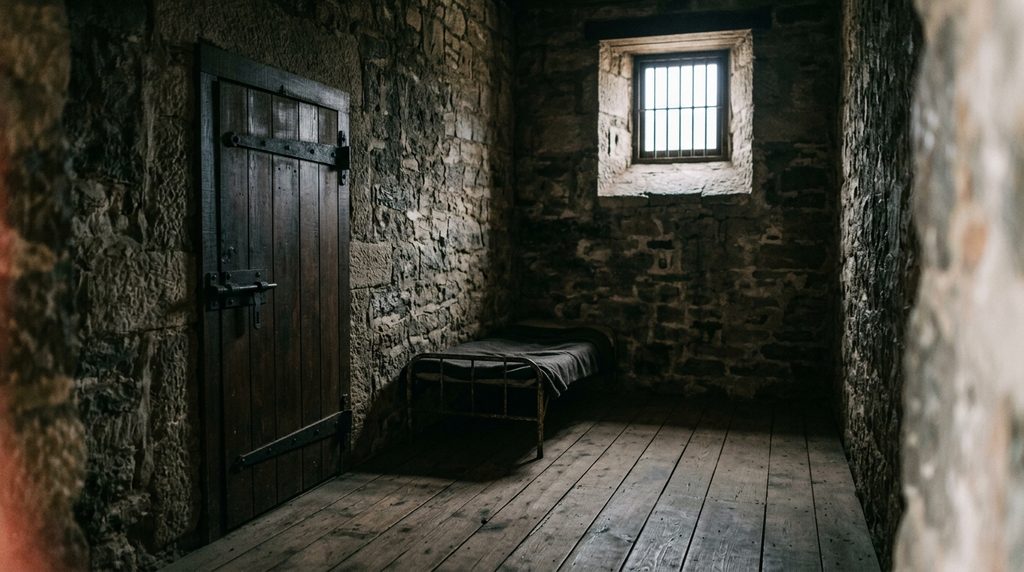
Entry No. 48 — the Lawton & Fort Sill file — filed under: miscellanea
Geronimo’s Cell in the Guardhouse
Atlas Obscura identifies Geronimo’s cell among the surviving prison cells in the Fort Sill guardhouse.
→ Three more haunted places & dark-history spots in Lawton & Fort Sill — never the same twice
The story
Built between 1872 and 1873 on Fort Sill's Old Post Quadrangle, the Post Guardhouse (Building 336) was engineered out of raw local grit: yellow limestone blocks quarried a mile to the east and timber milled in the fort's own sawmill. The Army raised it on a foundation with subterranean basement walls three feet thick, designed not just to sober up unruly cavalrymen, but to serve as the punitive iron fist of the Red River and Southern Plains campaigns. Before it held Geronimo, its cells confined Kiowa war leaders Satanta and Big Tree under armed guard.
In October 1894, the Chiricahua Apache leader arrived at Fort Sill following eight exhausting years of confinement in military stockades across Florida and Alabama. Classified as prisoners of war along with more than three hundred of his people, the Apaches were assigned to dispersed village settlements across the sprawling reservation. But freedom was an illusion. Whenever Geronimo clashed with post authorities, spoke out of turn, or got caught drinking, guards marched him straight down Geronimo Road and locked him in the basement cells. G.I.s took to dryly nicknaming the stockade the 'Geronimo Hotel.'
Stand in the dim corridor outside his cell and the bitter irony of the era snaps into focus. By the turn of the century, the federal government was trotting the aging warrior around the country as a captive celebrity—letting him sell autographed buttons at the 1904 St. Louis World's Fair and ride down Pennsylvania Avenue in Theodore Roosevelt's 1905 inaugural parade. Yet the moment the train brought him back to Oklahoma, he remained property of the War Department, subject to the iron bar latches and cold limestone flags of Building 336 until pneumonia took his life on base in 1909.
What it's like
Visiting means crossing into an active military installation, so do not just pull up to the gate. You have to stop at the Fort Sill Visitor Control Center near Bentley Gate on Sheridan Road, hand over a valid government-issued photo ID, complete an entry form, and clear an on-the-spot background check to get a vehicle pass. Once through, Building 336 sits quietly within the historic limestone quadrangle. Walk down into the basement cellblock and you will feel the air drop several degrees and smell the damp stone and aged timber. It is remarkably austere—no theatrical lights or gift shop hype, just narrow rows of heavy doors, barred wickets, and echoey, hollow silence that you will often have entirely to yourself on weekday mornings.
The move: Pick up your visitor pass, cross Fort Sill’s Old Post Quadrangle to the yellow limestone guardhouse, and pause together at the surviving cell that once held Geronimo.
- 📍 Fort Sill, OK
- 💸 $$
- ⚡ Up for anything
- 🌗 Indoors
Where: Old Post Guardhouse (Building 336), 336 Geronimo Road, Fort Sill, Lawton, OK 73503
Hours: Added 2026-11-18 — confirm current hours before you go.
Pair it with
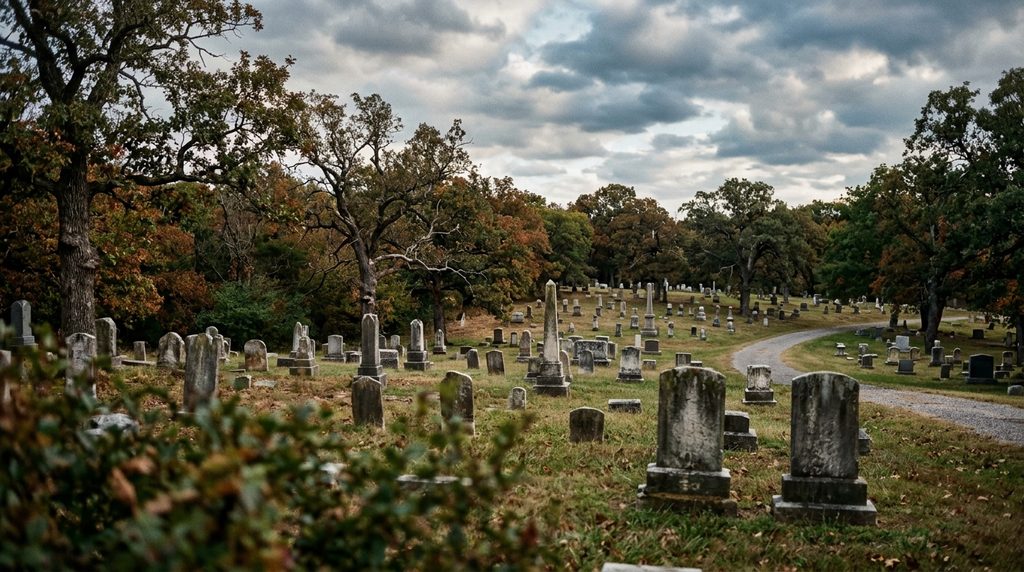
- Geronimo’s Grave & Apache Prisoner of War Cemetery — Follow Geronimo’s story to its quiet conclusion at Fort Sill’s Apache Prisoner of War Cemetery, where he was laid to rest under a pyramid cairn of native stones after his death in 1909.
- Grave of Kicking Bird — Stay within the boundaries of Fort Sill to find the burial place of Kicking Bird, the influential Kiowa peace leader who died under mysterious circumstances on post in 1875.
- Quanah Parker’s Star House — Drive west to Cache to visit the home of Comanche war chief Quanah Parker, who negotiated the reservation era alongside Geronimo and rode with him in Roosevelt's 1905 parade.
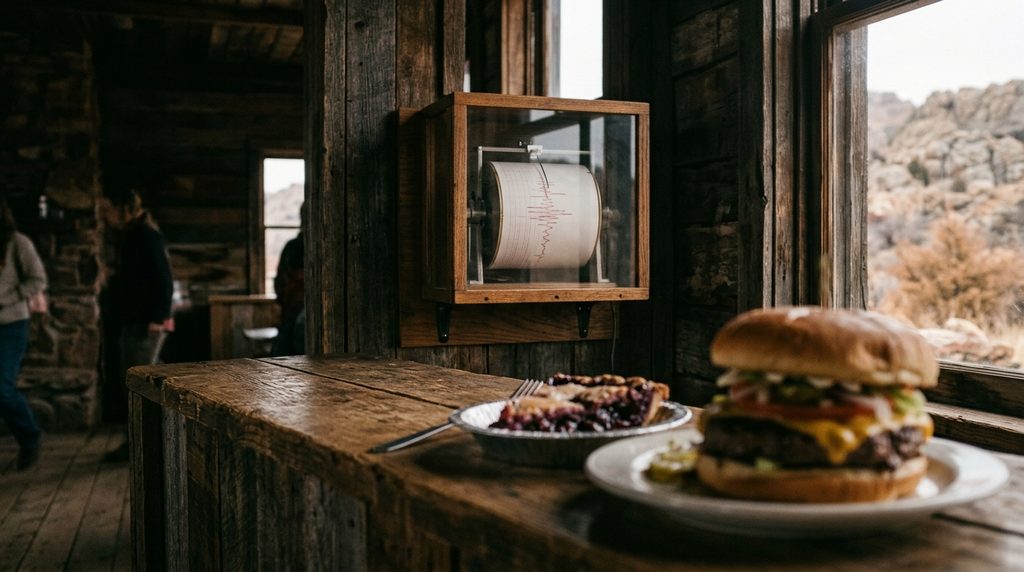
- Meers Store & Restaurant & Fault Seismograph — Head north toward the Wichita Mountains for a burger inside a preserved 1901 mining town outpost that exploded to life during the same turn-of-the-century land rush that encircled the fort.
More weird in Lawton & Fort Sill
Good to know
Do civilians need a pass to visit the guardhouse?
Yes. Because Fort Sill is an active Army installation, civilian visitors without military credentials must stop at the Fort Sill Visitor Control Center off Sheridan Road, present valid photo ID, and pass a quick background check to receive an installation entry pass.
How much does it cost to enter the guardhouse and see the cell?
Admission to the Old Post Guardhouse and the surrounding Fort Sill National Historic Landmark and Museum complex is completely free.
Did Geronimo live inside this prison cell continuously?
No. While officially held as a prisoner of war at Fort Sill from 1894 until his death in 1909, Geronimo lived in an Apache settlement village on base and worked as an Indian Scout; the guardhouse cells were used for disciplinary lockups and insubordination.
What else is housed in the Old Post Guardhouse?
Beyond the surviving basement cells, Building 336 contains exhibits detailing 19th-century frontier cavalry life, the Southern Plains campaigns, and artifacts connected to the U.S. Marshals and Native American leaders who passed through the post.
Plan a visit & invite your people →
Further reading: Atlas Obscura · denix.osd.mil · army.mil · hmdb.org · history.army.mil · npgallery.nps.gov
last checked: 2026-11-18