Entry No. 16 — the London, UK file — filed under: miscellanea
Old Operating Theatre Museum & Herb Garret
This small museum pairs a historic operating theatre with an herb garret and apothecary displays. A visitor singles out the lingering smell of old herbs and spices.
→ Three more oddity shops & curiosities in London, UK — never the same twice
The story
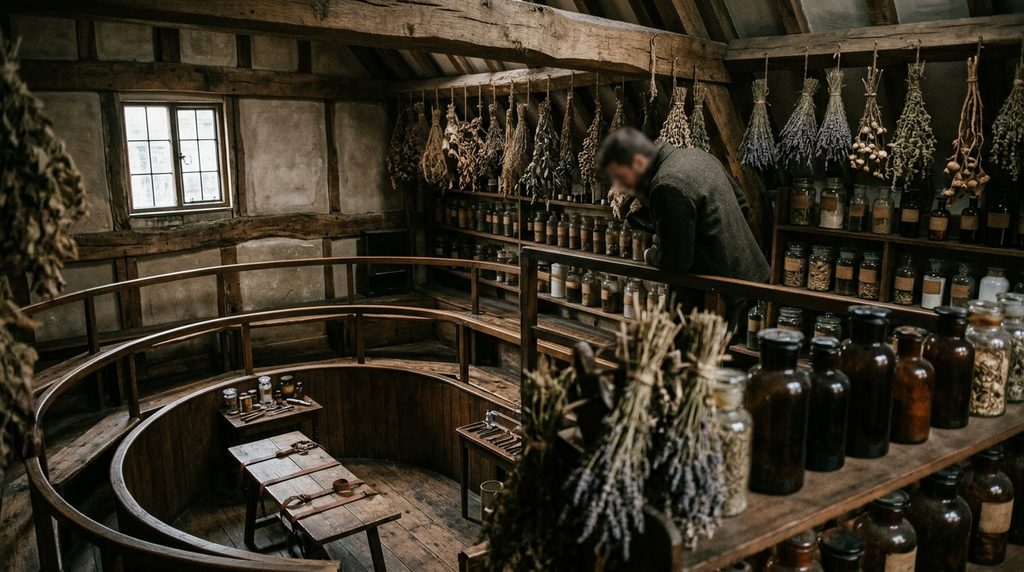
In 1822, governors at St Thomas’ Hospital needed an operating space for their female ward, so they built one directly into the timber rafters of the adjacent 1703 parish church. Prior to that, operations were carried out right in the open ward at the foot of the patients' beds. Up in the church garret—a warm, draft-free roof space already utilized by the hospital's apothecary to dry and store medicinal herbs—carpenters erected a semicircular wooden amphitheatre beneath a large Georgian skylight. Natural daylight was a strict operational requirement: without electric lighting, surgeons scheduled procedures between noon and one o'clock when the sun peaked. Operating before the arrival of antiseptic techniques or dependable anaesthetics, they worked at terrifying speed while up to 150 medical students crowded onto five steep wooden tiers to watch amputations and lithotomies over a sawdust-lined floor.
When the expansion of the railway viaduct into London Bridge station forced St Thomas’ Hospital to decamp to Lambeth in 1862, the attic theatre was decommissioned. Workers dismantled its furnishings, slated over the skylight, blocked the entrance, and left the room sealed in total darkness. It was completely forgotten until 1956, when researcher Raymond Russell tracked down an archival reference, climbed into the belfry of St Thomas's Church, and broke through to find the tiered timber theatre intact beneath a century of dust. Reopened as a museum in 1962, it remains Europe’s oldest surviving surgical theatre.
What it's like
You enter through an unassuming arched door in the church tower on St Thomas Street, where a traffic light manages the one-way human traffic up a cramped, 52-step spiral staircase. At the top, you squeeze straight out into the Herb Garret, where the rough-hewn timber rafters still smell faintly of dried roots, bark, and dried flora. The vitrines hold blunt Victorian medical kit: trepanning drills, scarificators, bone saws, and poison bottles. Just beyond lies the stepped operating theatre itself, lit from overhead by the rebuilt skylight. Keep your hands free for the climb, leave oversized backpacks behind, and hit the facilities beforehand, as there are no public toilets once you reach the rafters.
The move: Climb the cramped 52-step spiral, breathe in the garret’s dried roots and bark, then see which of you can look longest at the Victorian trepanning drills.
- 📍 London
- 💸 $$
- ⚡ Up for anything
- 🌗 Indoors
Where: 9a St Thomas Street, London SE1 9RY
Hours: Added 2026-11-18 — confirm current hours before you go.
Pair it with
- Call Me Mr Lucky — Walk two minutes down the street to decompress in this lantern-lit basement tequila den hidden beneath The Breakfast Club.
- G Baldwin & Co — Follow the trail of 19th-century medicinal plant history south to this still-operating Walworth Road herbal apothecary dating to 1844.
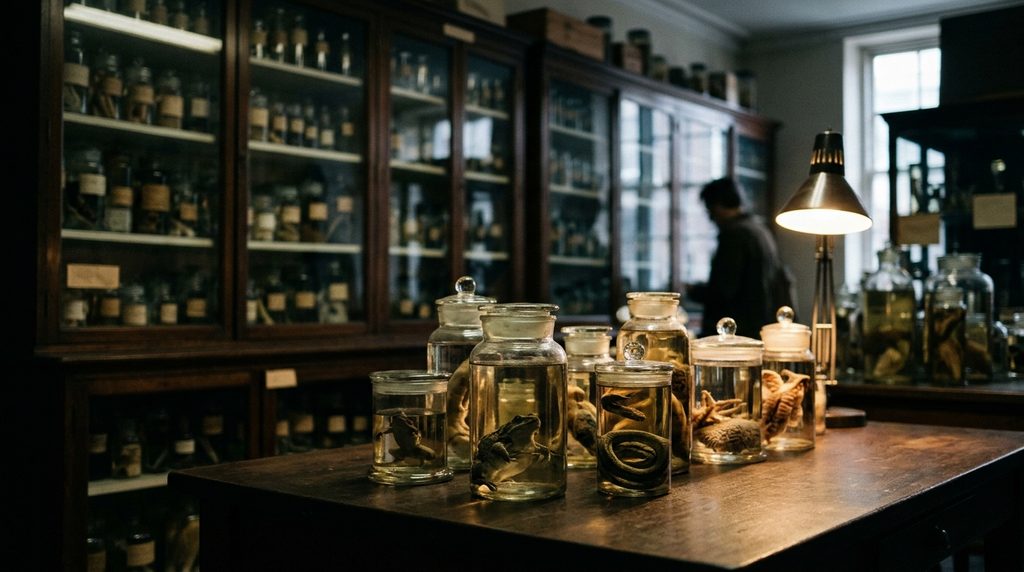
- Hunterian Museum — Double down on early surgical history across town with the Royal College of Surgeons' vast collection of anatomical specimens in glass jars.
- St Dunstan in the East Church Garden — Cross London Bridge to find quiet contrast among the overgrown Blitz ruins of another historic parish church.
More weird in London, UK
Good to know
Is the museum accessible for people with limited mobility?
No. The only access route is a narrow 52-step spiral staircase without a regular public lift, making the space unsuitable for wheelchairs, prams, or visitors with significant mobility limitations.
Are there public restrooms on site?
There are no toilets anywhere in the museum or attic garret. You will need to use facilities at London Bridge station or Borough Market before you head in.
What was the herb garret used for originally?
From the early 1700s, St Thomas's Hospital's apothecary used the warm, dry church attic to cure, dry, and store medicinal herbs and plants that were ground into tinctures, pills, and poultices for ward patients.
What days is the museum open?
It operates Thursday through Sunday from 10:30 am to 5:00 pm, with final entry at 4:15 pm, and is closed Monday through Wednesday.
Plan a visit & invite your people →
Further reading: Instagram · Tripadvisor · Atlas Obscura · flolondon.co.uk · Official site
last checked: 2026-11-18