Entry No. 52 — the London, UK file — filed under: miscellanea
The Musical Museum
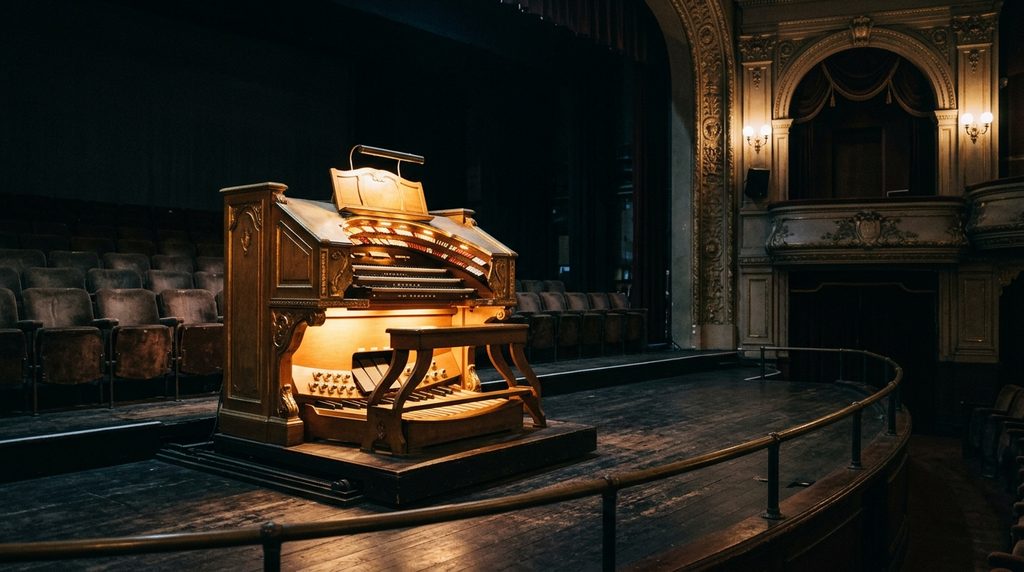
Frank Holland’s fascination with self-playing instruments grew into a museum where an illuminated Wurlitzer cinema organ rises out of the stage floor.
→ Three more unusual museums & collections in London, UK — never the same twice
The story
In 1963, an electrical engineer named Frank Holland noticed that Britain's redundant Victorian churches were sitting empty and decided one of them should house his personal obsession. He talked his way into an initial two-year lease on the deconsecrated St George’s Church in Brentford to stash a half-dozen reproducing pianos, then promptly moved his bed into the vestry and stayed there for over forty years. In the early days, elderly concert pianists who had cut paper rolls at the turn of the century dropped into the draughty nave just to listen to their own teenage keystrokes faithfully replayed by bellows and pneumatic valves.
The collection—now housed in a purpose-built riverfront building opened in 2008 near Kew Bridge—is an archive of sound recorded before microchips existed. Holland and a cadre of volunteer restorers rescued orchestrions, barrel organs, and self-playing violins that physically press rotating horsehair wheels against vibrating strings. The climate-controlled library holds more than 20,000 perforated paper rolls, containing mechanical, note-for-note captures of live performances by composers like Sergei Rachmaninoff and Igor Stravinsky.
The museum's heavyweight centerpiece is a 1928 Mighty Wurlitzer theatre pipe organ, salvaged by Holland in 1960 from the Regal Cinema in Kingston-upon-Thames just before the wrecking ball swung. Bolted onto an illuminated hydraulic lift in the 240-seat concert hall, the console rises straight up out of the floorboards while driving 890 hidden acoustic pipes, train sirens, sleigh bells, and a slave Steinway grand piano wired across the stage.
What it's like
Do not wander through unattended; looking at silent, polished wooden cabinets completely misses the point. You want to arrive in time for a guided demonstration, where volunteers with grease on their cuffs throw pneumatic switches, feed paper rolls into Edwardian reproducing pianos, and run turn-of-the-century orchestrions that rattle the room. The tour culminates upstairs in the auditorium as the illuminated Wurlitzer grinds up from the depths to demonstrate silent-film sound effects. It is overwhelmingly acoustic, slightly uncanny, and very loud.
The move: Catch a guided demonstration, listen to a paper roll play an Edwardian piano and watch the illuminated Wurlitzer rise through the stage floor.
- 📍 Brentford
- 💸 $
- ⚡ Up for anything
- 🌗 Indoors
Where: 399 High Street, Brentford, Middlesex, TW8 0DU
Hours: Added 2026-11-18 — confirm current hours before you go.
Pair it with
- Eel Pie Island Museum — Head three miles down the Thames to pivot from Brentford’s pneumatic machine-age player rolls to the nearby island club that birthed 1960s British rhythm and blues.
- Antique Breadboard Museum — Trade an auditorium full of roaring hydraulic cinema organs for another intensely hyper-specific west London private collection dedicated to carved Victorian timber.
- Evans & Peel Detective Agency — Extend the interwar atmosphere into the evening by sliding from 1920s cinema machinery to a subterranean Earl's Court speakeasy hidden behind a private investigator's appointment desk.
More weird in London, UK

Good to know
Do you get to hear the instruments play?
Yes, but only during the scheduled volunteer-led demonstrations. If you walk through alone on a self-guided stroll, the machines remain silent and locked, so schedule your arrival around the tour times.
When is the museum open?
Public visiting is generally limited to weekends (Friday through Sunday from 10am to 4pm), alongside scheduled evening cinema screenings and live organ concerts.
Where did the Mighty Wurlitzer come from?
It was built in North Tonawanda, New York, shipped to London in the early 1930s for the Regal Cinema in Kingston, and used for BBC radio broadcasts before Frank Holland bought it for salvage in 1960.
How does a reproducing piano differ from a standard player piano?
A standard player piano mechanically hits notes at uniform volume. A true reproducing piano uses complex vacuum expression mechanisms that precisely mimic the player's pedaling, touch, and dynamic nuances, playing back an exact facsimile of an artist's original 1910s performance.
Plan a visit & invite your people →
Further reading: theguardian.com · Reddit · Official site · musicalmuseum.co.uk
last checked: 2026-11-18