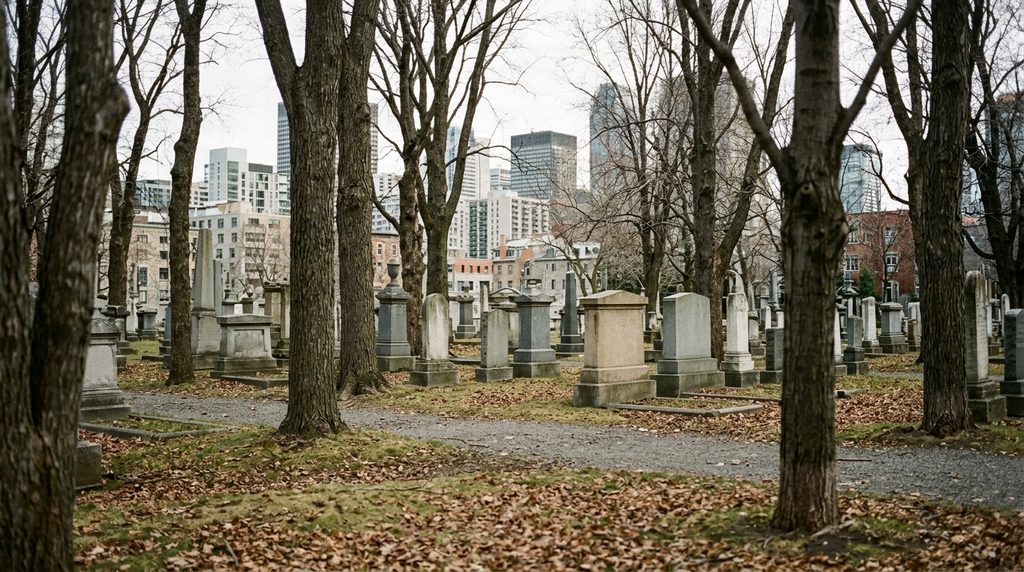
Entry No. 53 — the Montreal, QC file — filed under: miscellanea
Dorchester Square / Old Saint-Antoine Cemetery
The downtown square occupies the site of a former cemetery with thousands of unmarked graves linked to early nineteenth-century cholera outbreaks. Crosses and other symbols along the paths mark the site's burial history.
→ Three at a time, never the same twice — explore weird Montreal, QC
The story
In the summer of 1832, cholera arrived in Montreal aboard immigrant ships, tearing through the wooden tenements so fast that gravediggers could not keep pace with the carts. Saint-Antoine Cemetery—then an open, muddy expanse west of the old town walls—became the emergency dumping ground. Trenches were carved in haste, bodies stacked in rough pine boxes without rites, and quicklime dumped over the rows. By the time the burial ground shut its gates in 1854 following another catastrophic epidemic, between 40,000 and 70,000 bodies were packed beneath its soil.
When downtown development expanded outward in the 1870s, city authorities planned to exhume the dead and move them to Notre-Dame-des-Neiges Cemetery on Mount Royal. That effort ground to an abrupt halt in 1871 amid fierce public protest: citizens were terrified that disturbing decades of cholera and typhus graves would release dormant airborne miasmas across Montreal. So the city abandoned the shovels, graded the soil, planted turf, and laid out Dominion Square directly on top of the rotting coffins.
Decades of downtown infrastructure work continue to prove how little was actually moved. Whenever municipal crews dig a few feet down along Peel Street or Place du Canada, bio-archaeologists are summoned to pull stray leg bones and nineteenth-century coffin hardware from the mud. When landscape architect Claude Cormier oversaw the modern redesign of the square, he embedded the site's dark reality into the pavement itself: look down at the grey granite walkways and you'll spot recurring Latin cross pavers marking the massive burial ground you are strolling over.
What it's like
On a sunny weekday afternoon, you'll dodge office workers from the Sun Life Building eating sandwiches on the lawn while tourists circle the Boer War equestrian monument, almost entirely oblivious to what lies four feet beneath their heels. Visit around dusk when the downtown crowd empties out. Walk the diagonal interior paths slowly with your eyes on the ground to track the rough, charcoal-hued cross pavers, then cross Boulevard René-Lévesque to Place du Canada, which encompasses the other half of the cemetery tract.
The move: At dusk, take the diagonal paths through Dorchester Square and see who spots the first cross marking the old cholera burial ground beneath your feet.
- 📍 Downtown Montréal
- 💸 $$
- ⚡ Up for anything
- 🌗 Indoors
Where: 2903 Rue Peel, Montréal, QC H3B 4J5, Canada
Hours: Added 2026-11-20 — confirm current hours before you go.
Pair it with
- L’Orangerie — Walk two minutes east to trade the open burial ground for a hidden lounge concealed behind a library bookcase inside Soubois.
- Mona Loa — Head four blocks west to duck through a subterranean secret passage into a lava-rock cocktail den beneath Crescent Street.
- Remains of Saint Ann’s Church — Head south into Griffintown to see the exposed stone footprint of the demolished parish church that served Montreal's 19th-century Irish famine immigrants.
More weird in Montreal, QC


Good to know
How many skeletons are still buried under the square?
Historical estimates suggest Saint-Antoine Cemetery accepted between 40,000 and 70,000 burials between 1799 and 1854. Because exhumations were halted in 1871 due to fears of reigniting cholera, tens of thousands of bodies were left permanently in place.
Can you see any original tombstones?
No headstones survived the square's nineteenth-century conversion into a public park. The only visual markers today are the cross patterns arranged in the paving stones and commemorative municipal markers.
Are bones still uncovered during modern street work?
Yes. Roadwork and utility digging on surrounding streets—including Place du Canada in 2012 and Peel Street in 2019—regularly strike human remains and coffin fragments, triggering archaeological interventions.
What are the hours and cost to visit?
The square is a city-owned public park open 24 hours a day, 365 days a year, with completely free access.
Plan a visit & invite your people →
Further reading: mtl.org · hauntedmontreal.com · tclf.org · journaldemontreal.com · globalnews.ca
last checked: 2026-11-20