Entry No. 16 — the Montreal, QC file — filed under: miscellanea
Remains of Saint Ann’s Church
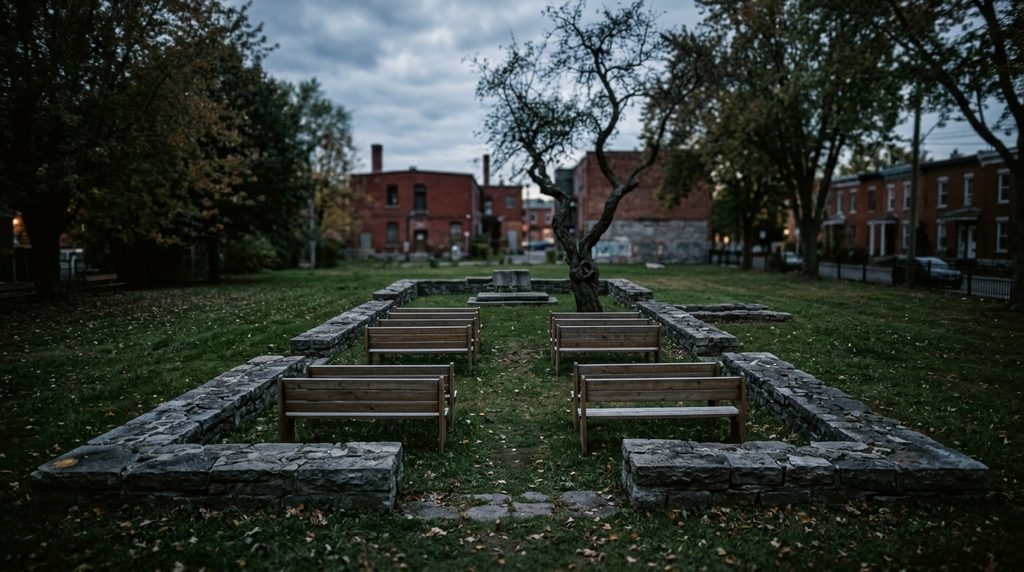
The church served Griffintown’s Irish community until its demolition in the 1970s. Its foundations are still visible in a small park, where benches are arranged like church pews.
→ Three at a time, never the same twice — explore weird Montreal, QC
The story
In the mid-nineteenth century, Griffintown was the hard-scrabble, soot-coated epicenter of Montreal's Irish Catholic diaspora—laborers who dug the Lachine Canal and drove the pilings of the Victoria Bridge. While affluent English-speaking Catholics built the soaring St. Patrick's Basilica uptown, the dockworkers and factory hands down in the 'Griff' packed into Saint Ann's Church, erected in 1854 at the corner of McCord (now Rue de la Montagne) and Basin. For well over a century, St. Ann's served as the neighborhood's undisputed spine, hosting the baptisms, contentious labor meetings, and raucous three-day wakes that held the enclave together.
The neighborhood's erasure was deliberate and municipal. In 1962, the city rezoned Griffintown as light-industrial, banning residential construction and condemning whole blocks of tenements to make way for the Bonaventure Expressway and tarmac parking lots. As families scattered to outer boroughs, the parish evaporated; in 1970, Saint Ann's was systematically hammered down into rubble. Instead of paving over the consecrated ground, however, the city preserved the foundation footprint within a modest green square, laying out crushed stone walking paths along the original aisles and anchoring wooden park benches in strict parallel rows where the pews once sat.
What remains today is an architectural negative hemmed in by glass condominium towers and tech offices. Because the neighborhood vanished so quickly, local superstition clings hard to the site: long-time residents and ghost-tour guides trade tales of phantom bells tolling over empty air, spectral funeral processions marching through the grass, and sightings of Mary Gallagher—the infamous 1879 Griffintown axe-murder victim whose headless ghost is said to roam the district every seven years. Even if you skip the folklore, watching modern condo residents walk their dogs through the phantom nave makes for one of Montreal's strangest historical collisions.
What it's like
You will find the park wedged between Rue de la Montagne, Rue Wellington, and Rue Rioux, framed by construction hoardings and sleek residential towers. There are no gates or ticket booths; it operates as an open municipal park where you can trace the low stone foundations freely. The site is best visited at dusk or on a foggy weekday evening when the streetlights kick on, casting long shadows across the benches and sharpening the outline of the absent sanctuary. Interpretive plaques explain the parish history, but the real atmosphere comes from sitting dead-center in the 'pews' and looking directly up at open sky where vaulted wooden rafters once stood.
The move: Trace the low stone foundations at dusk, then sit side by side on a bench lined up like a church pew as the streetlights come on.
- 📍 Griffintown, Montréal
- 💸 $$
- ⚡ Up for anything
- 🌗 Indoors
Where: Rue Rioux, Montréal, QC
Hours: Added 2026-11-20 — confirm current hours before you go.
Pair it with
- RECESS Thermal Station — A single block away, this cavernous industrial bathhouse offers extreme saunas and cold plunges directly beside Griffintown's phantom parish.
- Dorchester Square / Old Saint-Antoine Cemetery — A mile north, Dorchester Square conceals thousands of unmarked nineteenth-century cholera graves under its lawn, echoing St. Ann's buried immigrant history.
- Bassin Peel — A half-mile walk toward the canal brings you to the waters St. Ann's parish laborers excavated, now home to late-night waterfront markets.
- The Song of the Dodo — Pair a pilgrimage to a demolished neighborhood church with a quick walk over to an odd twenty-foot bronze monument honoring the extinct dodo.
More weird in Montreal, QC
Good to know
Where exactly is the site located?
The ruins sit in Parc Sainte-Anne (officially Parc Griffintown–St-Ann), located at the intersection of Rue de la Montagne, Rue Wellington, and Rue Rioux in Griffintown.
What are the park hours and admission costs?
The site is a public city park with free access around the clock, though visiting during daylight or early evening provides the clearest view of the stone outlines.
Are religious services ever held at the ruins?
Yes; Montreal's Irish community has periodically gathered at the park to celebrate an open-air commemorative mass on Saint Ann's Feast Day in late July.
Why were the benches installed in rows?
When the city created the memorial park after the church was demolished, planners deliberately arranged the park benches to mimic the exact formation of the original nave pews facing the altar.
Plan a visit & invite your people →
Further reading: mtl.org · canadashistory.ca · journaldemontreal.com · Wikipedia · hauntedmontreal.com
last checked: 2026-11-20